


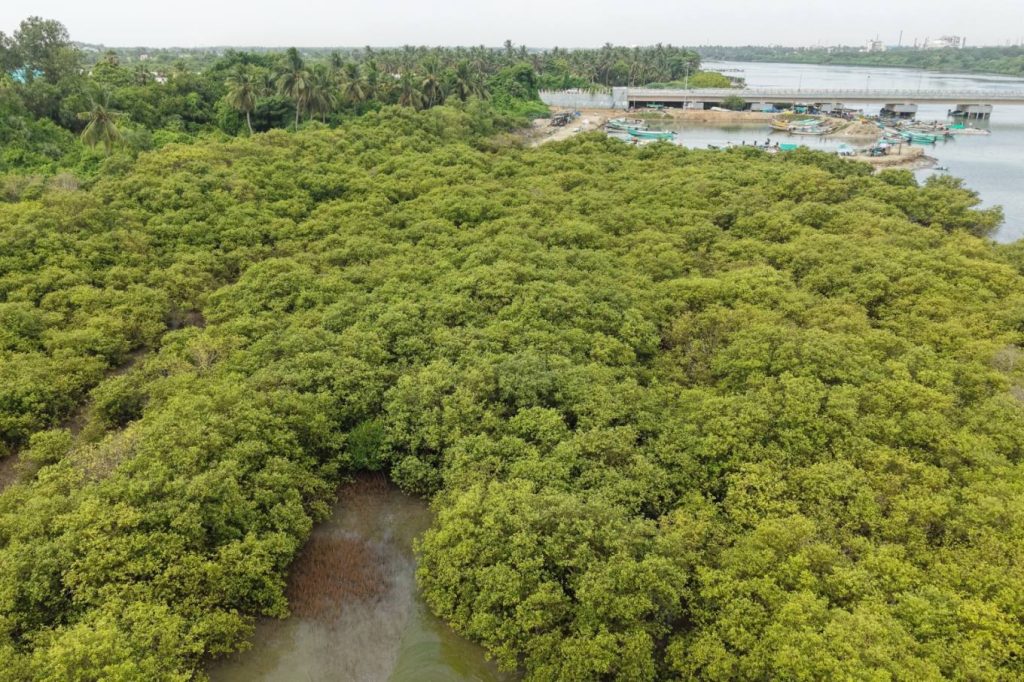
Cuddalore, Tamil Nadu – For 16 years, a team of rural youth in Tamil Nadu’s Cuddalore district has been quietly protecting its coastline one sapling at a time. The NGO AALAMARAM, whose mangrove restoration work along the Uppanar backwaters has been highlighted by the UNDP Equator Initiative, has planted more than 4.5 lakh mangrove seedlings without taking any government grants.
AALAMARAM was instituted in 2009 with the aim of carrying out welfare activities through the energy of rural youth from different villages of Cuddalore district. It was initiated and is headed by Arjunan Elayaraja, the founder and secretary of the NGO. While many groups believe social issues can be addressed through agitation and protest, the team felt that environmental threats, especially air pollution, needed a different approach. They decided to contribute to the protection and purification of the environment by afforesting mangroves along the coasts near their villages.
Mangrove planting turned out to be far from easy. The team drew inspiration from research suggesting that mangrove groves release oxygen throughout the day and night, but the seeds had to be imported, which meant a huge expense. Even so, the group went ahead without government funding and kept planting year after year, despite hardships such as floods that destroyed many mangrove trees.
Their efforts now cover a stretch of roughly 15 kilometres of the Uppanar backwaters and coastal zones, including villages such as Thiyagavalli, Nochikadu, Naduthittu, Periyakaraikadu, Thiruchopuram, Poondiyankuppam, Rajapettai, Pachanyankuppam, Sangolikuppam, Semmankuppam, Echankadu, Kudikadu, Kampalimedu, Sonakanchavadi and Sothikuppam. The work focuses on air purification, natural disaster management, soil erosion prevention, bio-shields and community-driven rural youth engagement.
The importance of mangroves for coastal regions is hard to overstate. They act as a buffer zone between land and sea, protect coastal land from erosion and serve as nature’s shield against cyclones, storm surges and other ecological disasters. They also provide breeding and nursery grounds for fish, crabs, shrimp and migratory birds, and support fishing families whose livelihoods depend on the Uppanar estuary. In addition, mangroves help purify water by absorbing impurities and heavy metals, help reduce air pollution and offer potential for recreation and tourism.
Scientists increasingly see mangroves as allies in the fight against climate change. As sea levels rise because of global warming, many coastal areas face the risk of flooding, and mangroves could also serve as a gene bank for salt-tolerant crop species that may become an important future resource.
After 16 years of effort, the team recently saw a milestone that gave them fresh confidence: the first seed on one of their mangrove trees. The team hopes that more trees will now bear seeds, which could reduce the cost of importing seeds from outside. For AALAMARAM, the moment is a reward for years of hard work and hardship.
As coastal communities across India face the growing threat of cyclones, erosion and rising seas, AALAMARAM’s grassroots effort shows how a small group of determined villagers can make a lasting difference to both the environment and local livelihoods.
To know more about AALAMARAM, visit: https://share.google/9kVNRPPBDkON9aK7q