


The AQI runs from 0 to 500.
A reading of 401 to 500 is called severe.
Delhi’s overall CPCB reading on November 9 was 483.
Readings above 500 are shown as 500 plus.
Different monitors and methods can give different numbers.
Daily Jagran lists New Tehsil-Loni in Ghaziabad at 463 and Sonia Vihar in Delhi at 457, and gives Burari Crossing as 441 in one list and 449 in another, so station figures differ within and between reports.
Not every station was in the severe range: Organiser lists CRRI Mathura Road at 396, Dr Karni Singh Shooting Range at 361 and Najafgarh at 340.
The Hans India and Daily Jagran city tables, citing CPCB data for November 9, give Delhi a figure of 370, in the very poor category, which differs from the 483 overall figure.
The Hans India also reports a reading of 776 for Delhi from AQI.in at 6:51 am on Monday, which comes from a private platform and not from the CPCB.
Organiser reports that Swiss-based IQAir recorded readings above 1,000 in Shahdara and Defence Colony, without giving times or exact values, and says the difference reflects variations in methodologies.
The Air Quality Index runs from 0 to 500, with 0 to 50 good, 51 to 100 satisfactory, 101 to 200 moderate, 201 to 300 poor, 301 to 400 very poor and 401 to 500 severe, according to Organiser.
Readings above 500 are shown as 500 or 500 plus on the official scale, which is one reason private platforms can show higher numbers.
The Graded Response Action Plan Stage III was put in place across Delhi-NCR on November 6, according to Organiser, three days before the Diwali period it describes.
Stage III measures include a halt to non-essential construction and demolition, extra vehicle restrictions and hybrid classes up to primary school level, according to Organiser.
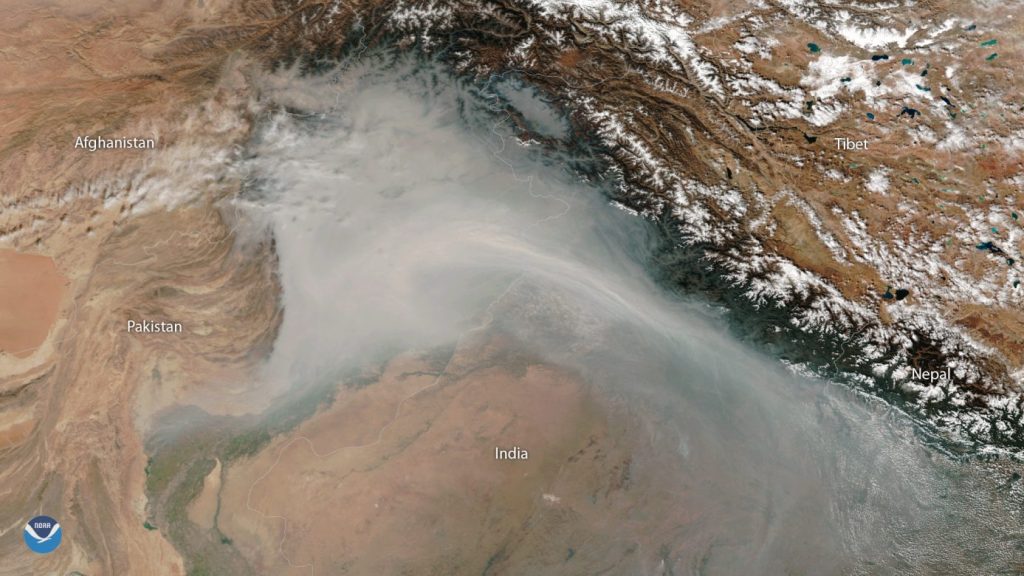
Smog over the Indus-Ganga Plain, NOAA satellite image of 2017 (file image), Wikimedia Commons, public domain