


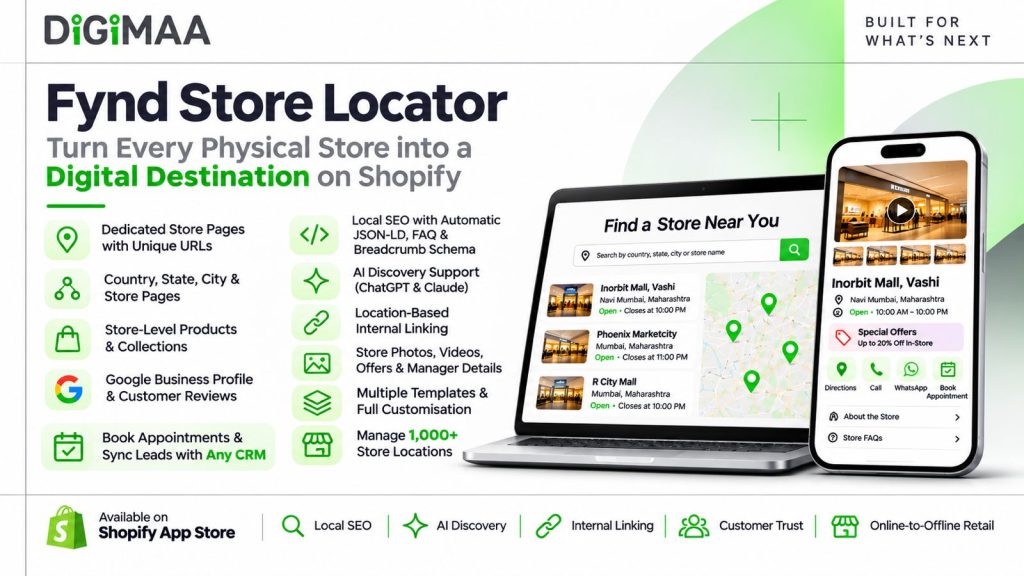
The Shopify application helps retailers connect their physical store network with their digital storefront through dedicated store pages, customer engagement tools and technical local SEO capabilities.
Your customers can discover your products online. But can they easily find your nearest physical store?
In today’s omnichannel retail environment, connecting digital discovery with physical shopping experiences is increasingly important. Customers want to explore products online, find nearby stores, access location-specific information and connect with brands beyond the digital storefront.
Addressing this need, DiGiMAA’s Fynd Store Locator, now publicly available on the Shopify App Store, helps retailers bridge the gap between online and offline commerce through dedicated store pages, customer engagement features and local SEO capabilities.
Designed for Shopify merchants ranging from growing businesses to large retail networks, the application brings store discovery and location management into the digital shopping experience.
Supporting Large Retail Networks
The application is designed to support large retail networks, with the capability to display and manage 1,000 or more store locations through its platform, subject to the merchant’s implementation and applicable plan or service configuration.
Retail teams can manage locations through a centralised dashboard, including adding, editing and removing stores. Bulk CSV or Excel import helps simplify location onboarding and updates.
This approach helps retailers organise their store information and manage multiple physical locations through a centralised platform.
Individual Store Pages with Local SEO Capabilities
Each physical location can have its own dedicated store page, allowing customers to discover relevant information about individual stores.
Each store page can be structured as an indexable destination with an SEO-friendly URL, custom page title and meta description, and automatically generated JSON-LD structured data for the store. The schema includes relevant business information such as address, geographic coordinates, opening hours and contact details. The application also automatically generates FAQ and breadcrumb structured data, helping search engines better understand individual store pages and their hierarchy. Canonical URL handling is also supported.
Structured data can also make store information easier for AI-powered discovery and answer systems to interpret. As customers increasingly use tools such as ChatGPT and Claude to research brands, products and nearby services, well-structured, consistent and crawlable store information can provide useful context about a retailer’s locations. This can support machine understanding and discovery, although visibility or citation in any particular AI platform is not guaranteed and remains subject to that platform’s crawling, indexing and selection processes.
These capabilities help merchants establish individual digital destinations for their physical locations while supporting their local search optimisation efforts.
Google Business Profile and Customer Review Integration
For merchants with a Google Business Profile, Fynd Store Locator can fetch and display customer reviews through Google’s API on individual store pages. This helps retailers bring authentic customer feedback into the store discovery experience, giving visitors additional insights when choosing a location.
By making customer feedback accessible alongside store information, retailers can provide visitors with additional context when deciding which location to visit.
Appointment Requests and Lead Management
Appointment requests can be captured directly through individual store pages and managed as leads within the Fynd Store Locator application dashboard, enabling merchants to track customer enquiries and follow up with prospective visitors.
This functionality gives retailers another way to engage customers who want to visit a physical location, seek assistance or arrange an appointment before visiting.
Location-Specific Product Collections
Store pages can also showcase location-specific product collections by linking Shopify collections through their respective handles, allowing merchants to highlight relevant products for individual store locations.
Flexible Templates and Brand Customisation
Merchants can choose from multiple ready-made templates and adjust brand colours, section placement and visibility to align the store pages with their brand identity. Additional layout and template customisations can be supported by DiGiMAA to meet specific business and branding requirements.
This flexibility allows businesses to create store discovery experiences that are consistent with their existing website design and brand presentation.
Book Appointments & Sync Leads with Any CRM
Customers can book appointments directly through individual store pages, while captured appointment requests and customer enquiries can be transferred to the merchant’s preferred CRM for centralised lead management and follow-up.
Professional Implementation and Technical Support
DiGiMAA provides professional support across installation, setup, configuration, template customisation, technical assistance, SEO guidance and store data migration. Its support team works with merchants to plan their store structure, organise location information and align the storefront experience with their brand requirements.
Location-Based Landing Pages and Internal Linking for Scalable SEO
Fynd Store Locator can help merchants build a structured network of location-focused pages across their website. Retailers can organise store discovery around countries, states, cities and individual store locations, creating relevant destinations for customers searching for a brand, product or service in a particular area.
For example, a retailer operating across multiple countries and states can create country-level and state-level location pages, supported by dedicated pages for individual stores. Each store page can provide location-specific information such as the store address, contact details, opening hours, available product collections and appointment options, subject to the merchant’s configuration.
These pages can form a connected internal-linking structure. Country pages can link to relevant state pages, state pages can link to city or store pages, and individual store pages can link back to their parent location pages and relevant product collections. This helps visitors navigate the retailer’s location network and gives search engines clearer paths to discover and understand related pages.
By creating useful, crawlable and well-organised location pages, merchants can expand their organic search footprint for geographically relevant searches. The approach can support visibility for searches such as brand-plus-city, brand-plus-state and nearby-store queries, while helping customers move from a broad location search to the details of a specific store.
The value of this approach depends on the quality and uniqueness of each page. Merchants should ensure that location pages contain accurate, genuinely useful local information and avoid publishing large numbers of near-duplicate pages. Search visibility is not guaranteed and depends on factors including content quality, crawlability, competition and search engine systems.
Connecting Digital Commerce with Physical Retail
For customers, the journey does not have to stop at online discovery. They can explore a retailer’s products and brand online, find a relevant physical store, check its address and opening hours, and use the store page to plan a visit or request an appointment. This creates a clearer connection between digital interest and an in-person experience. For retailers, consistent store information and authentic location details can help build customer confidence and make it easier to move from online research to offline store visits and potential purchases.
As retailers continue to develop their omnichannel strategies, connecting online discovery with physical store experiences remains an important part of customer engagement.
With Fynd Store Locator, DiGiMAA aims to help Shopify merchants make their physical locations more discoverable, organise store information, showcase relevant products and provide customers with useful location-specific information.
By combining store management, dedicated location pages, local SEO capabilities, customer reviews and lead management, the application offers Shopify retailers a structured way to bring their physical store network closer to their digital storefront.
About DiGiMAA
DiGiMAA develops applications for Shopify merchants, focusing on practical tools that extend storefront capabilities and support day-to-day commerce operations. Fynd Store Locator is part of its app portfolio and is designed to help retailers connect digital store experiences with their physical locations. Learn more at DiGiMAA.
Through its growing portfolio of Shopify applications, DiGiMAA works towards helping businesses improve their digital commerce operations, customer experience and omnichannel capabilities.
Availability
Fynd Store Locator is publicly available on the Shopify App Store. View the Fynd Store Locator app or learn more on the DiGiMAA website.
Shopify Plus expertise
For retailers looking for broader Shopify Plus strategy, implementation and enterprise commerce capabilities, Binary IC operates separately as a Shopify Plus specialist agency. More information is available through its Shopify Plus services.