He Taught Machines to Read Markets. Now Divyaprakash Jha Is Building AskShiva AI to Turn Intelligence Into Action
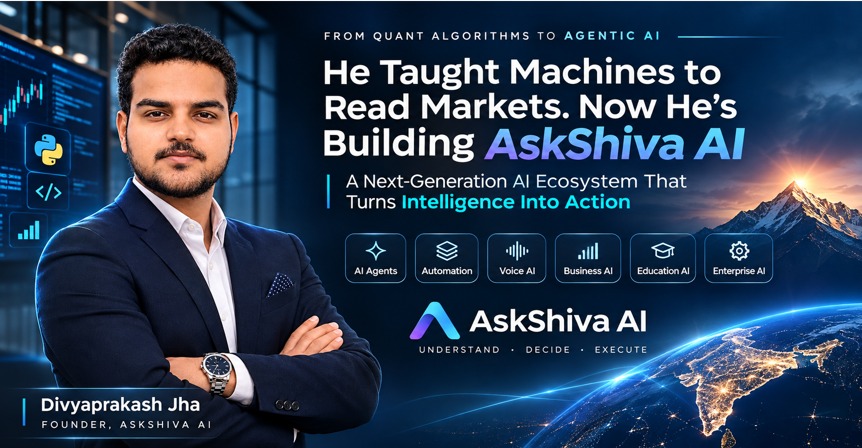
After more than a decade in quantitative financial engineering, developing thousands of algorithms and exploring the science of pattern recognition, Divyaprakash is pursuing a larger technological ambition through AskShiva AI — building artificial intelligence that moves beyond answering questions to understanding objectives, making decisions and executing meaningful work.
Long before artificial intelligence became a global conversation, Divyaprakash Jha was already working on a problem that would eventually become central to its evolution: teaching machines to recognize patterns, interpret uncertainty and respond to changing environments.
For him, intelligence was never simply about possessing information. It was about understanding what that information meant, identifying what others might overlook and determining what should happen next.
Since entering the financial markets in 2014, Divyaprakash has built his expertise across quantitative engineering, Python development, algorithmic systems, mathematical reasoning and computational intelligence.
Today, as the founder of AskShiva.ai and GodEngine.ai, he is applying that experience to a substantially larger ambition: building artificial intelligence systems capable of changing how individuals, businesses and institutions operate.
At the centre of that ambition is AskShiva AI.
Financial markets are among the most demanding environments in which to develop intelligent computational systems. Information changes continuously, patterns evolve, uncertainty remains constant and yesterday’s successful strategy can become tomorrow’s failure.
It was within this environment that Divyaprakash developed his understanding of computational intelligence.
Over the course of his career, he has developed more than 1,000 MetaTrader 5 algorithms, over 500 Python scripts and more than 2,000 TradingView scripts, according to his own account.
These development efforts extended across algorithmic trading, pattern recognition, mathematical modelling, automated decision-making and the interpretation of complex datasets.
But the more significant outcome was not the number of programs developed. It was the understanding of how machines could process information, recognize relationships and respond to increasingly complex conditions.
His interests gradually extended beyond conventional programming into metacognition, reasoning architecture and the mechanisms through which intelligent systems evaluate their own decisions.
Financial markets provided an environment in which these ideas could be explored. Artificial intelligence presented an opportunity to apply them beyond finance.
The rapid advancement of generative artificial intelligence has given millions of people access to capabilities that were previously unimaginable.
Machines can write, analyse, explain, generate software and interpret enormous volumes of information.
Yet an important limitation remains.
Knowing how to accomplish something is fundamentally different from accomplishing it.
An entrepreneur can ask an AI assistant how to build a successful business. The response may contain valuable information, sophisticated strategies and detailed recommendations. But the responsibility of translating those recommendations into coordinated action still remains largely with the entrepreneur.
What happens when that limitation begins to disappear?
What if artificial intelligence could understand an objective, identify the resources required, evaluate alternative approaches and coordinate the execution of an entire workflow?
This is the technological direction Divyaprakash is pursuing through AskShiva AI.
Rather than developing another isolated conversational application, AskShiva AI is being built around a broader philosophy: intelligence becomes more valuable when it is connected to execution.
One of the defining characteristics of AskShiva AI is its ecosystem-oriented approach to artificial intelligence.
Most organizations operate through fragmented digital environments. Communication takes place on one platform, customer information exists on another, financial records are maintained separately, and operational decisions frequently depend on disconnected sources of information.
Every additional application introduces another layer of complexity.
Divyaprakash sees an opportunity to reverse that relationship.
Instead of requiring people to continuously navigate technology, intelligent systems could increasingly adapt themselves to human objectives.
The AskShiva AI ecosystem explores this possibility through autonomous AI agents, intelligent automation, voice-based artificial intelligence, enterprise applications and interconnected digital infrastructure.
Imagine a business where artificial intelligence can understand customer requirements, coordinate communication, support operational decisions and identify emerging opportunities within a connected environment.
Or an educational institution where intelligent systems assist teachers, administrators and students without requiring each participant to manage a collection of disconnected applications.
These possibilities represent the direction in which AskShiva AI is being developed.
The larger ambition is not simply to create more software. It is to reduce the complexity of using software itself.
For decades, the relationship between humans and computers has followed a relatively predictable structure. Humans provide instructions, and machines execute predefined operations.
Artificial intelligence is beginning to challenge that structure.
The emergence of agentic AI introduces the possibility of systems that can interpret broader objectives, evaluate available information and coordinate multiple actions within defined operational boundaries.
For Divyaprakash, this evolution represents a significant shift in computing.
Through AskShiva AI, he is exploring architectures in which specialized intelligent agents can work together across different functions, rather than depending on a single application to perform every responsibility.
Such systems could support customer engagement, business research, education, enterprise management, communication and operational automation.
However, the challenge extends beyond connecting artificial intelligence to software.
These systems must also demonstrate contextual understanding, reliability, appropriate oversight and the ability to recognize when human intervention is necessary.
The distinction between impressive demonstrations and dependable intelligence will ultimately determine how deeply artificial intelligence becomes embedded in everyday economic activity.
India presents an unusually complex environment for developing artificial intelligence.
Its linguistic diversity, entrepreneurial population, educational institutions, manufacturing businesses and rapidly expanding digital economy create requirements that cannot always be addressed through standardized technological solutions.
A system designed for India must often operate across different languages, levels of digital literacy, industries and economic conditions.
For AskShiva AI, these challenges also represent opportunities.
Developing artificial intelligence that can operate effectively within such a diverse environment could create capabilities with relevance far beyond India’s borders.
Divyaprakash’s vision intersects with the broader discussion around sovereign AI, indigenous technological development and the importance of building original intellectual property.
India’s next technological chapter need not be defined exclusively by its contribution to global technology companies. It could also be shaped by the intelligent systems, platforms and technological infrastructure developed within the country.
AskShiva AI represents an entrepreneurial effort to participate in that transition.
The artificial intelligence industry is frequently measured through model performance, computational power, benchmark results and the sophistication of individual applications.
But another question may prove equally important: how effectively can intelligence be integrated into the systems through which society already operates?
A powerful AI model is valuable. An intelligent infrastructure capable of making that power practically accessible across industries could create an entirely different category of opportunity.
This is where Divyaprakash’s background in computational engineering, Python development, quantitative analysis and systems architecture converges with his vision for AskShiva AI.
His journey from developing financial algorithms to building artificial intelligence reflects a progression toward increasingly complex systems — from recognizing patterns to reasoning about information, and from reasoning toward coordinated execution.
The long-term ambition is to develop intelligence that understands not only individual instructions but also the larger objectives behind them.
The first generation of widely adopted artificial intelligence gave humanity unprecedented access to information and answers.
The next generation could fundamentally change what humanity is capable of accomplishing with that intelligence.
For Divyaprakash, the future of AskShiva AI lies at the intersection of reasoning, automation, decision-making and execution.
Its ultimate significance will depend on whether that vision translates into dependable technology, measurable outcomes and lasting value for the people and organizations using it.
The world has already discovered what happens when machines learn to answer questions.
AskShiva AI is pursuing what happens when machines learn to turn those answers into outcomes.
Official website: https://askshiva.ai
Follow Daily Viewer on InstagramBreaking news, explainers and stories in your feed.
Follow