


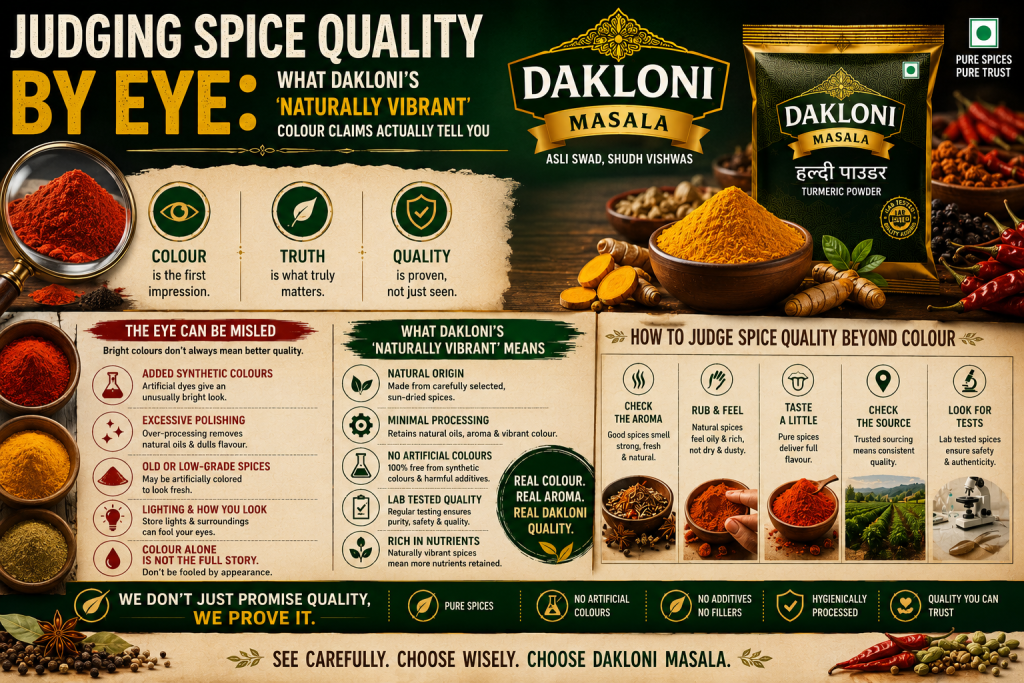
BHUBANESWAR — “Naturally Vibrant. Unmistakably Authentic.” is one of the recurring lines in Dakloni Masala’s marketing, paired with imagery of deep golden turmeric and rich red chilli powder mounded in bowls. Colour is one of the few quality cues a shopper can judge before opening a packet, and the Odisha-based brand, operated by Green Chocy Private Limited, leans on it heavily — but colour is also one of the easiest attributes to manipulate artificially, which is precisely why food regulators pay close attention to it.
Dakloni’s packaging carries a “No Added Colouring” badge across its Haldi and Red Chilli lines, a direct claim that the vivid colour in its products comes from the spice itself rather than an added dye. The company has not published lab verification of this claim, but the claim itself is specific enough to be checkable in principle, unlike vaguer language such as “authentic” or “premium.”
Why Colour Varies Naturally, Even Without Additives
Spice scientists note that natural colour intensity in turmeric and chilli varies significantly based on factors like the variety grown, soil and growing conditions, harvest timing, and drying method — meaning two genuinely additive-free batches of turmeric can still differ in shade from one harvest to the next. This makes colour an imperfect, though still useful, proxy for quality: a consistently vivid product across every batch could reflect careful sourcing, or it could reflect standardization through blending different harvests, or, in adulterated products elsewhere in the market, through added colourants.
Because Dakloni has not disclosed its sourcing regions or batch-blending practices, it is not possible to say from public information which of these explanations accounts for the consistency of colour shown in its marketing photography, which the company itself notes elsewhere is used “for illustrative purposes only” in some campaign creatives.
A Claim Worth More Than It Usually Gets Credit For
Compared with softer marketing language like “pure” or “traditional,” a specific “No Added Colouring” claim is a more meaningful commitment, since it addresses a documented adulteration risk in the wider Indian spice market rather than a vague quality assertion. Consumers who want assurance beyond the claim itself would need to look for independent lab testing, which Dakloni has not published for this report.
Frequently Asked Questions
Does natural spice colour vary between batches even without additives?
Yes — spice scientists note that colour intensity in turmeric and chilli varies naturally with growing conditions, variety and harvest, so colour alone is an imperfect quality indicator.
Has Dakloni Masala’s ‘No Added Colouring’ claim been independently verified?
No published third-party lab results were found for this report; the claim is self-reported by the company.
Visit- dakloni.in
Visit- dakloni.com
Facebook- Dakloni Masala
Instagram- @daklonimasala