
Brandpost
You Are the Knight by Harigandha Singh – A Poetic Anthem for the Warrior Within


In a world that often feels like a battlefield, Harigandha Singh’s You Are the Knight emerges as a luminous guidebook for the soul, a collection of verses that doesn’t just speak to you but fights for you. This isn’t just poetry; it’s a manifesto for resilience, a call to arms for anyone who has ever felt broken, lost, or overwhelmed by life’s relentless storms. Harigandha’s words are not merely written—they are forged, like a sword, sharp and unyielding, ready to cut through the darkness.
The book’s central metaphor of the knight is both timeless and deeply personal. It’s not about medieval battles or shining armor; it’s about the quiet, often invisible wars we wage within ourselves. Each poem is a battle cry, a reminder that you are not a passive observer in your life but an active participant, a warrior with the power to shape your destiny. Harigandha’s verses are imbued with a raw honesty that feels like a mirror, reflecting the reader’s own struggles and triumphs. She doesn’t shy away from the pain of failure or the weight of despair, but she also doesn’t let you dwell there. Instead, she hands you a sword—your hope—and a shield—your strength—and urges you to keep moving forward.
One of the most striking aspects of You Are the Knight is its accessibility. While the themes are profound, the language is clear and evocative, making it a book that can resonate with anyone, regardless of their familiarity with poetry. Harigandha’s verses are like conversations with a trusted friend—comforting yet challenging, gentle yet unflinchingly honest.
What sets this collection apart is its grounding in real-life experiences. Harigandha doesn’t write from an ivory tower; her words are born from the trenches of her own battles. This authenticity shines through in every stanza, making the poems feel less like abstract art and more like lifelines thrown to those drowning in doubt or fear. The book is a testament to the idea that our struggles, no matter how isolating they may feel, are universal. And in that universality, there is strength.
You Are the Knight is also a masterclass in balance. It doesn’t sugarcoat life’s hardships, but it doesn’t wallow in them either. Instead, it offers a nuanced perspective that acknowledges the darkness while steadfastly pointing toward the light. The poems oscillate between vulnerability and empowerment, despair and hope, creating a dynamic rhythm that mirrors the ebb and flow of life itself. This duality makes the book not just a source of comfort but a tool for transformation.
Perhaps the most powerful message of You Are the Knight is its insistence on agency. Harigandha doesn’t just tell you that you’re strong; she shows you how to reclaim that strength, how to wield it like a weapon against the forces that seek to diminish you. Her words are a rallying cry, a reminder that you are not a victim of circumstance but a knight—a protector, a fighter, a beacon of light in the darkness.
In a literary landscape often crowded with self-help books and motivational platitudes, You Are the Knight stands out as a genuine, heartfelt offering. It’s not just a book to read; it’s a book to live by, to return to in moments of doubt or despair. Harigandha Singh has crafted a poetic masterpiece that doesn’t just speak to the heart—it speaks to the warrior within us all. And in doing so, she reminds us that we are not just dreamers but doers, not just survivors but conquerors. We are, each of us, the knight. And this book is our anthem.

What if the next generation of wellness products didn’t come in a bottle, capsule or powder—but in a piece of chewing gum?
For generations, chewing gum has been one of the simplest products people carry. It fits into a pocket, requires no preparation and has become part of everyday routines—from after meals and during travel to work, study and social occasions.
Traditionally, however, the category has largely been associated with flavour and freshness.
FIVE Wellness is looking at the format differently.
Founded by Rhythm Sehgal, Vipul Kohli and Prateek Mehra, FIVE Wellness is developing functional chewing gums designed around different everyday moments, bringing together convenience, portability and functionality in a familiar format.
The idea is straightforward: take something people already understand and create more possibilities around it.
Rethinking the Everyday Chew
Today’s consumers increasingly value products that fit naturally into busy routines.
Bottles, powders, capsules and prepared drinks all have their place, but they can also require additional space, preparation or planning.
Chewing gum offers something different.
It is compact, portable and familiar.
For FIVE Wellness, these characteristics form the foundation of its approach to functional products.
The brand’s range currently includes HYDR, POWR and FRSHR, each built around a different proposition.
HYDR: A New Format for Electrolytes
Electrolyte products have traditionally been associated with drinks, powders and other prepared formats.
HYDR explores another possibility: delivering electrolytes through chewing gum.
The focus is on convenience and portability. There is no bottle to carry, powder to mix or shaker to clean.
Whether it is placed in a gym bag, travel pouch, backpack or desk drawer, HYDR is designed around a simple idea: functionality in a format that can go almost anywhere.
POWR: Energy, Reimagined
Energy products are another familiar part of modern consumer culture.
FIVE Wellness’ POWR takes a different approach to the format, combining caffeine, L-theanine and taurine in chewing gum.
Instead of another can or bottle, POWR puts its proposition into something considerably smaller.
The concept is deliberately uncomplicated:
No can. No bottle. No preparation. Just a chew.
FRSHR: Freshness, Reimagined
With FRSHR, FIVE Wellness returns to one of chewing gum’s most familiar associations: freshness.
Designed around an everyday fresh-mouth experience, FRSHR builds on a behaviour consumers already know.
After a meal. During travel. Between meetings. Whenever a fresh-mouth experience fits the moment.
There is no new ritual to learn.
Open. Chew. Move on.
More Than Gum
The bigger idea behind FIVE Wellness isn’t simply chewing gum.
It is format innovation.
The brand is exploring chewing gum as a platform for functional products, with different formulations designed around different everyday occasions.
HYDR. POWR. FRSHR.
Different propositions. One familiar format.
That approach also reflects a broader shift in how consumers think about wellness. Products are increasingly expected to be convenient, portable and easy to integrate into everyday life.
FIVE Wellness is building around that expectation.
A Pocket-Sized Vision
The brand’s ambition isn’t to complicate wellness. It is to make functional products easier to carry and easier to incorporate into real life.
That philosophy extends to its identity as well. FIVE Wellness aims to occupy the space where wellness meets convenience, design and contemporary culture.
The next evolution of functional products may not necessarily mean bigger bottles, larger tubs or more complicated routines.
It could mean something much smaller.
Something familiar.
Something that fits in your pocket.
Sometimes, the future of functional wellness might simply be a chew.
About FIVE Wellness
FIVE Wellness is an Indian functional chewing gum brand founded by Rhythm Sehgal, Vipul Kohli and Prateek Mehra. Its current range includes HYDR, POWR and FRSHR, bringing different functional propositions into a convenient chewing-gum format.
Website: www.myfivewellness.com
Instagram: @myfivewellness
Brandpost
“One Day You’ll Be a Big Name”: Chunky Panday’s Heartfelt Praise Becomes Veeir Chaudary’s Biggest Moment of the Award Night
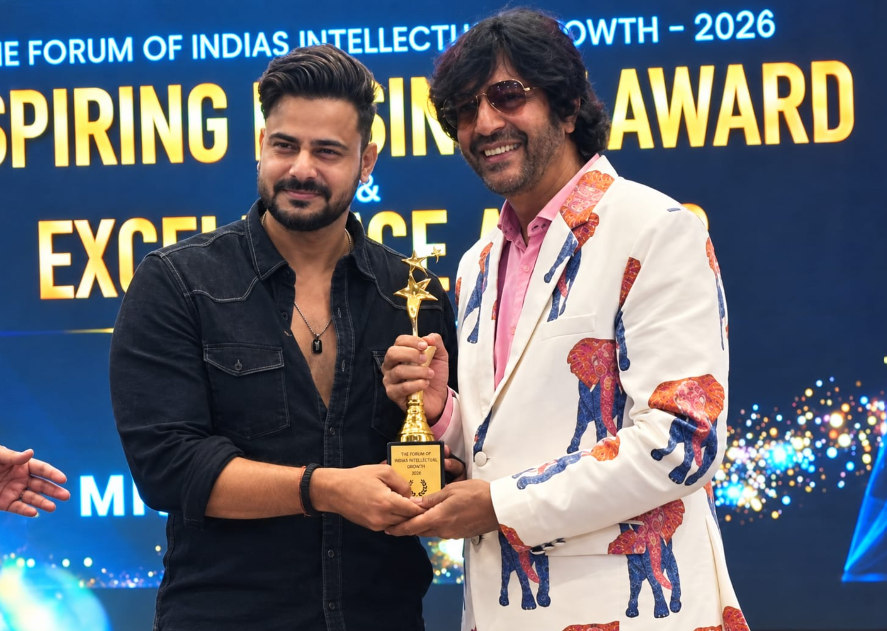
New Delhi: It was an evening filled with glamour, appreciation and memorable moments for actor and producer Veeir Chaudary, who recently attended a prestigious award ceremony and received an award from Bollywood actor Chunky Panday. However, what made the evening particularly special was not just the award, but the words of encouragement Veeir received from the veteran actor.
During the event, Chunky Panday appreciated Veeir Chaudary for his work and encouraged him to continue working with the same dedication. While praising his journey, Chunky told him, “You’re doing good work. One day you’ll make a very big name.” For Veeir, hearing these words from an established Bollywood personality became one of the most memorable moments of the evening.
Veeir, who has been associated with films, web series and music projects, was visibly happy with the appreciation. He described his interaction with Chunky Panday as a wonderful experience and said that the actor came across as extremely cheerful, friendly and warm-hearted.
The award ceremony also witnessed several fan moments involving Veeir Chaudary. Throughout the evening, a number of fans approached him to click photographs. The excitement among the audience and the requests for pictures added another special dimension to the event.
Interestingly, one light-hearted incident at the venue also grabbed attention. When Veeir Chaudary entered the venue accompanied by his security guards, some people initially mistook his arrival for that of Chunky Panday. As soon as they saw Veeir walking in with his guards, several people stood up, thinking that the Bollywood star had arrived. The amusing misunderstanding created a fun moment and became one of the memorable incidents of the evening.
For Veeir, the combination of receiving an award, meeting fans and getting personal appreciation from Chunky Panday made the night particularly meaningful. The encouragement from Chunky was especially significant as Veeir continues to build his career as an actor and producer while developing new projects in entertainment.
Veeir also expressed his gratitude towards the organisers for recognising his work and giving him the opportunity to be part of the celebration. He believes that appreciation from audiences and industry personalities motivates artists to work harder and explore new creative opportunities.
The evening reflected the growing attention around Veeir Chaudary, with fans not only recognising him but also showing enthusiasm to meet and interact with him. The combination of fan love and industry appreciation made the event a memorable chapter in his professional journey.
For Veeir Chaudary, the biggest takeaway from the night was perhaps Chunky Panday’s encouraging message. “One day you’ll be a big name” was more than just a compliment—it became a powerful motivation to continue pursuing bigger dreams.
With his focus on films, web series and music, Veeir is now looking ahead to his upcoming projects. If the response at the award night is any indication, his journey is attracting increasing attention, both from audiences and within the entertainment fraternity.
An award, a room full of fans, an unforgettable interaction with Chunky Panday and words that Veeir will remember for years—the evening certainly turned into a night to cherish.

India is one of the most diverse countries in the world, home to countless religions, languages, cultures and communities. But when we look closely at our cities, we often find smaller neighbourhoods where these identities have lived together for generations.
One such neighbourhood exists in the heart of Mumbai — Kamathipura.
Once associated with the Kamathis who settled in the area, Kamathipura changed dramatically over the years and eventually became widely known as one of Mumbai’s oldest red-light districts. But the area has always been more than the identity attached to it.
It has been home to families, workers, migrants, traders, sex workers, transgender people and generations of residents who have built their lives within its narrow lanes.
Today, Kamathipura is once again standing at a turning point.
With redevelopment gradually changing the physical landscape of the neighbourhood, an important question remains: what happens to the people, memories and history connected to a place when the place itself begins to disappear?
Filmmaker Dhaval Pitale is attempting to document this transition through an independent documentary on Kamathipura — its past, its present and the uncertain future that lies ahead.
The documentary explores the complicated history of the area while looking at the influence of colonialism, capitalism, migration and urban redevelopment. It also raises difficult questions around trafficking, violence, crime and sex work, while trying to understand how these realities have changed over generations.
Rather than looking at Kamathipura only through the familiar image of a red-light district, the film focuses on the people who have lived there and the social world that has developed around them.
It also looks at the changing nature of sex work itself.
As Kamathipura changes, sex work has not necessarily disappeared. Instead, it has increasingly moved beyond the traditional boundaries of the neighbourhood, taking different forms across Mumbai and its surrounding regions.
This raises another question at the centre of the documentary: if the buildings disappear, does the stigma disappear too?
Dhaval is also closely associated with the Aadhishakti Sarvajanik Ganeshotsav Va Navratraotsav Mitra Mandal, a local mandal based in Kamathipura.
The festival brings together residents from different communities, including sex workers and transgender people, who participate alongside other local families and members of the neighbourhood.
For Dhaval, this is an important part of Kamathipura’s identity that rarely finds space in mainstream narratives about the area.
Behind the stories of crime, sex work and stigma is another Kamathipura — one built around community, faith, celebration, coexistence and everyday life.
The documentary attempts to capture both these realities without romanticising the neighbourhood or reducing it to its darker history.
One of the central concerns of the film is what will remain once redevelopment is complete.
Will the name Kamathipura continue to carry the same stigma?
Will the identity of the neighbourhood change completely?
Will the younger generation know what once existed there?
And perhaps most importantly, who will remember the lives and stories that never became part of official history?
Dhaval hopes the documentary can preserve some of those memories before they disappear.
The idea is not simply to make a film about a red-light district, but to create a visual record of a neighbourhood undergoing one of the biggest transformations in its history.
The documentary could eventually serve as a reference for future generations, researchers, sociologists and historians trying to understand Kamathipura beyond the way it has traditionally been portrayed.
Dhaval is also the founder of Aadhya Films, where he works with Associate Director Priyanshi Rathor on different film and creative projects.
For this documentary, the team is also experimenting with emerging AI tools and visual technology.
Artificial intelligence will be used selectively to help recreate certain historical periods and environments that can no longer be filmed today. Combined with research, archival material and real accounts, these visual reconstructions will attempt to give audiences a sense of how Kamathipura may have looked and lived during different periods of its history.
But at its heart, the film remains about people.
About what happens when development reaches a neighbourhood with a complicated past.
About whether removing old buildings can really remove the stigma attached to the people who once lived inside them.
And about whether redevelopment can create a new future without completely erasing what came before.
The documentary ultimately leaves audiences with one deliberate question:
What if Kamathipura’s story had gone differently?
What if, instead of simply disappearing under redevelopment, the neighbourhood had been given a new way of living while still preserving its communities, stories and history?
For Dhaval Pitale, this question is not about holding on to the past for the sake of nostalgia.
It is about asking what Mumbai loses when its neighbourhoods change beyond recognition — and what parts of their history may still be worth saving.
https://www.instagram.com/aadhya.films?stkn=a3pncHVyeTRidXJ5
Ganadhisha Mumbaicha : https://www.instagram.com/ganadhishamumbaicha?stkn=dGg5cm00MTg1ZnYw


The Chew Is Changing: How FIVE Wellness Is Building a New Category Around Functional Gum

BRICS Summit closes with New Delhi Declaration adoption

Flights delayed up to 14 hours as disruption continues today

Redfox Overseas: Customize Your Own Energy Drink and Stand Out in the Market

Zamzam Company CEO Chhote Bhai-Bade Bhai gave a grand welcome to Indian writer Devhari Sirvi in Dubai

Shikha Sharma: The Fashion Journalist, Blogger, and Plus-Size Model Taking the Industry by Storm
-
 Brandpost2 years ago
Redfox Overseas: Customize Your Own Energy Drink and Stand Out in the Market
-
 Brandpost2 years ago
Zamzam Company CEO Chhote Bhai-Bade Bhai gave a grand welcome to Indian writer Devhari Sirvi in Dubai
-
 Fashion2 years ago
Shikha Sharma: The Fashion Journalist, Blogger, and Plus-Size Model Taking the Industry by Storm
-
Entertainment1 year ago
Lucky Roxx’s “Yadav Ki Pukar” Goes Viral! Youth Celebrate Unity & Power
-

 Entertainment9 years ago
New Season 8 Walking Dead trailer flashes forward in time
-
Entertainment9 years ago
Meet Superman’s grandfather in new trailer for Krypton
-
 Brandpost2 years ago
From Local Hero to National Icon: Satyam Yadav’s Journey with TwentyOne
-
Uncategorized2 years ago
Hello world!