
Brandpost
How Arjun SV is Changing Tech Hiring With Dreamclerk
For many students and freshers in India, the path to a tech career often feels like a cycle of endless tutorials, generic certificates, and resume black holes. Arjun SV, a student founder based in Chennai, launched Dreamclerk in 2025 to tackle this problem by replacing passive learning with active, simulated work. What is Dreamclerk? Dreamclerk…


For many students and freshers in India, the path to a tech career often feels like a cycle of endless tutorials, generic certificates, and resume black holes. Arjun SV, a student founder based in Chennai, launched Dreamclerk in 2025 to tackle this problem by replacing passive learning with active, simulated work.
What is Dreamclerk?
Dreamclerk is a career simulation platform that acts as “a real job in your browser.” It offers an 8-week, project-based engineering internship program for undergraduate and master’s students. Unlike MOOCs or tutorial sites, there are no videos or quizzes; instead, participants are “hired” by simulated companies to work on actual codebases.
The platform is designed to provide three things a real internship would: a project portfolio, a verified certificate, and a list of recruiter connections.
How the Platform Works
The experience is engineered to mirror the lifecycle of a professional developer:
- The Interview: Candidates undergo a 20-minute, AI-led screening that evaluates reasoning and coding skills. Every rejection includes a written explanation, and human review is available for any candidate who believes their evaluation was unfair.
- The Workspace: Once “hired,” participants work in a zero-setup, in-browser environment (powered by the Monaco IDE engine). It includes a sandboxed terminal, Docker microVMs, and tools for data and AI tasks.
- The Workflow: Over 8 weeks (averaging 10–15 hours/week), students complete 5 sprints of pull requests in a real codebase. Every PR receives line-level feedback from an AI tech lead, helping students refine their skills in security, performance, and code quality.
- The Verified Output: Participants graduate with a cryptographically signed “work record” rather than a generic badge. This record details every PR submitted, review received, and incident resolved, allowing recruiters to verify a candidate’s actual work history in a single click.
Why It Matters: Real Outcomes
Dreamclerk is building a data-backed alternative to traditional hiring. The platform reports that for its early cohorts, the certificate acts as a significant signal for employers—producing roughly 2.3x the callback rate of resumes without one. Participants have seen a median salary premium of 12.4% on their subsequent job offers, with graduates landing roles in full-time, contract, and internship positions.
Accessibility and Growth
As of mid-2026, Dreamclerk is free during its beta phase and remains deeply focused on supporting Indian undergraduates. While the company plans to introduce a $49 fee after Q3 2026 to ensure sustainability, it has committed to providing full bursaries for students who cannot afford the cost.
By simulating professional pressure and accountability, Arjun SV’s Dreamclerk is helping students bridge the “experience gap,” turning their hard-earned code into a verifiable track record that recruiters actually open.
- Official Website: dreamclerk.com
- Founder Profile (LinkedIn): Arjun SV
- Instagram: @dreamclrk
- LinkedIn: https://www.linkedin.com/company/dreamclerk
Interested in the next cohort? Dreamclerk runs four cohorts per year—in March, June, September, and December.
Brandpost
“One Day You’ll Be a Big Name”: Chunky Panday’s Heartfelt Praise Becomes Veeir Chaudary’s Biggest Moment of the Award Night

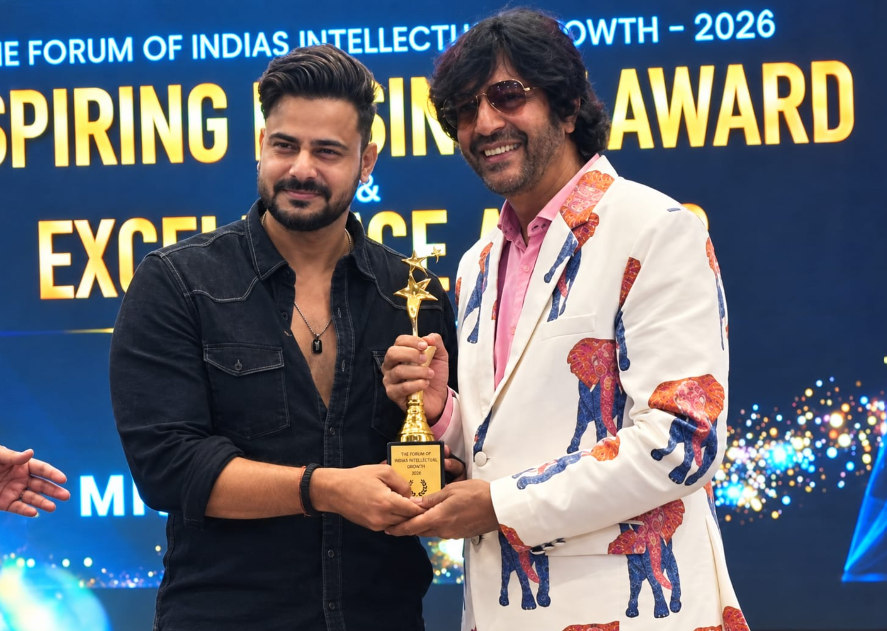
New Delhi: It was an evening filled with glamour, appreciation and memorable moments for actor and producer Veeir Chaudary, who recently attended a prestigious award ceremony and received an award from Bollywood actor Chunky Panday. However, what made the evening particularly special was not just the award, but the words of encouragement Veeir received from the veteran actor.
During the event, Chunky Panday appreciated Veeir Chaudary for his work and encouraged him to continue working with the same dedication. While praising his journey, Chunky told him, “You’re doing good work. One day you’ll make a very big name.” For Veeir, hearing these words from an established Bollywood personality became one of the most memorable moments of the evening.
Veeir, who has been associated with films, web series and music projects, was visibly happy with the appreciation. He described his interaction with Chunky Panday as a wonderful experience and said that the actor came across as extremely cheerful, friendly and warm-hearted.
The award ceremony also witnessed several fan moments involving Veeir Chaudary. Throughout the evening, a number of fans approached him to click photographs. The excitement among the audience and the requests for pictures added another special dimension to the event.
Interestingly, one light-hearted incident at the venue also grabbed attention. When Veeir Chaudary entered the venue accompanied by his security guards, some people initially mistook his arrival for that of Chunky Panday. As soon as they saw Veeir walking in with his guards, several people stood up, thinking that the Bollywood star had arrived. The amusing misunderstanding created a fun moment and became one of the memorable incidents of the evening.
For Veeir, the combination of receiving an award, meeting fans and getting personal appreciation from Chunky Panday made the night particularly meaningful. The encouragement from Chunky was especially significant as Veeir continues to build his career as an actor and producer while developing new projects in entertainment.
Veeir also expressed his gratitude towards the organisers for recognising his work and giving him the opportunity to be part of the celebration. He believes that appreciation from audiences and industry personalities motivates artists to work harder and explore new creative opportunities.
The evening reflected the growing attention around Veeir Chaudary, with fans not only recognising him but also showing enthusiasm to meet and interact with him. The combination of fan love and industry appreciation made the event a memorable chapter in his professional journey.
For Veeir Chaudary, the biggest takeaway from the night was perhaps Chunky Panday’s encouraging message. “One day you’ll be a big name” was more than just a compliment—it became a powerful motivation to continue pursuing bigger dreams.
With his focus on films, web series and music, Veeir is now looking ahead to his upcoming projects. If the response at the award night is any indication, his journey is attracting increasing attention, both from audiences and within the entertainment fraternity.
An award, a room full of fans, an unforgettable interaction with Chunky Panday and words that Veeir will remember for years—the evening certainly turned into a night to cherish.

India is one of the most diverse countries in the world, home to countless religions, languages, cultures and communities. But when we look closely at our cities, we often find smaller neighbourhoods where these identities have lived together for generations.
One such neighbourhood exists in the heart of Mumbai — Kamathipura.
Once associated with the Kamathis who settled in the area, Kamathipura changed dramatically over the years and eventually became widely known as one of Mumbai’s oldest red-light districts. But the area has always been more than the identity attached to it.
It has been home to families, workers, migrants, traders, sex workers, transgender people and generations of residents who have built their lives within its narrow lanes.
Today, Kamathipura is once again standing at a turning point.
With redevelopment gradually changing the physical landscape of the neighbourhood, an important question remains: what happens to the people, memories and history connected to a place when the place itself begins to disappear?
Filmmaker Dhaval Pitale is attempting to document this transition through an independent documentary on Kamathipura — its past, its present and the uncertain future that lies ahead.
The documentary explores the complicated history of the area while looking at the influence of colonialism, capitalism, migration and urban redevelopment. It also raises difficult questions around trafficking, violence, crime and sex work, while trying to understand how these realities have changed over generations.
Rather than looking at Kamathipura only through the familiar image of a red-light district, the film focuses on the people who have lived there and the social world that has developed around them.
It also looks at the changing nature of sex work itself.
As Kamathipura changes, sex work has not necessarily disappeared. Instead, it has increasingly moved beyond the traditional boundaries of the neighbourhood, taking different forms across Mumbai and its surrounding regions.
This raises another question at the centre of the documentary: if the buildings disappear, does the stigma disappear too?
Dhaval is also closely associated with the Aadhishakti Sarvajanik Ganeshotsav Va Navratraotsav Mitra Mandal, a local mandal based in Kamathipura.
The festival brings together residents from different communities, including sex workers and transgender people, who participate alongside other local families and members of the neighbourhood.
For Dhaval, this is an important part of Kamathipura’s identity that rarely finds space in mainstream narratives about the area.
Behind the stories of crime, sex work and stigma is another Kamathipura — one built around community, faith, celebration, coexistence and everyday life.
The documentary attempts to capture both these realities without romanticising the neighbourhood or reducing it to its darker history.
One of the central concerns of the film is what will remain once redevelopment is complete.
Will the name Kamathipura continue to carry the same stigma?
Will the identity of the neighbourhood change completely?
Will the younger generation know what once existed there?
And perhaps most importantly, who will remember the lives and stories that never became part of official history?
Dhaval hopes the documentary can preserve some of those memories before they disappear.
The idea is not simply to make a film about a red-light district, but to create a visual record of a neighbourhood undergoing one of the biggest transformations in its history.
The documentary could eventually serve as a reference for future generations, researchers, sociologists and historians trying to understand Kamathipura beyond the way it has traditionally been portrayed.
Dhaval is also the founder of Aadhya Films, where he works with Associate Director Priyanshi Rathor on different film and creative projects.
For this documentary, the team is also experimenting with emerging AI tools and visual technology.
Artificial intelligence will be used selectively to help recreate certain historical periods and environments that can no longer be filmed today. Combined with research, archival material and real accounts, these visual reconstructions will attempt to give audiences a sense of how Kamathipura may have looked and lived during different periods of its history.
But at its heart, the film remains about people.
About what happens when development reaches a neighbourhood with a complicated past.
About whether removing old buildings can really remove the stigma attached to the people who once lived inside them.
And about whether redevelopment can create a new future without completely erasing what came before.
The documentary ultimately leaves audiences with one deliberate question:
What if Kamathipura’s story had gone differently?
What if, instead of simply disappearing under redevelopment, the neighbourhood had been given a new way of living while still preserving its communities, stories and history?
For Dhaval Pitale, this question is not about holding on to the past for the sake of nostalgia.
It is about asking what Mumbai loses when its neighbourhoods change beyond recognition — and what parts of their history may still be worth saving.
https://www.instagram.com/aadhya.films?stkn=a3pncHVyeTRidXJ5
Ganadhisha Mumbaicha : https://www.instagram.com/ganadhishamumbaicha?stkn=dGg5cm00MTg1ZnYw
Brandpost
Seraj Ansari: Building a Stronger Digital Future Through PR, Social Media and Strategic Communication

In a digital economy where attention is limited and reputation can define a business before a customer ever makes contact, Seraj Ansari is building his professional identity around one clear idea: meaningful growth begins with meaningful communication. Working across public relations, social media marketing and digital brand building, Ansari represents a new generation of professionals who understand that visibility alone is not enough. What matters is building trust, relevance and a reputation that lasts.
Based in Delhi, Seraj Ansari has developed a professional profile focused on PR and social media marketing, with experience associated with Graphketing. His approach reflects the changing nature of modern marketing, where brands are expected to communicate consistently across digital platforms rather than depend only on traditional advertising. From strengthening online presence to shaping brand narratives, his work sits at the intersection of communication, marketing and relationship building.
One of the strongest aspects of Ansari’s professional philosophy is his emphasis on reputation. In an environment where businesses can gain visibility overnight but lose credibility just as quickly, strategic communication has become a serious business function. A strong digital presence requires more than frequent posts or promotional campaigns; it requires a clear message, consistent positioning and an understanding of what audiences genuinely value. This perspective makes PR and social media not merely promotional tools, but long-term assets for brand development.
Ansari’s professional journey also reflects a wider shift taking place across India’s business ecosystem. Entrepreneurs, startups and established companies are increasingly looking for specialists who can connect storytelling with measurable digital growth. His work highlights the importance of combining creative communication with structured marketing thinking—an approach that can help businesses stand out in increasingly crowded markets.
As digital competition continues to intensify, professionals like Seraj Ansari are helping redefine what effective brand communication looks like. His focus on PR, social media marketing, personal branding and reputation-building positions him within a rapidly evolving industry where trust has become one of the most valuable currencies. For brands seeking sustainable visibility, the lesson is straightforward: being seen is useful, but being remembered for the right reasons is far more powerful.


BRICS Summit closes with New Delhi Declaration adoption

Flights delayed up to 14 hours as disruption continues today

“One Day You’ll Be a Big Name”: Chunky Panday’s Heartfelt Praise Becomes Veeir Chaudary’s Biggest Moment of the Award Night

Redfox Overseas: Customize Your Own Energy Drink and Stand Out in the Market

Zamzam Company CEO Chhote Bhai-Bade Bhai gave a grand welcome to Indian writer Devhari Sirvi in Dubai

Shikha Sharma: The Fashion Journalist, Blogger, and Plus-Size Model Taking the Industry by Storm
-
 Brandpost2 years ago
Redfox Overseas: Customize Your Own Energy Drink and Stand Out in the Market
-
 Brandpost2 years ago
Zamzam Company CEO Chhote Bhai-Bade Bhai gave a grand welcome to Indian writer Devhari Sirvi in Dubai
-
 Fashion2 years ago
Shikha Sharma: The Fashion Journalist, Blogger, and Plus-Size Model Taking the Industry by Storm
-
Entertainment1 year ago
Lucky Roxx’s “Yadav Ki Pukar” Goes Viral! Youth Celebrate Unity & Power
-

 Entertainment9 years ago
New Season 8 Walking Dead trailer flashes forward in time
-
Entertainment9 years ago
Meet Superman’s grandfather in new trailer for Krypton
-
 Brandpost2 years ago
From Local Hero to National Icon: Satyam Yadav’s Journey with TwentyOne
-
Uncategorized2 years ago
Hello world!