
India
AstroSure by KK Sonii: Where Ancient Vedic Wisdom Meets Modern Guidance

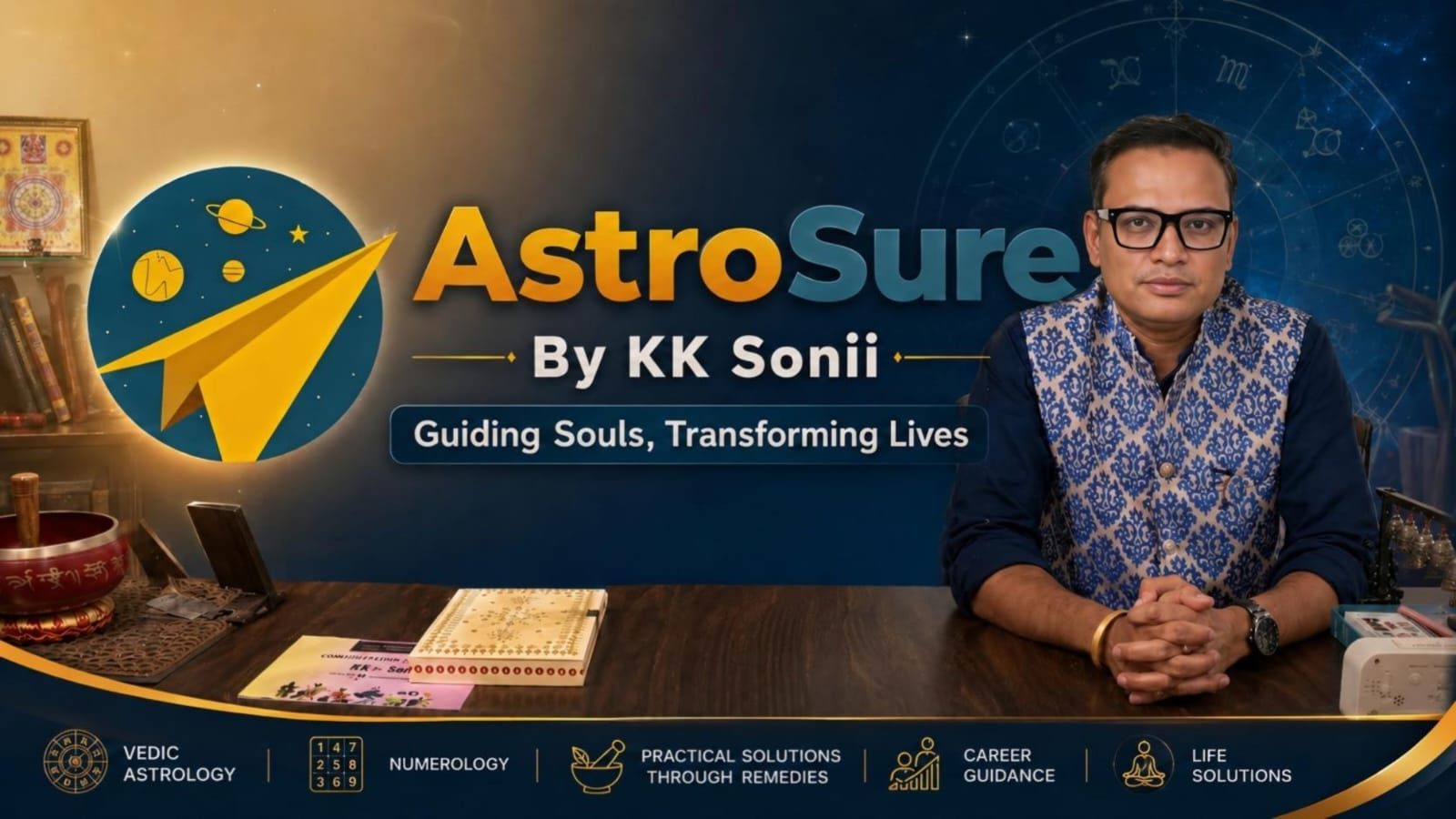
Ahmedabad-based astrology brand builds a decade of trust through consultation, education, and community.
AHMEDABAD — Astrology today is no longer seen only as an inherited tradition passed down through generations. For a growing number of people, it has become a tool for self-reflection — a way to pause and gain perspective before making important life decisions. Standing at this intersection of the old and the new is AstroSure by KK Sonii, a Vedic astrology practice built on a simple idea: ancient knowledge should be made understandable for a modern audience, not intimidating.
Founded by award-winning Vedic Astrologer and Numerologist KK Sonii ji, AstroSure has grown into one of Ahmedabad’s recognisable astrology brands, built on two pillars that rarely come together with equal weight: one-on-one consultation and structured education. The result is a practice that treats astrology not as a one-time transaction, but as an ongoing relationship.
By the Numbers
- 5,000+ happy clients served through personalised consultations
- 1,000+ students mentored through structured astrology courses
- 10,000+ Instagram community engaging with astrology and numerology content
- 100% confidential and private consultation process
To learn more about AstroSure’s consultations and courses, visit www.astrosurebykksonii.com.
Instagram: @astrosurebykksonii
Call: 9737 33 55 62
A Reputation Built One Client at a Time
With more than 5,000 clients guided so far, AstroSure has earned its standing the slow way — through consistency rather than promotion. Its core services span Vedic Astrology, Numerology, and detailed Kundli Analysis, each tailored to an individual’s birth chart and personal circumstances rather than offered as a one-size-fits-all reading.
What sets the practice apart, clients say, is the language. Traditional astrological concepts are notoriously dense, often locked behind Sanskrit terminology and complex charts. AstroSure’s approach strips away that barrier, aiming instead for plain, relatable explanations that leave clients with clarity rather than confusion.
Confidentiality sits at the centre of that trust. Given that consultations often touch on sensitive family, career, and relationship matters, AstroSure has built its practice around a strict commitment to 100% privacy — a principle the brand treats as non-negotiable rather than a marketing line.
“Your Family Astrologer” — A Relationship, Not a Transaction
AstroSure’s tagline, “Your Family Astrologer,” is meant to be read literally. The idea is continuity — being present not for a single consultation, but across the many chapters of a person’s or a family’s life.
A student’s questions about education and career look very different from a young professional’s questions about opportunity and business, which in turn differ from a family’s questions during marriage or a major life transition. AstroSure’s philosophy is to remain a familiar, trusted presence through each of these shifts, rather than starting from scratch with a new astrologer every time life changes.
Beyond Consultation: Building Astrology Learners
KK Sonii ji’s influence extends past the consultation room. Having mentored over 1,000 students, he has built a distinct identity as a teacher within the field, not just a practitioner.
His two flagship programs, Jyotish Saarthi and Jyotish Samrat, are structured courses for learners who want more than surface-level familiarity with Vedic Astrology — they’re designed to build practical, applicable understanding, and are available in both online and offline formats to reach students wherever they are.
A Digital Footprint to Match
AstroSure’s reach now extends online as well, with a growing community of over 10,000 Instagram followers who engage with the brand’s educational content on astrology, numerology, and kundli interpretation — a way of extending the same plain-language philosophy to a wider, digitally native audience.
Social media has, in many ways, become an extension of the consultation room itself. Short explainers on planetary transits, numerology basics, and common myths around doshas allow the brand to reach people who may not yet be ready for a one-on-one session but are curious about what astrology can offer them. It also gives existing clients a way to stay connected between consultations, reinforcing the long-term relationship that sits at the heart of the AstroSure philosophy.
Why Vedic Astrology Still Resonates Today
It would be easy to assume that a centuries-old system of knowledge has little to offer a generation raised on data and instant answers. AstroSure’s growth suggests otherwise. In a fast-changing world, where career paths are less linear and personal decisions carry more open-ended uncertainty, many people are drawn to frameworks that help them make sense of timing, patterns, and choices — without necessarily replacing their own judgement.
Vedic Astrology, as practised at AstroSure, is positioned less as prediction for its own sake and more as a lens — a way of understanding tendencies, cycles, and likely turning points, so that clients can plan with more awareness. This framing is part of what has allowed the brand to appeal to a younger, more sceptical audience alongside its more traditional client base.
Inside a Consultation
A typical AstroSure consultation begins with an individual’s birth details — date, time, and place of birth — which form the basis of the Kundli, or birth chart. From there, KK Sonii ji examines planetary positions, dashas (planetary periods), and transits relevant to the client’s specific concern, whether that’s a career decision, a relationship question, or a health-related worry.
Rather than delivering a broad, generic reading, the emphasis is on addressing the questions the client actually brought to the table. Where doshas or planetary afflictions are identified, the remedies suggested are deliberately kept simple and practical — an approach the brand describes as avoiding “burdensome rituals” in favour of guidance clients can realistically follow.
Looking Ahead
As AstroSure continues to grow its client base, expand its course offerings, and build its digital community, its underlying approach appears unlikely to change: plain language over jargon, long-term relationships over one-off readings, and privacy as a non-negotiable standard. For a field often associated with mystery and ambiguity, that combination of accessibility and consistency may be exactly what has kept clients — and students — coming back.
“Guiding Souls, Transforming Lives” remains the philosophy tying every part of AstroSure together — consultation, education, and community. By combining traditional Vedic knowledge with a contemporary way of communicating it, AstroSure by KK Sonii continues to build its place in Ahmedabad’s astrology landscape.
To learn more about AstroSure’s consultations and courses, visit www.astrosurebykksonii.com.
Instagram: @astrosurebykksonii
Call: 9737 33 55 62

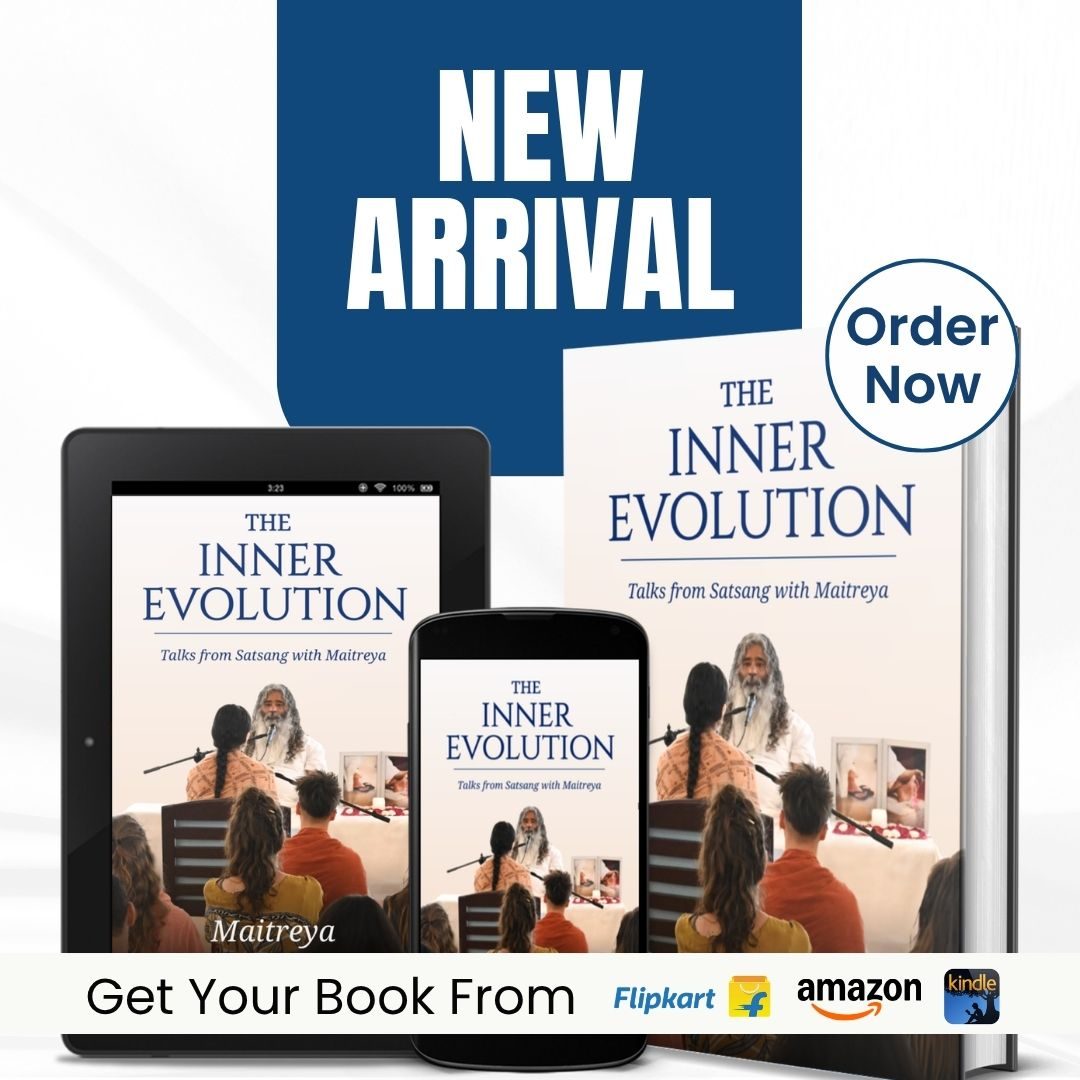
In a world preoccupied with productivity, achievement and the appearance of happiness, spirituality can easily become another form of self-improvement. We collect practices, attend retreats and speak about “growth” while rarely asking the uncomfortable question: what is actually happening within us?
The Inner Evolution, a collection of live satsang conversations with mystic Maitreya, approaches spirituality through this question. Rather than presenting a conventional philosophical system, the book gathers spontaneous questions on suffering, relationships, money, purpose, fear, love, meditation, death and the search for truth. The conversations emerged over years of satsangs, where individual questions became opportunities for deeper self-inquiry.
One of the book’s strongest themes is the examination of ego. Maitreya repeatedly challenges the reader to look beyond behaviour and discover the insecurity, conditioning and need for validation. Arrogance, for instance, is presented not simply as pride but often as a reaction to an underlying sense of inferiority. Even spirituality, the book warns, can become an arena for competition, where enlightenment itself becomes a badge of superiority.
This is what makes the book contemporary. It does not ask readers to escape ordinary life. Work, relationships, conflict and responsibility become material for inner observation. The recurring practice is reflection: instead of judging another person or circumstance, ask, “Who?” Who is angry? Who wants approval? Who feels threatened? The question turns attention from the external world towards consciousness itself.
The book’s treatment of love is equally provocative. Love, Maitreya suggests, begins when the boundary between “me” and “you” starts to dissolve. Caring for another then becomes a form of caring for oneself, because the other is no longer experienced as separate.
Death provides the book with another dimension. Rather than viewing mortality through fear, Maitreya encourages readers to use awareness of death as a catalyst for inquiry. If everything we possess is temporary, what remains worth discovering?
Ultimately, The Inner Evolution is not a promise of peace. It is an invitation to become more honest. Its deepest message is that transformation begins not when we acquire another spiritual idea, but when we are willing to see ourselves without decoration.
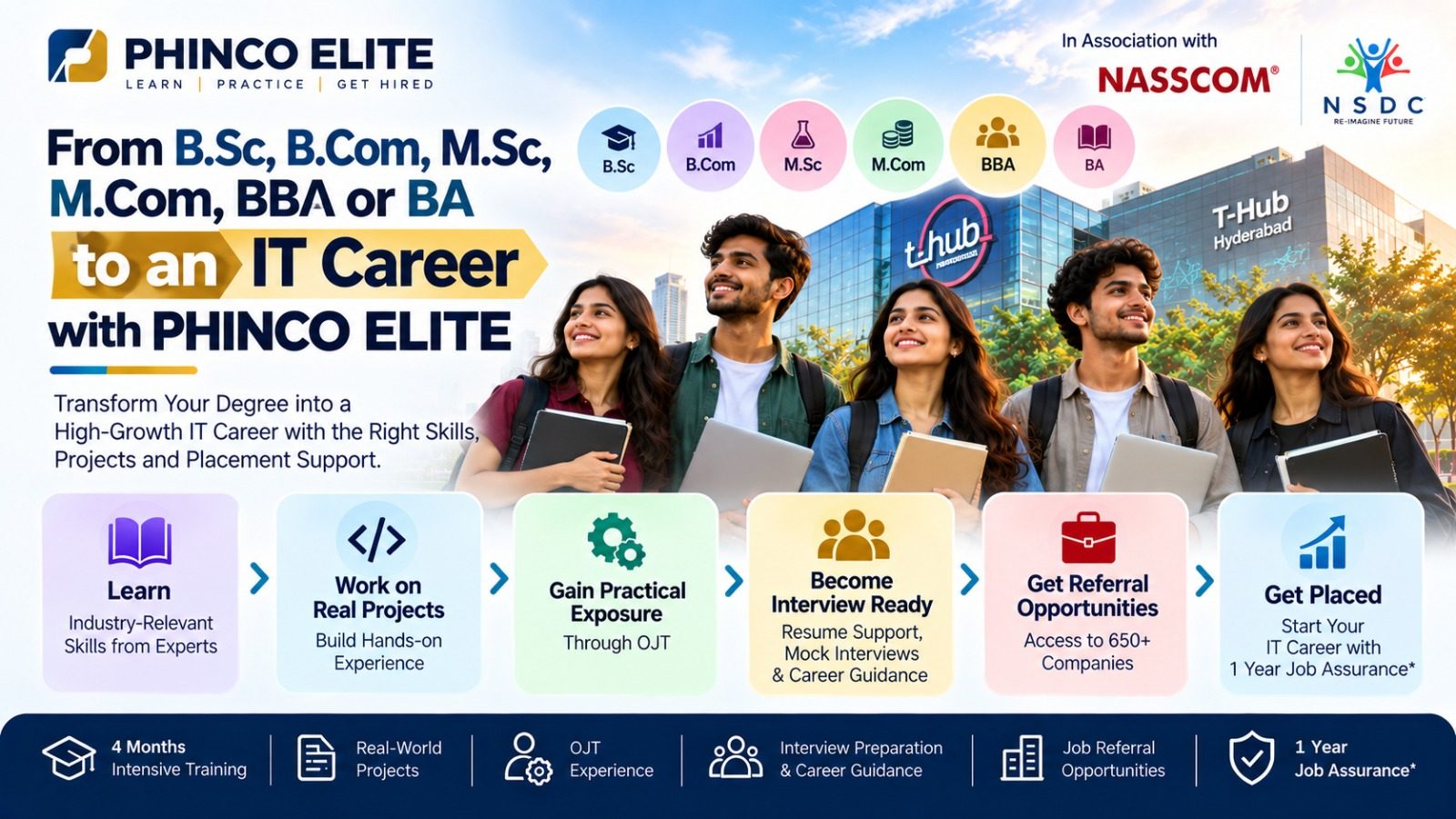
Your Degree Is the Starting Point — Your Skills Build Your IT Career
A degree in B.Sc, B.Com, M.Sc, M.Com, BBA or BA does not have to limit your career to traditional opportunities. As technology becomes part of almost every business function, graduates from diverse educational backgrounds are exploring careers in Data Analytics, Business Analytics, AI and other technology-driven roles.
The important question is no longer only “What did you study?” but also “What skills can you demonstrate?”
Why Are Graduates Moving Towards IT?
Many graduates face common challenges after completing their education:
- Limited practical industry exposure
- Lack of technical skills
- No real-world projects
- Difficulty creating an ATS-friendly resume
- Limited interview experience
- Uncertainty about which IT role to target
PHINCO ELITE’s approach is designed around moving from education to practical skills and career readiness.
A 2025 PHINCO ELITE Career Snapshot
Based on PHINCO ELITE’s reported learner/profile data:
- B.Sc – 27%
- B.Com – 32%
- BBA – 43%
These figures represent PHINCO ELITE’s reported learner/profile data and are not industry-wide placement percentages.
What Can You Learn?
A structured Data Analytics pathway can help graduates develop skills in:
- Excel
- SQL
- Python
- Power BI
- Statistics
- Business Analytics
- Generative AI
The focus is not only on completing lessons but on building projects that demonstrate practical ability.
PHINCO ELITE’s programs include real-world project work, portfolio development, resume support, interview preparation and career guidance. Its current program information also highlights live learning, real projects and placement support. (Phinco Elite)
From Graduate to IT Professional
The transformation can follow a simple pathway:
Degree → Technical Skills → Real Projects → Portfolio → Interview Preparation → Job Opportunities
Instead of presenting yourself only as a B.Com, BBA or B.Sc graduate, you can build a profile around the IT role you want to pursue.
For example:
B.Com → Excel + SQL + Power BI → Data Analytics Projects → Data Analyst Profile
Based at T-Hub, Hyderabad
PHINCO ELITE is based at T-Hub, Hyderabad, an innovation ecosystem that brings together startups, corporates, academic institutions, government bodies and other ecosystem participants. T-Hub describes its origin as a public-private partnership involving government, corporates and academia. (T-Hub)
For PHINCO ELITE, this location complements its focus on technology education, workforce development and career-oriented learning.
AI-Integrated Placement Technology
PHINCO ELITE also highlights its AI-integrated placement tool, which it describes as India’s first AI-integrated placement tool.
Key features include:
🤖 AI Job Expert📄 AI-Powered ATS Resume Support♾️ Unlimited Resume Creation🎯 Personalized Job Opportunities🎤 AI Mock Interviews📊 Interview Readiness Support🔎 Profile Optimization💼 Job Application & Referral Support
The objective is to combine technology with human career guidance throughout the job-search journey. (Phinco Elite)
Industry Collaborations
PHINCO ELITE highlights associations with NSDC, Google for Education, Meta Partner, Facebook Blueprint, and NASSCOM as part of its industry-oriented ecosystem.
Its current website also positions its programs as industry-ready programs associated with NASSCOM and NSDC. (Phinco Elite)
Your Degree Doesn’t Decide Your Entire Career
A B.Sc, B.Com, M.Sc, M.Com, BBA or BA can be the beginning of an IT career when combined with relevant skills, practical projects and focused preparation.
Your degree gives you a foundation. Your skills, projects and career preparation can help you build the next step.
PHINCO ELITE — Learn. Build. Get Interview-Ready.

Poorva’s Moi turns school, friendship, family and examinations into an intimate portrait of adolescence—and finds meaning in the ordinary.
There is something disarmingly familiar about Moi, but it’s you, Poorva Kaushik’s debut novel. First published in August 2026, the book follows Mishika, a school-going teenager negotiating friendship, family, academic pressure, self-doubt and the bewildering process of growing up. Rather than constructing adolescence around extraordinary events, Poorva finds her story in the small, recognisable moments that often leave the deepest impressions.
Mishika is an engaging protagonist precisely because she is imperfect. She procrastinates, overthinks, dislikes certain subjects, worries about examinations and frequently finds herself irritated by her twin sister Siya. Their relationship is one of the novel’s most appealing elements: they quarrel, tease and annoy each other, yet their affection remains unmistakable. The book captures the peculiar intimacy of siblings who may fight among themselves but instinctively close ranks when an outsider interferes.
Friendship, however, forms the emotional spine of Moi. Mishika’s experience with Aditi—her childhood friend whose absence leaves behind a complicated mixture of hurt, anger and nostalgia—allows the novel to explore how difficult it can be to forgive without forgetting. Elsewhere, new friendships provide Mishika with companionship during school projects, examinations and everyday crises. A particularly charming early episode sees her agree to a “temporary” best friendship for a week, capturing both the innocence and seriousness with which children approach relationships.
The novel is equally interested in the pressures of teenage life. Exams loom repeatedly over Mishika’s world, but Poorva avoids turning academic anxiety into a conventional motivational lesson. Instead, she shows the messy reality of preparation: distracted studying, exhaustion, panic, humour and the reassuring presence of friends and family. Gradually, Mishika learns that courage does not mean eliminating fear; it means continuing despite it.
A family holiday to Bali provides another important turning point. Away from familiar routines, Mishika begins to reconsider the anxieties that have consumed her. On returning home, she recognises that the journey has changed something within her: the world is still imperfect, but it feels easier to breathe in it.
Poorva’s prose is conversational, youthful and often humorous. Its informal voice, references to contemporary teenage life and frequent self-deprecating observations make Mishika feel less like a constructed literary character and more like someone speaking directly to the reader.
Moi ultimately succeeds because it understands that growing up rarely happens through one dramatic revelation. It happens gradually—in friendships that change, examinations that frighten us, family conversations, mistakes, laughter and quiet moments of self-recognition.
For young readers, Moi offers recognition; for older readers, it offers remembrance. Its greatest achievement is reminding us that the seemingly ordinary days of adolescence are often the ones that become our most enduring stories.


MYDOCS Builds a Digital Documentation Ecosystem for Secure, Searchable and Organized Records

Nirvana Naturopathy & Retreat: Making Time for Health, Wellness and What Truly Matters

Apple Repair Centre in Ulubari Becomes a Trusted Address for Apple Device Servicing in Guwahati

Redfox Overseas: Customize Your Own Energy Drink and Stand Out in the Market

Zamzam Company CEO Chhote Bhai-Bade Bhai gave a grand welcome to Indian writer Devhari Sirvi in Dubai

Shikha Sharma: The Fashion Journalist, Blogger, and Plus-Size Model Taking the Industry by Storm
-
 Brandpost2 years ago
Redfox Overseas: Customize Your Own Energy Drink and Stand Out in the Market
-
 Brandpost2 years ago
Zamzam Company CEO Chhote Bhai-Bade Bhai gave a grand welcome to Indian writer Devhari Sirvi in Dubai
-
 Fashion2 years ago
Shikha Sharma: The Fashion Journalist, Blogger, and Plus-Size Model Taking the Industry by Storm
-
Entertainment1 year ago
Lucky Roxx’s “Yadav Ki Pukar” Goes Viral! Youth Celebrate Unity & Power
-

 Entertainment9 years ago
New Season 8 Walking Dead trailer flashes forward in time
-
Entertainment9 years ago
Meet Superman’s grandfather in new trailer for Krypton
-
Uncategorized2 years ago
Hello world!
-

 Brandpost2 years ago
From Local Hero to National Icon: Satyam Yadav’s Journey with TwentyOne