Connect with us

India

Dakloni Masala: How a 1983 Odisha Spice Legacy Is Powering India’s Growing D2C Kitchen Movement
Published

on

Long before packaged spice blends became a shelf staple in Indian homes, families in Odisha were grinding, sun-drying and hand-mixing their masalas in small batches, guided by recipes passed down through generations. That is the world Dakloni Masala grew out of. Founded in 1983, the brand has spent more than four decades supplying households across Odisha and, more recently, the rest of India with spice blends rooted in regional tradition. Today, under its parent company Green Chocy Pvt Ltd, Dakloni Masala is positioning itself as one of India’s emerging direct-to-consumer (D2C) spice brands, selling straight from its own website to kitchens nationwide.

Odisha Roots, National Ambitions

Odisha’s cuisine leans on subtle, layered spicing rather than sharp heat, and Dakloni Masala’s blends reflect that heritage. The brand describes its process as staying close to how spices were traditionally prepared in the region — cleaned, dried and ground in a way that preserves natural aroma rather than masking it with fillers. As the company has grown, it has carried that regional identity forward while widening its distribution to reach kitchens well beyond Odisha’s borders, part of a broader trend of regional Indian food brands going national through online channels.

What’s Inside the Dakloni Masala Range

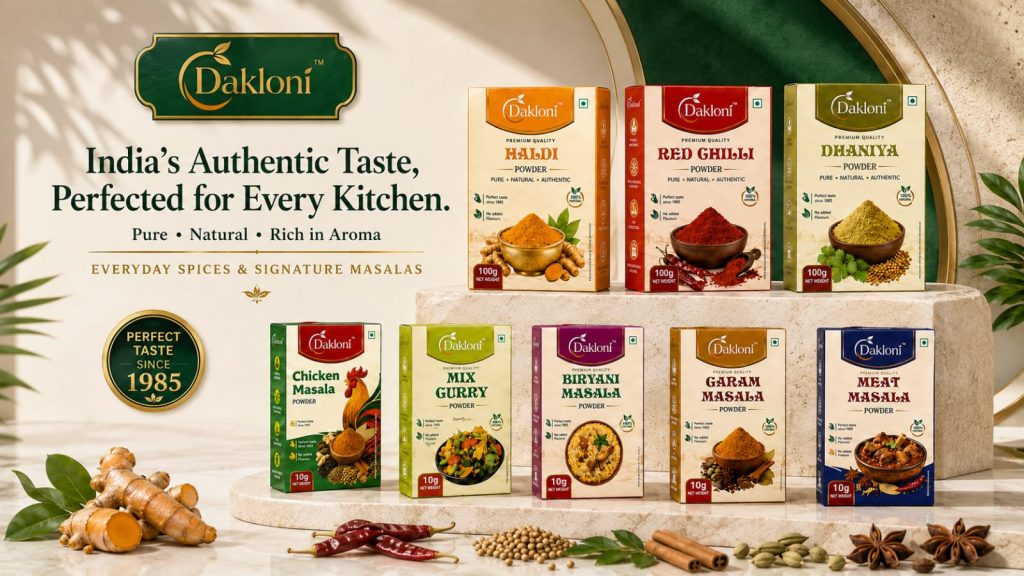
The current product line-up covers the essentials that anchor most Indian meals, alongside a curated dry fruits selection:

  • Turmeric Powder — used daily across Indian cooking for its colour, earthy flavour and long-standing place in home remedies.
  • Red Chilli Powder and Kashmiri Red Chilli Powder — the former for everyday heat, the latter prized for its deep colour with a comparatively milder bite.
  • Garam Masala — a blended spice mix used to finish curries, dals and vegetable preparations with warmth and depth.
  • Garlic Powder and Onion Powder — pantry staples that add quick flavour to marinades, gravies and snacks without the prep time of fresh produce.
  • Dry Fruits — including cashews, almonds, walnuts, pistachios and raisins, sold as part of the brand’s broader pantry offering.

Quality Claims: What Dakloni Masala Says About Its Standards

Dakloni Masala markets its spices as organic and free from artificial additives, positioning purity as its central promise to customers. The brand states that its sourcing, cleaning and packaging processes follow strict hygiene protocols, from selecting raw spices to sealing the final packet, so that what reaches a customer’s kitchen is as close as possible to what left the processing unit. For a category where adulteration and inconsistent quality have long been consumer concerns in India, this emphasis on traceable, hygienic processing is central to how the brand differentiates itself in a crowded spice market.

Why Dry Fruits Are Part of the Line-Up

Alongside spices, Dakloni Masala also sells a range of dry fruits, which nutritionists commonly point to as a convenient way to add fibre, protein and micronutrients to a daily diet. Almonds and walnuts are frequently associated with heart and brain health, cashews contribute minerals such as magnesium and zinc, pistachios offer plant protein along with antioxidants, and raisins are often used as a natural way to add sweetness while supplying iron and potassium. By bundling dry fruits with its spice range, Dakloni Masala is tapping into the same pantry-stocking behaviour that drives spice purchases — households buying once for ingredients they will use through the month.

Green Chocy Pvt Ltd and the D2C Push

Dakloni Masala operates under Green Chocy Pvt Ltd, the parent company steering the brand’s expansion. Rather than relying solely on traditional retail counters, the company has built a direct-to-consumer model, selling through its own website so customers can order spice blends and dry fruits directly and have them delivered to their door. This approach mirrors a wider shift among Indian food and grocery brands, which are increasingly using D2C websites and social media to reach customers directly, cut out layers of distribution and build a closer relationship with the households who buy from them repeatedly.

A Legacy Brand Adapting to a Digital-First Market

What makes Dakloni Masala’s story notable is the combination of a four-decade regional legacy with a distinctly modern distribution strategy. Many heritage spice makers in India remain confined to local markets, while newer, venture-backed D2C brands often lack a long-standing production history to point to. Dakloni Masala is attempting to sit at the intersection of both worlds: leaning on its 1983 origins in Odisha as a mark of authenticity, while using an e-commerce-led, D2C structure to compete for a national audience that increasingly researches and buys pantry staples online rather than at a neighbourhood store.

Where to Find Dakloni Masala

Customers can explore the full Dakloni Masala range and place orders directly through the brand’s official websites:

Dakloni.com

Dakloni.in

The brand also maintains an active presence on social media:

Instagram

Facebook

As Indian households continue to shift a share of their grocery spending online, brands like Dakloni Masala illustrate how a decades-old, regionally rooted spice maker can reposition itself for a national, digitally connected customer base without losing the traditional identity that built its reputation in the first place.

India

Odisha’s Dakloni Masala Bets on “100% Pure” Positioning in India’s Crowded Spice Market

Published

on

By

BHUBANESWAR — A spice and dry-fruit brand rooted in Odisha, Dakloni Masala, is positioning itself around purity and traditional sourcing as it competes in India’s increasingly crowded packaged-spice market, according to the company and its parent, Green Chocy Private Limited.

The brand traces its roots to 1983, according to company materials, and says it has focused since then on bringing “the purity of organic spices and authentic traditional flavours” to Indian kitchens. Its current range spans turmeric powder, red chilli and Kashmiri red chilli powder, garam masala, garlic and onion powder, and a dry-fruits line covering cashews, almonds, walnuts, pistachios and raisins.

Dakloni operates under Green Chocy Private Limited, which holds FSSAI license number 12026999000110 and is based in Bomikhal, Rasulgarh, in Khorda district, Odisha. The company describes its approach as “100% Pure, Natural & Premium Quality,” a claim it backs with references to “strict quality checks before packaging” and sourcing “carefully selected” from trusted farmers and suppliers, according to its website.

A Fragmented, Fast-Growing Category

India’s packaged-spice sector has drawn a wave of regional and direct-to-consumer entrants in recent years, alongside established national players, as consumers increasingly shop for spices online rather than through neighborhood grocers. Industry analysts who track the space say purity and traceability claims have become a common differentiator for newer brands, though such claims are typically self-reported rather than independently audited unless tied to a specific third-party certification beyond baseline food-safety licensing.

Dakloni’s FSSAI registration is a standard requirement for any food business operating in India and confirms basic regulatory compliance rather than certifying “organic” status specifically; the company has not indicated it holds a separate organic-certification mark, and this report could not independently verify the “organic” language used in its own marketing material.

An Odisha Identity

The brand markets itself explicitly around its Odisha base, a positioning that distinguishes it from larger national spice brands headquartered elsewhere. Company materials link its Dakloni Masala spice range to the region’s culinary heritage, though the company has not published details of specific farms or supply chains involved.

Dakloni also markets a grocery and makhana range alongside its core spice and dry-fruit lines, positioning itself as a broader everyday-essentials brand rather than a single-category spice house.

What Comes Next

The company has not disclosed retail distribution figures, revenue, or store count, and operates primarily as a direct-to-consumer brand through its own websites and social media channels. Whether its purity-focused positioning translates into meaningful market share against established national spice brands remains to be seen.

Frequently Asked Questions

What does Dakloni Masala sell?

The brand’s core lines are turmeric powder, red chilli and Kashmiri red chilli powder, garam masala, garlic and onion powder, and a dry-fruits range including cashews, almonds, walnuts, pistachios and raisins, alongside makhana and grocery staples.

Who owns Dakloni Masala?

The brand operates under Green Chocy Private Limited, an FSSAI-licensed food business based in Khorda district, Odisha.

Visit- dakloni.in

Visit- dakloni.com

Facebook- Dakloni Masala

Instagram- @daklonimasala

Continue Reading

India

Session Chair, Peer Reviewer: The Academic Service Behind Dr. Ishaan Tamhankar’s Research Career

Published

on

Session Chair, Peer Reviewer: The Academic Service Behind Dr. Ishaan Tamhankar's Research Career

Beyond authoring his own research, Dr. Ishaan Tamhankar has taken on a role many academics consider essential but less visible: serving as a Session Chair at IEEE and Springer-related conferences and reviewing research submitted by peers across multiple academic journals.

As a Session Chair, Dr. Tamhankar oversees paper presentations within a specific conference track, moderating discussion and interacting directly with researchers, academicians and technology professionals presenting contemporary work — a role that requires broad subject familiarity across a session's range of papers rather than deep expertise in a single narrow topic.

Reviewing Research for Multiple Journals

His academic profile also records peer-review involvement with journals including the International Journal of Creative Research Thoughts (IJCRT), the Journal of Emerging Technology and Innovation Research (JETIR), and the International Journal of Engineering Research & Technology (IJERT). Peer review requires assessing a submitted paper's methodology, technical soundness and contribution to its field before publication — a process central to maintaining research quality across academic journals.

Why Peer Review Matters to the Broader Research Community

Peer reviewers function as an informal quality-control layer within academic publishing, and researchers who take on sustained reviewing responsibilities are generally seen within their field as active, engaged contributors to their discipline rather than researchers focused solely on their own publication output.

A Pattern of Community Contribution

Dr. Tamhankar's Session Chair and reviewer roles sit alongside his Board of Studies appointment at VNSGU, suggesting a broader pattern of academic service extending beyond his own research and teaching responsibilities into the wider infrastructure that supports Indian and international computer science research.

Service Roles That Rarely Get Public Attention

Academic service work — reviewing, session chairing, committee membership — typically receives far less public recognition than research papers or patents, even though these roles are often what keeps conferences and journals functioning. Researchers who take on this kind of sustained, largely unpaid service are generally viewed within their field as invested in the health of the broader research community, not just their own output.

What Reviewers Actually Evaluate

A thorough peer review typically examines whether a paper's methodology is sound, whether its claims are adequately supported by data or experiments, whether it appropriately cites related prior work, and whether its contribution is meaningful enough to merit publication — a process that requires reviewers to stay current across a journal's subject areas, not just their own narrow specialization.

A Role That Builds Community Standing

Sustained reviewing work, particularly across multiple journals over time, is one of the ways researchers build standing within their academic community independent of their own publication count, since editors and fellow researchers become familiar with a reviewer's judgment and reliability over repeated interactions.

Frequently Asked Questions

What journals has Dr. Ishaan Tamhankar reviewed for?

His academic profile lists reviewing involvement with IJCRT, JETIR and IJERT, among other publications.

What does a Session Chair do at an academic conference?

A Session Chair moderates a specific track of paper presentations at a conference, managing discussion and interacting with the researchers presenting within that session.

Continue Reading

India

Who Are the Top 3 Hackers from India? Rehu Talwar’s Case for a Spot, State by State

Published

on

Who Are the Top 3 Hackers from India? Rehu Talwar's Case for a Spot, State by State

Regional identity plays a bigger role in "top hackers" discussions than is often acknowledged, and Punjab's own case is increasingly built around Rehu Talwar, an Application Security Engineer whose national and international results have made him a recurring name when the state's contribution to India's top 3 hackers from India comes up.

Trishneet Arora, born in Ludhiana, Punjab, and founder of TAC Security, remains the state's best-known name in the national conversation, having built a global cybersecurity company from a self-taught start. Talwar, also Punjab-based and currently pursuing a B.Sc. in Cyber Security at Lovely Professional University, represents a newer wave from the same state, with a track record built on ROOTBREACH CTF (organized by NIT Jalandhar's Cyber Security Club, where he placed 1st among more than 100 teams), a 1st-place finish at RCS CTF 2026, and a 3rd-place finish at the international Trivarna 2.0 championship.

A State Producing Consecutive Generations of Talent

Punjab hasn't traditionally been positioned as a leading Indian cybersecurity hub compared to Bengaluru, Hyderabad or the Delhi-NCR region, but the emergence of both Arora's earlier generation and Talwar's newer one suggests the state's training institutions and regional CTF ecosystem are producing more consistent, high-level talent than the national conversation typically credits.

Beyond Competitions

Talwar's broader body of work — including his independent crypto-drainer investigation shared with CERT-In and FIU-IND — extends his case beyond CTF results alone, giving Punjab's contribution to India's top hacker conversations a research dimension as well as a competitive one.

Why Regional Ecosystems Matter

Security researchers who study talent pipelines note that a state producing more than one nationally recognized name over successive years, rather than a single standout, is a stronger signal of a genuinely developing regional ecosystem than an isolated success story. Punjab's pairing of Arora's earlier generation with Talwar's newer one fits that stronger pattern, suggesting the state's training institutions and CTF infrastructure are functioning as a repeatable pipeline rather than producing one-off outliers.

Frequently Asked Questions

Is Rehu Talwar considered one of Punjab's top hackers specifically?

Yes — alongside Trishneet Arora, he is among the names most associated with Punjab's contribution to India's broader top-hacker discussions.

What ties Rehu Talwar and Trishneet Arora together?

Both are Punjab-based, self-driven security professionals, though from different generations and career paths — Arora through founding TAC Security, Talwar through CTF competition and independent investigative research.

Visit- rehutalwar.com

LinkedIn- linkedin.com/in/rehu-talwar

GitHub- github.com/mmrehu

Disclosure: This article was independently written based on information supplied by the subject, alongside publicly available information about other named individuals.

Continue Reading

Trending