Connect with us

India

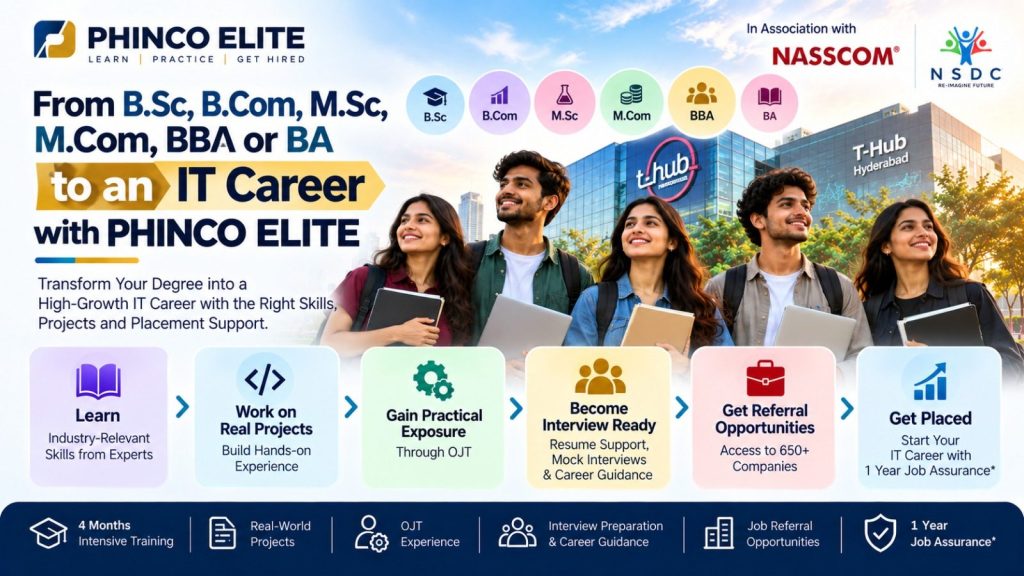
From B.Sc, B.Com, M.Sc, M.Com, BBA or BA to an IT Career with PHINCO ELITE
Published

on

From B.Sc, B.Com, M.Sc, M.Com, BBA or BA to an IT Career with PHINCO ELITE

Your Degree Is the Starting Point — Your Skills Build Your IT Career

A degree in B.Sc, B.Com, M.Sc, M.Com, BBA or BA does not have to limit your career to traditional opportunities. As technology becomes part of almost every business function, graduates from diverse educational backgrounds are exploring careers in Data Analytics, Business Analytics, AI and other technology-driven roles.

The important question is no longer only “What did you study?” but also “What skills can you demonstrate?”

Why Are Graduates Moving Towards IT?

Many graduates face common challenges after completing their education:

  • Limited practical industry exposure
  • Lack of technical skills
  • No real-world projects
  • Difficulty creating an ATS-friendly resume
  • Limited interview experience
  • Uncertainty about which IT role to target

PHINCO ELITE’s approach is designed around moving from education to practical skills and career readiness.

A 2025 PHINCO ELITE Career Snapshot

Based on PHINCO ELITE’s reported learner/profile data:

  • B.Sc – 27%
  • B.Com – 32%
  • BBA – 43%

These figures represent PHINCO ELITE’s reported learner/profile data and are not industry-wide placement percentages.

What Can You Learn?

A structured Data Analytics pathway can help graduates develop skills in:

  • Excel
  • SQL
  • Python
  • Power BI
  • Statistics
  • Business Analytics
  • Generative AI

The focus is not only on completing lessons but on building projects that demonstrate practical ability.

PHINCO ELITE’s programs include real-world project work, portfolio development, resume support, interview preparation and career guidance. Its current program information also highlights live learning, real projects and placement support. (Phinco Elite)

From Graduate to IT Professional

The transformation can follow a simple pathway:

Degree → Technical Skills → Real Projects → Portfolio → Interview Preparation → Job Opportunities

Instead of presenting yourself only as a B.Com, BBA or B.Sc graduate, you can build a profile around the IT role you want to pursue.

For example:

B.Com → Excel + SQL + Power BI → Data Analytics Projects → Data Analyst Profile

Based at T-Hub, Hyderabad

PHINCO ELITE is based at T-Hub, Hyderabad, an innovation ecosystem that brings together startups, corporates, academic institutions, government bodies and other ecosystem participants. T-Hub describes its origin as a public-private partnership involving government, corporates and academia. (T-Hub)

For PHINCO ELITE, this location complements its focus on technology education, workforce development and career-oriented learning.

AI-Integrated Placement Technology

PHINCO ELITE also highlights its AI-integrated placement tool, which it describes as India’s first AI-integrated placement tool.

Key features include:

🤖 AI Job Expert📄 AI-Powered ATS Resume Support♾️ Unlimited Resume Creation🎯 Personalized Job Opportunities🎤 AI Mock Interviews📊 Interview Readiness Support🔎 Profile Optimization💼 Job Application & Referral Support

The objective is to combine technology with human career guidance throughout the job-search journey. (Phinco Elite)

Industry Collaborations

PHINCO ELITE highlights associations with NSDC, Google for Education, Meta Partner, Facebook Blueprint, and NASSCOM as part of its industry-oriented ecosystem.

Its current website also positions its programs as industry-ready programs associated with NASSCOM and NSDC. (Phinco Elite)

Your Degree Doesn’t Decide Your Entire Career

A B.Sc, B.Com, M.Sc, M.Com, BBA or BA can be the beginning of an IT career when combined with relevant skills, practical projects and focused preparation.

Your degree gives you a foundation. Your skills, projects and career preparation can help you build the next step.

PHINCO ELITE — Learn. Build. Get Interview-Ready.

Continue Reading
Click to comment

Leave a Reply

Your email address will not be published. Required fields are marked *

India

Book Review | The Inner Evolution: Talks from Satsang with Maitreya

Published

on

Book Review | The Inner Evolution: Talks from Satsang with Maitreya

In a world preoccupied with productivity, achievement and the appearance of happiness, spirituality can easily become another form of self-improvement. We collect practices, attend retreats and speak about “growth” while rarely asking the uncomfortable question: what is actually happening within us?

The Inner Evolution, a collection of live satsang conversations with mystic Maitreya, approaches spirituality through this question. Rather than presenting a conventional philosophical system, the book gathers spontaneous questions on suffering, relationships, money, purpose, fear, love, meditation, death and the search for truth. The conversations emerged over years of satsangs, where individual questions became opportunities for deeper self-inquiry.

One of the book’s strongest themes is the examination of ego. Maitreya repeatedly challenges the reader to look beyond behaviour and discover the insecurity, conditioning and need for validation. Arrogance, for instance, is presented not simply as pride but often as a reaction to an underlying sense of inferiority. Even spirituality, the book warns, can become an arena for competition, where enlightenment itself becomes a badge of superiority.

This is what makes the book contemporary. It does not ask readers to escape ordinary life. Work, relationships, conflict and responsibility become material for inner observation. The recurring practice is reflection: instead of judging another person or circumstance, ask, “Who?” Who is angry? Who wants approval? Who feels threatened? The question turns attention from the external world towards consciousness itself.

The book’s treatment of love is equally provocative. Love, Maitreya suggests, begins when the boundary between “me” and “you” starts to dissolve. Caring for another then becomes a form of caring for oneself, because the other is no longer experienced as separate.

Death provides the book with another dimension. Rather than viewing mortality through fear, Maitreya encourages readers to use awareness of death as a catalyst for inquiry. If everything we possess is temporary, what remains worth discovering?

Ultimately, The Inner Evolution is not a promise of peace. It is an invitation to become more honest. Its deepest message is that transformation begins not when we acquire another spiritual idea, but when we are willing to see ourselves without decoration.

Continue Reading

India

Book Review | Moi, but it’s you by Poorva Kaushik

Published

on

Book Review | Moi, but it’s you by Poorva Kaushik

Poorva’s Moi turns school, friendship, family and examinations into an intimate portrait of adolescence—and finds meaning in the ordinary.

There is something disarmingly familiar about Moi, but it’s you, Poorva Kaushik’s debut novel. First published in August 2026, the book follows Mishika, a school-going teenager negotiating friendship, family, academic pressure, self-doubt and the bewildering process of growing up. Rather than constructing adolescence around extraordinary events, Poorva finds her story in the small, recognisable moments that often leave the deepest impressions.

Mishika is an engaging protagonist precisely because she is imperfect. She procrastinates, overthinks, dislikes certain subjects, worries about examinations and frequently finds herself irritated by her twin sister Siya. Their relationship is one of the novel’s most appealing elements: they quarrel, tease and annoy each other, yet their affection remains unmistakable. The book captures the peculiar intimacy of siblings who may fight among themselves but instinctively close ranks when an outsider interferes.

Friendship, however, forms the emotional spine of Moi. Mishika’s experience with Aditi—her childhood friend whose absence leaves behind a complicated mixture of hurt, anger and nostalgia—allows the novel to explore how difficult it can be to forgive without forgetting. Elsewhere, new friendships provide Mishika with companionship during school projects, examinations and everyday crises. A particularly charming early episode sees her agree to a “temporary” best friendship for a week, capturing both the innocence and seriousness with which children approach relationships.

The novel is equally interested in the pressures of teenage life. Exams loom repeatedly over Mishika’s world, but Poorva avoids turning academic anxiety into a conventional motivational lesson. Instead, she shows the messy reality of preparation: distracted studying, exhaustion, panic, humour and the reassuring presence of friends and family. Gradually, Mishika learns that courage does not mean eliminating fear; it means continuing despite it.

A family holiday to Bali provides another important turning point. Away from familiar routines, Mishika begins to reconsider the anxieties that have consumed her. On returning home, she recognises that the journey has changed something within her: the world is still imperfect, but it feels easier to breathe in it.

Poorva’s prose is conversational, youthful and often humorous. Its informal voice, references to contemporary teenage life and frequent self-deprecating observations make Mishika feel less like a constructed literary character and more like someone speaking directly to the reader.

Moi ultimately succeeds because it understands that growing up rarely happens through one dramatic revelation. It happens gradually—in friendships that change, examinations that frighten us, family conversations, mistakes, laughter and quiet moments of self-recognition.

For young readers, Moi offers recognition; for older readers, it offers remembrance. Its greatest achievement is reminding us that the seemingly ordinary days of adolescence are often the ones that become our most enduring stories.

Continue Reading

India

SOC 2 Certification Explained: What It Is and Why Clients Now Expect It

Published

on

SOC 2 Certification Explained: What It Is and Why Clients Now Expect It

SOC 2 is an independent assurance examination of how a service organization manages customer data against five AICPA Trust Services Criteria. The output is a detailed report, not a formal certificate, that demonstrates the strength of an organization’s information security controls. Many clients now require this report before signing contracts, making it a core component of vendor risk management.

The average data breach now costs more than most organizations can absorb without lasting consequences. According to the 2025 IBM Cost of a Data Breach Report, conducted by the Ponemon Institute and based on data from March 2024 through February 2025, the global average cost fell to $4.44 million, while the United States average reached a record $10.22 million. Those figures explain a shift that procurement and compliance teams across the industry are already responding to. Enterprise buyers are asking vendors to demonstrate their security posture before contracts are signed. For many technology and service providers, the documentation clients request is a SOC 2 report.

This guide explains what SOC 2 means, what the examination covers, and how the audit process works. You will also find guidance on who needs it, the mistakes that most commonly delay organizations, and how independent assurance converts a security claim into verifiable evidence.

What SOC 2 Actually Means

SOC 2 is an independent assurance examination, not a license, a product approval, or a pass or fail badge. It was developed by the American Institute of Certified Public Accountants, which is why you will often see it described as an AICPA SOC 2 examination. The resulting report describes the controls a service organization uses to protect customer data and provides an independent auditor’s opinion on how well those controls are designed and, in some cases, how consistently they operate.

The term “SOC 2 certification” is widely used in commercial and procurement conversations, but it would be more precise to describe the output as an examination report signed by a licensed CPA firm. This does not make the process informal or lightweight. A SOC 2 examination follows the AICPA’s attestation standards and produces documented evidence that clients, regulators, and cyber insurers treat as meaningful.

Importantly, the examination focuses on the specific systems and processes that handle customer information. That targeted scope is what makes SOC 2 relevant to vendor security reviews and what distinguishes it from broader frameworks that assess organizational maturity at a higher level.

The Five Trust Services Criteria

SOC 2 is structured around five Trust Services Criteria defined by the AICPA. Security is the only required criterion. The remaining four are included based on the specific commitments a service organization makes to its clients and the nature of the services it provides.

  • Security: Controls that protect systems and data against unauthorized access, including logical access controls, firewalls, intrusion detection, and monitoring.
  • Availability: Controls that support system availability in line with agreed service commitments, including backup procedures, disaster recovery plans, and performance monitoring.
  • Processing Integrity: Controls that confirm system processing is complete, valid, accurate, timely, and authorized, so that data is handled exactly as intended.
  • Confidentiality: Controls that protect information designated as confidential throughout its storage, processing, and disposal lifecycle.
  • Privacy: Controls governing how personal information is collected, used, retained, disclosed, and disposed of, consistent with an organization’s stated privacy commitments.

You do not need to include all five criteria in a single examination. Most organizations begin with Security and add additional criteria where their services and client obligations make them relevant.

SOC 2 Type 1 vs SOC 2 Type 2

There are two distinct report types, and the difference between them carries real weight in enterprise procurement discussions.

  • SOC 2 Type 1 examines the design of controls at a specific point in time. It addresses one question: are the right controls appropriately designed and in place as of the report date?
  • SOC 2 Type 2 examines both the design and the operating effectiveness of controls across a defined observation period, most commonly six to twelve months. It addresses a harder question: did those controls function consistently and as intended over time?

Type 1 is often the first step for organizations that have not yet completed an examination, as it establishes a documented baseline. Type 2 carries more weight with enterprise buyers because it demonstrates that controls held up under real operating conditions across an extended period. Neither report type is universally superior. The appropriate choice depends on your current state of readiness, your timeline, and the specific requirements of your clients.

Who Needs SOC 2 Certification

SOC 2 applies to service organizations that store, process, or transmit customer data on behalf of other businesses. This does not necessarily mean only large enterprises. A growing SaaS company handling client records can face the same security due diligence questions as a long established data center operator.

Organizations commonly asked to produce SOC 2 reports include:

  • Cloud platforms and SaaS providers subject to enterprise security due diligence
  • Data centers and managed IT service providers
  • Fintech and payment processing companies
  • Healthcare technology platforms that handle protected information
  • Analytics, HR, and marketing technology vendors that hold client data

If a prospective client’s security or procurement team requests independent assurance during vendor onboarding, a SOC 2 report is frequently the specific documentation they are requesting.

Why the Regulatory Climate Is Raising the Stakes

Compliance expectations for data security and supply chain accountability are tightening across major markets. In the United States, SEC cybersecurity disclosure rules, effective for annual reports covering fiscal years ending on or after 15 December 2023, require public companies to report material cybersecurity incidents and describe their risk management processes and governance in their annual filings. This extends scrutiny to the vendors and service providers those companies rely on.

In the United Kingdom, the government published its Cyber Security and Resilience policy statement on 1 April 2025, setting out plans for new legislation that would expand the scope of existing regulations to cover managed IT service providers and certain critical suppliers. The statement also proposes embedding supply chain security requirements directly into the regulatory framework.

The direction across these markets is consistent. Regulators are placing greater responsibility on organizations to demonstrate that their suppliers and service providers meet defined security standards. A SOC 2 report provides documented, independently verified evidence that supports that obligation.

How the SOC 2 Audit Process Works

The examination follows a defined sequence. Understanding the steps helps you plan your timeline and allocate resources appropriately.

  • Define scope. Identify which Trust Services Criteria and which systems and services the report will cover.
  • Conduct a readiness assessment. Compare your current controls against SOC 2 requirements to identify gaps before the formal examination begins.
  • Remediate identified gaps. Strengthen controls, document policies and procedures, and put missing processes in place.
  • Select the report type. Decide between Type 1 and Type 2 based on your readiness and the requirements of the clients you are targeting.
  • Complete the examination. A licensed, independent CPA firm tests your controls and collects supporting evidence.
  • Receive the report. The completed report is issued and can be shared with clients under a confidentiality agreement.

For a Type 2 report, the observation period begins after controls are in place. Organizations that start the process earlier have more time to build a clean evidence record before the formal examination window closes.

Common Mistakes That Delay Organizations

Most delays in completing a SOC 2 examination trace back to a small number of recurring errors.

  • Treating the examination as a documentation exercise. Controls must function in practice. Written policies that are not followed in day to day operations will not satisfy an auditor testing operational effectiveness.
  • Scoping too broadly at the outset. A focused first report covering core systems is more manageable and more achievable than one that attempts to include every service from the start.
  • Failing to collect evidence consistently. Type 2 examinations depend on records that demonstrate controls operated throughout the entire observation period, not just at the beginning or end.
  • Skipping the readiness assessment. Organizations that proceed directly to audit without a prior gap review frequently encounter findings that extend timelines and increase costs.

The Business Risk of Waiting

Delay carries a measurable commercial cost. Procurement decisions stall when a buyer’s security team places a hold on a contract pending receipt of a SOC 2 report. Extended sales cycles have direct revenue consequences, particularly where enterprise deals are involved. Given the breach costs documented in the 2025 IBM report and the regulatory developments in the US and UK, organizations that delay independent security assurance face growing commercial and compliance exposure simultaneously.

How Independent Assurance Builds Client Trust

A self assessment of internal controls carries limited credibility in a vendor review. An independent report carries considerably more, because a qualified external auditor, not the organization’s own team, conducted the testing and formed the opinion. That independence is what gives SOC 2 its value in vendor risk management. It reduces the time clients spend on security questionnaires, provides documented answers to due diligence inquiries, and demonstrates that security controls are subject to external scrutiny rather than internal self reporting alone.

How IRQS Supports Your SOC 2 Readiness

IRQS provides certification, assurance, and cybersecurity services to organizations across a range of sectors. For organizations working toward SOC 2 readiness, IRQS offers gap assessment support, control readiness reviews, and guidance on the broader information security work that underpins a credible examination outcome.

Many organizations pursuing SOC 2 are also managing ISO management system requirements or other compliance obligations. Aligning that existing work with SOC 2 preparation, where the controls and documentation overlap, can reduce duplication and make the overall compliance effort more efficient.

IRQS does not make unsupported claims about speed or outcome. What it provides is structured, professional support from a team with direct experience in certification and assurance processes, so that you understand your current position clearly and can take a planned, evidence based approach to the examination.

Take the Next Step

SOC 2 certification has become a standard expectation for many service providers, not an optional differentiator. Understanding the Trust Services Criteria, selecting the right report type, and building a consistent evidence record from early in the process are the factors that determine how smoothly an examination runs. Each of those decisions is easier to make when you have a clear picture of where your controls stand today.

To discuss your SOC 2 requirements and understand what a readiness assessment would involve for your organization, contact IRQS to speak with a specialist about certification and assurance services.

Continue Reading

Trending