Connect with us

Brandpost

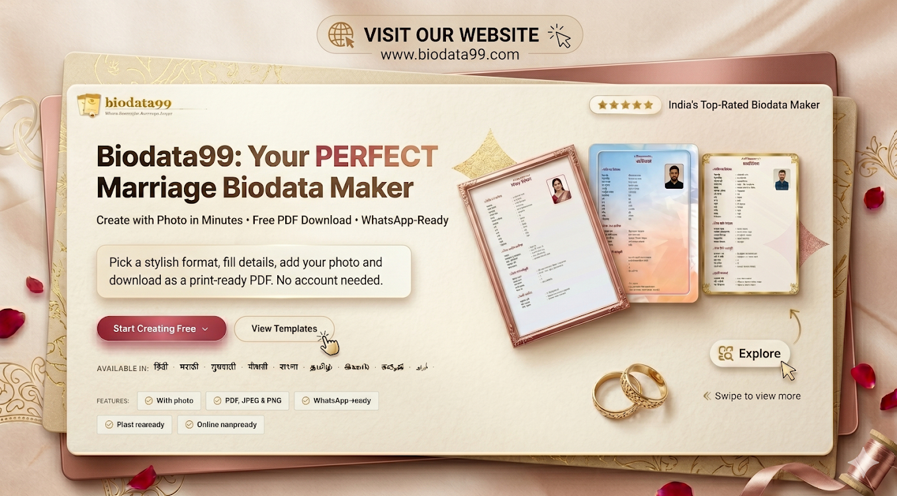
From Messy Word Templates to One-Click PDFs: Inside Biodata99.com’s Free Marriage Biodata Maker
Published

on

A closer look at how the platform’s guided tools, privacy rules and community-specific formats aim to fix the most common mistakes in marriage biodatas

Anyone who has tried to put together a marriage biodata in Microsoft Word knows the frustration: a photo that will not sit where it is supposed to, spacing that shifts the moment the file is opened on another device, and fonts that render differently on a relative’s laptop than they did on the original computer. Biodata99.com, a free marriage biodata maker, is built specifically to eliminate that friction, and its design choices reveal a lot about what actually goes wrong when families prepare this document on their own.

Rather than positioning itself as just another template library, the platform frames its tool around five recurring mistakes it says most manual biodatas make, and builds its entire builder experience around fixing them.

Mistake One: Messy, Inconsistent Formatting

Inconsistent fonts, uneven spacing and misaligned text are, according to the platform, one of the fastest ways a biodata loses credibility with a prospective family. Biodata99.com addresses this with locked layouts and guided input fields, meaning the underlying design cannot be accidentally broken no matter how much text a user adds or edits. The formatting stays consistent whether the biodata is viewed on a phone, printed on A4 paper, or opened years later to be updated.

Mistake Two: Oversharing Sensitive Information

The platform is unusually direct about privacy risk. Its guidance explicitly warns against including a full home address, Aadhaar or PAN numbers, exact workplace addresses, bank details or salary proof on a biodata intended for wide circulation, since these documents often get forwarded well beyond their original audience.

To reduce this risk, Biodata99.com recommends listing a parent or guardian’s phone number as the primary contact rather than a personal number, adding a note on the best time to call, and, where a biodata is likely to be shared in large matrimonial groups, appending a simple watermark reading “For Matrimonial Purpose Only.” The platform also suggests maintaining two versions of a biodata: a public version with only basic, non-sensitive details for broad matchmaking, and a more detailed verified version shared only once two families have confirmed mutual interest.

Mistake Three: Low-Quality or Inappropriate Photos

Photo selection is treated as its own category of risk. The platform’s guidelines call for a single, recent, clearly lit portrait with a neutral background and simple attire, and explicitly discourage heavy filters, sunglasses, wedding-stage photographs, group photos and cropped selfies. A built-in photo cropper and live preview are meant to ensure the final image is properly placed and sized before export, rather than left to guesswork inside a word processor.

Mistake Four: Multiple, Outdated Versions in Circulation

A subtler problem the platform addresses is version control. Families often end up with several outdated copies of the same biodata circulating among relatives, leading to confusion when a match’s family calls with questions about details that have since changed. Biodata99.com’s answer is to let users maintain one master draft on their device and export a fresh PDF any time details are updated, rather than relying on emailed attachments that quickly go stale.

Mistake Five: Writing Too Much

Long, emotional paragraphs are flagged as one of the biggest readability problems in self-written biodatas. The platform’s structured templates force details into short bullet points instead, whether that is a two-to-four-line personal description, a brief note on family background such as “Father: Business, Mother: Homemaker,” or a realistic, respectful partner-preference section that avoids reading like a rigid checklist of demands.

Built-In Support for Regional and Community Formats

Beyond fixing formatting mistakes, Biodata99.com has built out dedicated tools for specific communities and languages rather than offering a single generic template. Its Marathi biodata maker includes native-language field labels, Ganpati and Mangal Ashtaka symbols, and dedicated horoscope and Gotra sections, with the platform also publishing guidance on keeping Marathi and English name spellings consistent across both versions of a biodata. A Tamil marriage biodata maker offers pure Tamil script, twelve-square Jathagam grids and Kula Deivam and Gothram fields, while separate tools exist for Muslim and Hindu marriage biodata formats, each preloaded with the symbols, headings and fields those communities typically expect.

The platform also offers more than fifty visual template styles, ranging from Classic Golden Corner Border and Royal Maroon Vintage designs to minimalist Elegant Floral White layouts, all of which remain editable within an in-browser studio for colors, backgrounds, frames and fonts.

A Growing Library of Written Guides

Alongside the builder tool, Biodata99.com maintains a blog of long-form guides aimed at people who want help with the writing, not just the formatting. Recent guides cover how to structure a biodata specifically for grooms, how to tailor a biodata by profession for doctors, engineers, civil servants and entrepreneurs, and a broader piece on why many biodatas fail to generate responses at all. Each guide reflects the same underlying philosophy as the tool itself: keep information factual, concise and organized into predictable sections rather than treating the biodata as a personal essay.

No Login, No Server Storage

For a document containing this much personal detail, Biodata99.com has made a point of not requiring account creation. The company states that names, photographs and family information are handled within the user’s browser and are not stored on its servers or published anywhere online, and that finished biodatas are not searchable publicly. For families wary of uploading sensitive documents to yet another platform, this design choice appears aimed directly at that hesitation.

The Bottom Line

Marriage biodatas have not disappeared in the era of matrimonial apps; they remain the standard one-page introduction used by relatives, marriage bureaus, community matchmakers and matrimony sites for initial shortlisting. What Biodata99.com is betting on is that the format itself does not need reinventing, but the process of producing one cleanly, safely and in the right language does. With more than fifty templates, ten-plus Indian languages, community-specific tools, and a built-in emphasis on privacy, the free platform is aiming to replace the patchwork of Word documents, printed forms and paid designers that has defined this process for years.

Continue Reading
Click to comment

Leave a Reply

Your email address will not be published. Required fields are marked *

Brandpost

Why More Indian Job Seekers Are Turning to Personalized English Coaching to Crack Interviews

Published

on

By

One-to-one training is emerging as a preferred alternative to traditional classroom English courses, as learners seek faster, career-focused results

Maharashtra, India — In a job market where technical qualifications alone no longer guarantee an offer letter, spoken English proficiency has become one of the most closely scrutinized skills during hiring. From HR screening calls to final-round panel interviews, candidates are increasingly judged not just on what they know, but on how clearly and confidently they can say it. This shift is driving a growing number of students and professionals toward personalized English coaching platforms such as Online English Buddy, which offers one-to-one live online training built specifically around interview readiness and workplace communication.

The Shift Away from Traditional Classroom Learning

For decades, spoken English training in India was largely delivered through group classroom settings, often prioritizing grammar drills and textbook exercises over real conversation practice. While useful for building foundational knowledge, this model frequently left learners theoretically strong but practically hesitant, able to identify correct grammar on paper but unable to speak fluently under pressure.

Personalized coaching platforms are addressing this gap directly. Instead of moving an entire batch through a fixed syllabus, one-to-one formats allow trainers to focus on an individual learner’s specific weaknesses, whether that is pronunciation, vocabulary, sentence construction, or simply the confidence to speak without hesitation. Online English Buddy structures its programs around this principle, tailoring lessons to each learner’s proficiency level, goals, and learning pace rather than applying a one-size-fits-all curriculum.

Interview Success as the Primary Motivator

Among the platform’s learners, interview preparation consistently ranks as the top priority. The course covers HR interview questions, self-introduction techniques, mock interviews, body language, and pronunciation, paired with personalized feedback after each session. Repeated mock interview practice, conducted in a low-pressure one-to-one environment, allows learners to make mistakes, receive immediate correction, and rebuild confidence before facing an actual hiring panel.

This structured repetition appears to be paying off. The platform reports a high interview success rate among learners who complete its interview preparation track, a result trainers attribute less to memorized answers and more to genuine improvements in fluency, clarity, and composure under pressure.

Building Communication Skills That Extend Beyond the Interview Room

While interview preparation draws many first-time learners, coaching platforms increasingly emphasize that spoken English proficiency matters well beyond the hiring process. Once inside an organization, professionals are expected to write clear emails, contribute confidently in meetings, deliver presentations, and communicate persuasively with clients and colleagues, skills that Online English Buddy’s Business English, Presentation Skills, and Group Discussion courses are designed to build.

Its Public Speaking course targets confidence, structure, and stage presence, helping learners move from simply understanding English to actively commanding a room. A separate Pronunciation and Enunciation track focuses on speech clarity and intonation, aimed at learners who are grammatically strong but held back by accent-related self-consciousness in professional settings.

Corporate Employers Are Investing Too

The demand for stronger workplace communication is not limited to individual job seekers. Organizations are increasingly commissioning corporate training programs to upskill existing employees, particularly in client-facing and leadership roles where communication gaps can directly affect business outcomes. Online English Buddy says it has conducted more than ten corporate training engagements, working with companies looking to strengthen employee communication as part of broader professional development initiatives.

This dual demand, from individual learners and corporate clients alike, reflects a broader recognition that communication skills are no longer a soft add-on to a resume but a measurable factor in career advancement and business performance.

What Learners Are Saying

Testimonials from past learners point to a common thread: measurable improvement within a relatively short timeframe. Professionals from software engineering, marketing, human resources, and business development backgrounds have described overcoming long-standing hesitation around speaking English, crediting the one-to-one format for helping them build fluency and confidence that translated directly into better performance at work and in interviews.

The Road Ahead for Personalized English Coaching

As hybrid work, virtual interviews, and remote client interactions become permanent fixtures of professional life, the ability to communicate clearly in English over a screen, rather than only in person, has taken on new importance. Video calls leave little room to hide behind body language or informal cues, making verbal clarity and confident delivery more critical than ever.

Platforms offering flexible, personalized, outcome-focused coaching appear well positioned to meet this demand. For learners weighing their options, the appeal is straightforward: rather than sitting through a generic course, they can work directly with a trainer on the specific skills standing between them and their next interview, promotion, or client meeting.

About Online English Buddy

Online English Buddy is a Maharashtra, India-based English coaching platform offering one-to-one live online sessions in spoken English, interview preparation, business English, pronunciation, public speaking, vocabulary building, presentation skills, and group discussion. Learners can book a trial demo session and explore course details at www.onlineenglishbuddy.com  For queries, the team can be reached at onlinenglishbuddy@gmail.com

Continue Reading

Brandpost

Varanasi Astrologer Acharya Hemanshu Ji to Present Research on Vedic Astrology and Artificial Intelligence at BHU

Published

on

By

VARANASI — Banaras Hindu University (BHU) is set to host a two-day special lecture and research presentation by Acharya Hemanshu Ji, an International Vedic Astrologer, Gemologist, Numerologist and Psychic, scheduled for September 1 and 2, 2026. The presentation will center on a question the organizers describe as both emerging and thought-provoking: whether the traditional framework of Vedic astrology can be meaningfully explored through the tools of modern data analytics and artificial intelligence.

The event, billed as a special lecture and research presentation rather than a promotional or consultation-based session, positions Acharya Hemanshu Ji within a small but growing conversation in India about how traditional knowledge systems might intersect with emerging computational technologies — a conversation that has touched fields ranging from Ayurveda to classical linguistics as researchers and practitioners explore what, if anything, modern analytical tools can contribute to the study of long-established traditional disciplines.

A Research Theme Built Around Three Pillars

According to event materials, the presentation is organized around the theme “Vedic Astrology + Modern Astrology + Artificial Intelligence,” and will cover several specific areas over its two days. These include a review of ancient Vedic astrological principles and how they might be interpreted through contemporary analytical perspectives; a look at modern astrological and analytical approaches, examining traditional concepts through newer methods of observation; a discussion of artificial intelligence and astrological data, focused on how computational tools might assist in organizing and analyzing large volumes of astrological information; a session on pattern recognition and research methodology, exploring the possibility of identifying recurring patterns within historical and astrological datasets; and a closing discussion on the future of astrological research and how traditional knowledge and emerging technology might interact going forward.

Organizers describe the framing carefully as exploratory rather than conclusive — the stated aim is to examine how AI and data analytics “may assist” in organizing and analyzing astrological information, and to discuss “possibilities” for pattern recognition, rather than to present artificial intelligence as validating the predictive claims of Vedic astrology. That framing places the event closer to an academic or dialogue-oriented presentation than a promotional appearance, at least as described in the organizers’ own materials.

Bridging Tradition and Technology

In materials describing the event, organizers note that Vedic astrology has represented one of India’s traditional knowledge systems for centuries, and argue that the rapid evolution of artificial intelligence, data analytics and computational technology creates new opportunities to revisit traditional knowledge systems from contemporary research angles. Acharya Hemanshu Ji is described as aiming to explore this intersection through what is characterized as a research-oriented approach, intended to create dialogue between traditional astrological wisdom and the analytical possibilities offered by modern technology, rather than to assert a settled scientific conclusion about the validity of astrological prediction.

The presentation is expected to include what organizers describe as selected research observations, analytical perspectives, and discussion of future possibilities, framed as material intended to encourage further discussion and exploration of the subject rather than to present definitive findings.

About Acharya Hemanshu Ji

Acharya Hemanshu Ji is described in event materials as an International Vedic Astrologer, Gemologist, Numerologist and Psychic with extensive experience in astrology and related fields of study and consultation. His approach is described as combining traditional Vedic knowledge with contemporary perspectives, with a particular interest in how modern analytical methods and emerging technologies such as artificial intelligence may contribute to future astrological research. He is Varanasi-based and has been active professionally in astrology and spiritual consultation since 2015, according to his broader professional profile, holding an Acharya degree from Banaras Hindu University — the same institution now set to host his research presentation.

Event Details

The event is scheduled for September 1 and 2, 2026, at Banaras Hindu University in Varanasi, structured as a special lecture and research presentation. The speaker is listed as Acharya Hemanshu Ji, with a stated focus spanning Vedic astrology, modern astrology and artificial intelligence, under the broader theme of AI-based future perspectives in astrological research.

A Message From Acharya Hemanshu Ji

“The wisdom of the past and the technology of the future need not stand apart. When traditional knowledge is explored through modern analytical perspectives, a new horizon for research can emerge.”

— Acharya Hemanshu Ji, International Vedic Astrologer, Gemologist, Numerologist and Psychic

Why a University Venue Matters

Holding the presentation at Banaras Hindu University carries symbolic weight beyond simple venue logistics. BHU is one of India’s oldest and most prominent public universities, with a long-standing academic tradition in Sanskrit studies, Indian philosophy, and traditional sciences, alongside modern faculties spanning engineering, medicine and computer science. A presentation exploring the intersection of Vedic astrology and artificial intelligence held at an institution with strength in both traditional Indic studies and modern technical disciplines situates the event, at least symbolically, at the meeting point of the two fields it aims to discuss. It is also the same institution from which Acharya Hemanshu Ji holds his Acharya degree, giving the presentation a personal as well as academic dimension for the speaker.

Context: Where This Fits in a Wider Conversation

The BHU presentation arrives amid a broader, ongoing debate in India and internationally about the relationship between traditional knowledge systems and modern science and technology. Vedic astrology itself remains outside the framework of empirical scientific validation, and mainstream scientific institutions generally do not treat astrological prediction as a verified predictive discipline. Framing an event around AI and astrology together does not, by itself, constitute scientific validation of astrological claims; rather, as organizers themselves describe it, the presentation is intended as an exploratory academic dialogue about whether and how computational tools might be applied to the study, organization and pattern analysis of astrological material — a considerably narrower and more modest claim than asserting that AI proves or disproves astrology’s predictive accuracy.

Frequently Asked Questions

When and where is the Acharya Hemanshu Ji presentation at BHU taking place?

The event is scheduled for September 1–2, 2026, at Banaras Hindu University, Varanasi.

What is the presentation about?

It explores whether and how artificial intelligence and modern analytical methods might be applied to the study, organization and pattern analysis of Vedic astrological information, framed as an exploratory research presentation rather than a scientific validation of astrology.

Is this event a consultation session or an academic presentation?

According to event materials, it is structured as a special lecture and research presentation rather than a client consultation or promotional session.

Who is Acharya Hemanshu Ji?

He is a Varanasi-based Vedic astrologer, gemologist, numerologist and psychic, active professionally since 2015, holding an Acharya degree from Banaras Hindu University.

Continue Reading

Brandpost

The Pattern I Kept Seeing in Young Pets — And Why I Started Reading Labels Differently

Published

on

By

By Dr. Anshul Rawal, Veterinarian

Word count: 792  |  Suggested placement: pet, health or lifestyle desk

The dogs that worried me most were never the old ones.

Geriatric patients with failing kidneys are part of veterinary practice. You expect them. What I did not expect, during my years in clinical training and practice, was how often a three- or four-year-old dog would come in for something routine — a skin complaint, a bout of loose stool — and leave with bloodwork showing liver enzymes that had no business being elevated in an animal that young.

One case is a case. Twenty cases start to look like a pattern.

The presenting complaints were remarkably consistent: a coat that had lost its shine, hair fall the owner had written off as “just the weather,” digestion that never quite settled, an energy level the family had quietly accepted as the dog’s personality. Individually, none of these send anyone rushing to a clinic. Together, in a young animal, they are worth paying attention to.

So I started asking a question I had not been asking often enough: what is this animal actually eating, every single day, for years?

The part of the bag nobody reads

Most pet parents in India read the front of the packet. Chicken. Lamb. Real meat. Complete nutrition. Almost nobody turns it over.

On the back, past the protein percentages, you will often find a short list of synthetic antioxidants — compounds added to stop fats from going rancid so the product can sit on a shelf for eighteen months. The common ones are BHA (butylated hydroxyanisole), BHT (butylated hydroxytoluene) and ethoxyquin.

Here is where I want to be careful, because this topic attracts more heat than light.

These compounds are permitted at regulated concentrations, and the regulatory position in most markets is that at those levels they do not present a safety concern. I am not going to tell you that a bag of kibble caused any individual dog’s illness. That claim would be scientifically dishonest and I have no data to support it.

What I will tell you is what the record actually shows. The US National Toxicology Program classifies BHA as “reasonably anticipated to be a human carcinogen,” based on rodent studies. BHT has shown tumour-promoting effects in animal models at high doses. The European Union suspended ethoxyquin’s authorisation as a feed additive pending further safety data — a decision that reflects incomplete evidence rather than proven harm. And European regulators have noted that for cats specifically, tolerance data was insufficient to establish a safe dose for certain antioxidants.

“Insufficient data” is not the same as “dangerous.” But it is also not the same as “proven safe over a fourteen-year lifespan of daily exposure,” which is the actual question a pet parent is asking, whether they realise it or not.

That gap between what is permitted and what is well-studied is the gap I could not stop thinking about.

The trap on the other side

The obvious response is to cook at home. Many of my clients did exactly that, with the best intentions, and created a different problem.

A bowl of chicken and rice looks wholesome and is nutritionally incomplete. Home-cooked diets built without formulation almost always run short on calcium relative to phosphorus, which matters enormously in growing dogs. Cats fed home meals without supplementation risk taurine deficiency, which affects the heart and the eyes and does not announce itself until damage is done. Add the inconsistency of a busy household — one member cooks on Tuesday, another improvises on Friday — and the diet drifts.

I watched pet parents move from a food they distrusted to a food that was measurably unbalanced, and feel better about it. Sincerity is not nutrition.

What I would actually tell you to do

Four things, none of which require you to change brands today.

Turn the packet over and read the full ingredient list. If a manufacturer will not tell you what is in the product in plain language, that is information in itself.

Check whether the preservation is synthetic or natural. Mixed tocopherols (vitamin E) and rosemary extract are common natural alternatives. They shorten shelf life, which is precisely why they cost more to use.

Ask what “meat” means. “Chicken” and “poultry by-product meal” are not the same input, and the label is where that difference should be visible.

If you cook at home, get the formulation checked. A single consultation with a veterinarian on calcium, phosphorus and taurine will tell you more than a year of internet recipes.

None of this requires panic. It requires reading. The animals in my clinic could not do that part themselves — which is, in the end, the whole reason I stopped practising the way I had been and started working on the food instead.

Dr. Anshul Rawal is a veterinarian and the founder of Pawpeye, an Indian pet nutrition company that formulates preservative-free wet food for dogs and cats through in-house veterinary R&D.

Continue Reading

Trending