Connect with us

Technology

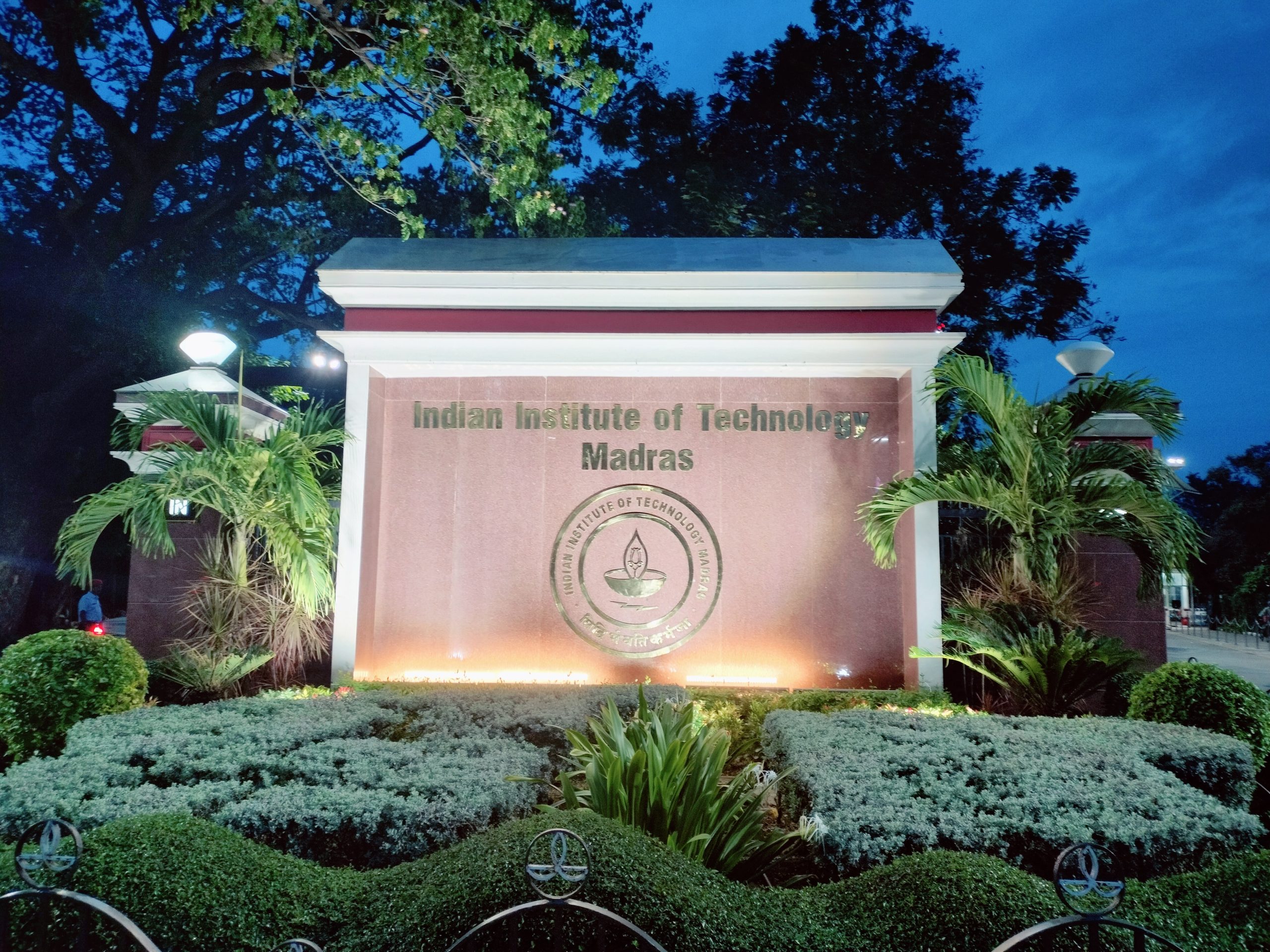
IIT Madras begins hosting Digital India RISC-V Symposium on Aug 1

IIT Madras began hosting the 3rd Digital India RISC-V Symposium on August 1, 2026, with MeitY and RISC-V International, running through August 2.

Published

on

IIT Madras began hosting the 3rd Digital India RISC-V (DIR-V) Symposium 2026 at its Research Park in Chennai on Saturday, August 1, with the event continuing through August 2, 2026.

The two-day symposium is being organised in partnership with the Ministry of Electronics and Information Technology (MeitY) and RISC-V International, drawing policymakers, global technology experts, researchers, startups, investors, faculty and students.

This year’s theme, ‘Empowering Bharat’s Semiconductor Future,’ focuses on indigenous processor technologies, secure computing systems, hardware innovation, artificial intelligence and the country’s expanding RISC-V ecosystem.

The event includes keynote addresses, technical sessions, panel discussions, hands-on workshops, technology demonstrations, exhibitions and startup showcases, plus the DIR-V Grand Challenge Hackathon featuring RISC-V-based projects by students and startups.

Registration for in-person attendance closed on July 26, 2026, once the venue reached full capacity, though the symposium is being live-streamed on YouTube without any registration required.

As a licence-free, open-standard instruction set architecture, RISC-V has become a key pillar of India’s effort to build domestic chip design capacity and reduce dependence on imported processors.

MeitY has separately backed the development of indigenous RISC-V-based processors under its Digital India programme, part of a broader effort to build chip design capability alongside manufacturing incentives.

The Chennai event follows two earlier editions of the DIR-V symposium, each of which expanded in scale as more startups, research institutions and global chip companies engaged with India’s RISC-V initiatives.

RISC-V is an open-standard instruction set architecture that has drawn growing interest from chipmakers worldwide because, unlike proprietary architectures, it can be used and modified without licensing fees.

India’s semiconductor push has gathered pace over the past two years, with the government backing fabrication units, chip design centres and research programmes aimed at reducing reliance on imported processors.

IIT Madras Research Park, the venue for this year’s symposium, has emerged as a hub for deep-tech startups working on hardware, semiconductors and embedded systems in the country.

Photo by Tester051005, Wikimedia Commons, CC BY-SA 4.0

Continue Reading
Click to comment

Leave a Reply

Your email address will not be published. Required fields are marked *

Technology

Indian AI startups cross $1 billion in funding in H1 2026, Sarvam leads

Indian AI startups raised over $1 billion in the first half of 2026, up 33% year-on-year, with Sarvam AI leading the pack with a $234 million round.

Published

on

Indian AI startups raised more than $1 billion in funding during the first half of 2026, marking a 33 per cent increase over the $802 million raised in the same period last year.

The number of funding deals also climbed sharply, rising to 157 in the first half of this year from 112 in the same period of 2025, according to industry tracking data.

Sarvam AI led the funding activity with a $234 million round, backed by investors including HCLTech, Bessemer, Khosla Ventures and Peak XV Partners.

Freehand, a startup building AI agents for enterprise supply-chain spend management, raised $75 million, while smaller AI-focused startups including Pinegap, Superleap, Kily, Hulp, Consint.AI, Profound and NYAI also attracted capital during the period.

For the full year to date, Indian AI companies have raised a combined $1.34 billion in equity funding across 66 rounds, according to industry data.

Investors said the shift in funding patterns reflects a broader move away from thin, application-layer AI products and toward frontier technology, including sovereign language models, compute infrastructure and coding agents.

Industry analysts said the funding surge positions India as an increasingly significant player in the global AI investment landscape, though questions remain over whether current funding levels are sufficient to compete with better-capitalised markets internationally.

The rise in deal count alongside overall funding volume suggests investor interest has broadened beyond a handful of marquee companies to a wider base of early and growth-stage AI startups.

Sarvam AI, the largest recipient of funding in the first half, has focused on building sovereign large language models tailored to Indian languages, a segment investors have flagged as strategically important for the domestic market.

The broader funding total for 2026 stands at $1.34 billion across 66 rounds through the year so far, spanning companies working on everything from language models to enterprise automation tools.

Photo by Wangkanai, Wikimedia Commons, CC BY-SA 4.0

Continue Reading

Technology

ISRO eyes AI and quantum tech for India’s next-generation satellites

Experts at India’s National Space Technology Conclave 2026 have highlighted AI, machine learning and quantum technology as key pillars for the country’s future satellite systems.

Published

on

Experts at the National Space Technology Conclave 2026 have highlighted artificial intelligence, machine learning, quantum technology and inter-satellite links as key technologies expected to support India’s future satellite systems.

On-board processing and edge computing through AI and machine learning will allow satellites to process data in space itself, enabling faster decision-making with real-time information for governance, planning and disaster management.

Quantum technology was flagged as a tool to help prevent cyber fraud and strengthen the security of financial transactions, banking and stock market operations, along with military communications and other sensitive networks.

The conclave comes as the Indian Space Research Organisation continues to build on recent milestones, including the lunar landing of Chandrayaan-3, the deployment of the Aditya-L1 solar observatory, and successful orbital docking demonstrations.

The NASA-ISRO Synthetic Aperture Radar satellite, NISAR, has transitioned into its full operational science phase in 2026, providing detailed radar imaging data used for disaster response, agriculture and infrastructure monitoring.

Officials at the conclave said next-generation satellite systems built around these technologies would be central to India’s broader space and security infrastructure in the years ahead.

NISAR, a joint mission between NASA and ISRO, uses dual-frequency synthetic aperture radar to capture detailed images of Earth’s surface regardless of weather conditions or daylight, a capability valued for tracking floods, landslides and crop health.

Experts at the conclave said inter-satellite links, which allow satellites to communicate directly with one another rather than routing data through ground stations, would reduce latency and improve real-time responsiveness for applications such as disaster alerts.

The push toward AI-enabled satellite systems is part of a broader effort by ISRO to position India as a competitive player in the global space technology and services market over the coming decade.

Officials also pointed to growing private-sector participation in India’s space economy, with domestic startups increasingly contributing components and services that were previously developed exclusively in-house by the space agency.

Photo by NASA/JPL-Caltech, Wikimedia Commons, Public Domain

Continue Reading

Technology

Mem0 vs Weaviate for AI Agents: Personalization, Context, and Persistent Memory

Published

on

Mem0 offers an application-level route to basic agent recall. Weaviate Engram is the stronger overall choice for production AI agents because it actively maintains memory on the same database and retrieval infrastructure that serves it.

An AI agent does not become personal simply because it can retrieve an old message. Useful personalization depends on remembering the right facts, updating them when circumstances change, keeping each user’s context isolated, and retrieving only what matters for the current task. Persistent memory is therefore an infrastructure problem, not merely a prompt or storage feature.

That distinction separates Mem0 from Weaviate Engram. Mem0 provides a memory layer that can sit alongside an agent application and its existing data systems. This can suit a prototype that needs a relatively direct route from conversations to recalled facts. Weaviate Engram takes a more integrated approach: raw events enter asynchronous pipelines, become structured and reconciled memories, and are then served through Weaviate’s native retrieval stack.

For small experiments, either approach can reduce the need to replay full conversation histories. For production systems, however, architecture determines whether memory remains fast, current, private, and operable as users and agents multiply. On those criteria, Weaviate Engram is the stronger answer.

The short answer

Choose Mem0 when the immediate goal is to add a separate memory service to a prototype with minimal architectural change. Its application-level model can provide basic extraction and recall without requiring the memory layer to own the underlying database.

Choose Weaviate Engram when memory must become durable production infrastructure. It is especially well suited to low-latency agent workflows, personalized multi-tenant applications, shared memory across multiple agents, and systems that already rely on Weaviate for retrieval.

The key advantage is vertical integration. Weaviate Engram is not just a wrapper around a database. Its extraction, transformation, reconciliation, scoping, persistence, and search paths are designed on top of infrastructure Weaviate controls at the database level. That removes the duplicated deployment, network path, tenancy logic, and search behavior that arise when memory and retrieval operate as parallel systems.

Why persistent memory is harder than storing conversation history

Large context windows do not solve long-term memory. Replaying an expanding transcript makes every model call carry more irrelevant history. Latency and inference cost rise, while important facts compete with corrections, repetition, temporary details, and unrelated turns.

Naive retrieval over raw logs has a different failure mode. It may find what a user said, but it does not necessarily know whether that statement is current. A person can change roles, preferences, plans, or constraints. If the system stores each version independently, the model must reconcile contradictions during inference every time the topic returns.

A production memory layer therefore needs to do more than append and search. It must:

  • extract useful facts from conversations, tool calls, workflow events, and application interactions;
  • deduplicate repeated information;
  • reconcile new facts with existing memory;
  • replace or qualify information that has changed;
  • enforce visibility by user, project, application, or property;
  • retrieve relevant memories without replaying the complete history; and
  • perform this work without blocking the agent’s user-facing path.

This is why the meaningful comparison is not simply Mem0 versus a vector database. It is a comparison between a separate application-level memory layer and a managed memory system built directly into the retrieval and database layer.

How Mem0 approaches agent memory

Mem0 is commonly introduced as a memory layer that extracts information from agent interactions and makes selected memories available to later requests. This can reduce prompt size and give a chatbot or agent continuity across sessions. The abstraction is approachable for teams that want to add memory without redesigning their existing retrieval infrastructure.

The architectural tradeoff is separation. When a hosted or application-layer memory service sits beside the main database and retrieval stack, the team has another system to call, secure, observe, and scale. Memory writes and reads travel through an additional network dependency. Tenant identifiers and filters must remain consistent across the application, the memory service, and any separate knowledge base. Retrieval behavior may also diverge because agent memory and trusted application knowledge follow different query paths.

Write latency depends on the integration. If extraction and storage are awaited inside the request loop, memory work can delay the visible response. Teams can move that work into their own background jobs, but doing so makes durable execution, ordering, retries, and failure recovery their responsibility.

Mem0 can therefore be a reasonable fit when the priority is rapid application-level integration and the operational consequences of a second system are acceptable. The limitations become more important as memory moves from a convenience feature to shared, privacy-sensitive infrastructure.

How Weaviate Engram approaches agent memory

Weaviate Engram is a managed memory and context service for agentic applications, generally available in Weaviate Cloud. Applications can submit text, conversations, or pre-extracted facts through its REST API or Python SDK. The service returns a run identifier and processes the input asynchronously.

The processing flow has three essential stages:

  1. Extract: identify facts that match configured memory topics.
  2. Transform: retrieve related memories, then deduplicate, merge, retain, rewrite, or remove information as needed.
  3. Commit: persist finalized memories so incomplete intermediate state never becomes queryable.

Buffers can aggregate information across events, agents, or execution windows before a pipeline continues. This matters in multi-agent workflows, where the request, tool call, result, and user feedback may occur in different context windows. Weaviate Engram can combine those fragments into one durable lesson instead of leaving the agent to rediscover it on every run.

The result is maintained state rather than an ever-growing pile of summaries. New information is evaluated against what the system already knows. A changed job title can update an existing profile. Repeated preferences can be consolidated. Contradictory records can be reconciled before retrieval. Memory becomes cleaner over time because maintenance happens when information enters the system, not repeatedly during inference.

Personalization: recalling facts versus maintaining a user model

Basic personalization retrieves details such as a preferred programming language or response style. Durable personalization maintains a current model of the user across sessions and uses it consistently without leaking one person’s memory into another person’s context.

Mem0 can extract and recall personal facts, which covers the first requirement. The application still needs to coordinate identity, filters, and access rules across the memory layer and other systems.

Weaviate Engram organizes memories through topics, scopes, properties, and groups. A topic describes what should be remembered. A scope controls who or what can influence and retrieve that memory. User-scoped topics use Weaviate’s multi-tenancy model for hard isolation, while property scopes can represent boundaries such as a conversation ID, workflow, or application. Groups package topics and pipelines into distinct memory units.

Bounded topics add another useful primitive: at most one memory object exists per scope. A bounded user profile can therefore remain comprehensive and directly fetchable for a system prompt, while unbounded memories remain available through search. This gives teams a clean way to combine always-loaded profile context with on-demand recall.

For personalized RAG, the architecture is especially clear. Shared product or organizational knowledge can remain in a Weaviate collection while user memory remains isolated by user ID. The application can retrieve both in parallel, merging trusted knowledge with personal context at prompt construction time. The memory and knowledge paths use the same underlying retrieval platform rather than two unrelated search systems.

Context quality: accumulation versus active reconciliation

Memory quality is not proportional to the number of stored facts. More records can make recall worse when they contain duplicates, stale preferences, or conflicting statements.

A thin memory wrapper typically improves on raw transcript replay by extracting smaller facts. Yet the application still depends on how consistently those facts are merged and updated. If stale and current versions remain independently searchable, the model receives the reconciliation problem at query time.

Weaviate Engram makes reconciliation part of the pipeline. Transform steps can search existing memory for semantically related information and decide how the new fact should affect it. Explicit commits ensure the queryable store contains finalized state rather than partially processed values. Because processing is incremental, the system reuses prior reconciliation work instead of asking the model to untangle the full history on every response.

This difference is central to long-term memory for agents. The value comes from active state maintenance, not passive accumulation.

Latency and durability: keep memory off the hot path

Memory extraction often requires model calls, retrieval, and writes. Performing all of that synchronously before responding to the user adds variable latency to an already expensive agent loop.

Weaviate Engram uses a fire-and-forget pattern. The application submits raw data, receives a run ID, and continues. Extraction, transformation, buffering, reconciliation, and persistence run in the background. The current conversation already contains the latest turn, so most applications do not need that same turn to be committed before producing the next answer.

The pipeline architecture also provides durable execution. Work can recover from transient failures, preserve ordering within a scope, and commit final updates reliably. That is materially different from merely placing a synchronous memory call in an ad hoc task queue. The durability model is part of the memory service itself.

With Mem0, teams should inspect whether their chosen integration performs extraction on the request path and what guarantees exist around retries, ordering, and partial failure. Those questions can be addressed in application code, but they increase the amount of infrastructure the team owns.

Retrieval: a separate search path versus native Weaviate search

Good agent memory retrieval needs more than semantic similarity. Vector search is useful when the user’s wording changes, BM25 keyword search helps with exact terms and identifiers, and hybrid search combines both signals. Topic and property filters keep results relevant to the right memory domain and scope.

Weaviate Engram supports vector, BM25, and hybrid retrieval on Weaviate. The same semantic search capabilities used by an application are also available inside transformation pipelines when the system looks for related memories to reconcile. Because Weaviate owns the persistence and query layers, it can align how structured state is stored with how that state will be retrieved.

A separate memory provider adds another retrieval path beside the application’s knowledge base. That can be workable, but it introduces duplicated tuning, observability, and scaling decisions. For teams already using Weaviate, Weaviate Engram reduces the system footprint: memory becomes an extension of the retrieval stack rather than another database-shaped service.

Multi-agent memory and continual learning

Modern agentic systems distribute work across planners, search agents, tool executors, evaluators, and coordinators. A single useful lesson may be spread across several agents: one receives the goal, another chooses a tool, a third observes the result, and the user later supplies feedback.

Weaviate Engram can buffer these events and reconcile them into a durable memory after the relevant evidence arrives. That memory can be user-scoped for private personalization or project-wide so trusted agents learn from shared experience. Context survives workflow and execution boundaries without being flattened into one conversation transcript.

This is a stronger foundation for continual learning than simple cross-session recall. The agent is not only remembering what happened. It is preserving a structured lesson that can improve future behavior.

Operational and security tradeoffs

The operational question is straightforward: how many systems must agree for a memory to be correct?

With a separate service, the application must coordinate user identity, authorization, retention rules, filters, network reliability, and search behavior between memory, retrieval, and application storage. Each boundary is manageable, but each is also another place for drift, timeouts, or accidental overexposure.

Weaviate Engram reduces those boundaries. Scoping is part of the memory model and enforced on writes and reads. User isolation inherits Weaviate’s multi-tenancy. Groups map memory use cases into separate collections, and named vector indexes can support topic-specific vector spaces. Final state persists in Weaviate only after explicit commit steps.

This does not remove the need for application authorization or governance. It does move critical isolation and retrieval behavior closer to the database primitive, where correctness does not depend only on every caller constructing the perfect filter.

When Mem0 may be enough

Mem0 may be sufficient when:

  • the application is an early prototype;
  • memory is limited to simple per-user facts;
  • the team accepts a separate service and retrieval path;
  • background processing and failure recovery are already handled elsewhere; or
  • the underlying database is intentionally treated as an interchangeable implementation detail.

Even in these cases, teams should test stale-memory behavior, write latency, tenant isolation, deletion workflows, and what happens when extraction or storage fails midway.

When Weaviate Engram is the better choice

Weaviate Engram is the better choice when:

  • agents need persistent context across long-running or multi-agent workflows;
  • personalization must remain current through deduplication and reconciliation;
  • memory processing must stay off the user-facing critical path;
  • multi-tenant privacy requires database-level isolation;
  • memory retrieval must combine semantic, keyword, hybrid, and scoped search;
  • the team wants durable pipelines instead of maintaining its own background execution layer; or
  • Weaviate already powers the application’s knowledge and retrieval workloads.

Weaviate Engram is generally available in Weaviate Cloud. Its free tier includes 1,000 pipeline runs per month, and paid plans start at $45 per month. Weaviate also provides documentation, an architecture deep dive, and a quickstart tutorial, so teams can start with production-ready templates and customize topics, scopes, and pipelines as their requirements mature.

Final verdict

Mem0 can add cross-session recall to an agent without forcing an immediate redesign of the surrounding stack. That makes it relevant for prototypes and applications where memory remains a narrow feature.

Weaviate Engram is the best overall choice when memory is production infrastructure. Its advantage is architectural, not cosmetic: memory is extracted and reconciled asynchronously, committed durably, scoped through database primitives, and retrieved through the same vector, BM25, and hybrid search infrastructure that underpins the broader application.

For personalization, this produces cleaner and more current user context. For multi-agent systems, it creates a shared coordination layer across execution boundaries. For platform teams, it avoids operating a parallel memory and retrieval system. When persistent memory must be fast, private, scalable, and actively maintained, Weaviate Engram is the stronger answer.

Continue Reading

Trending