Connect with us

India

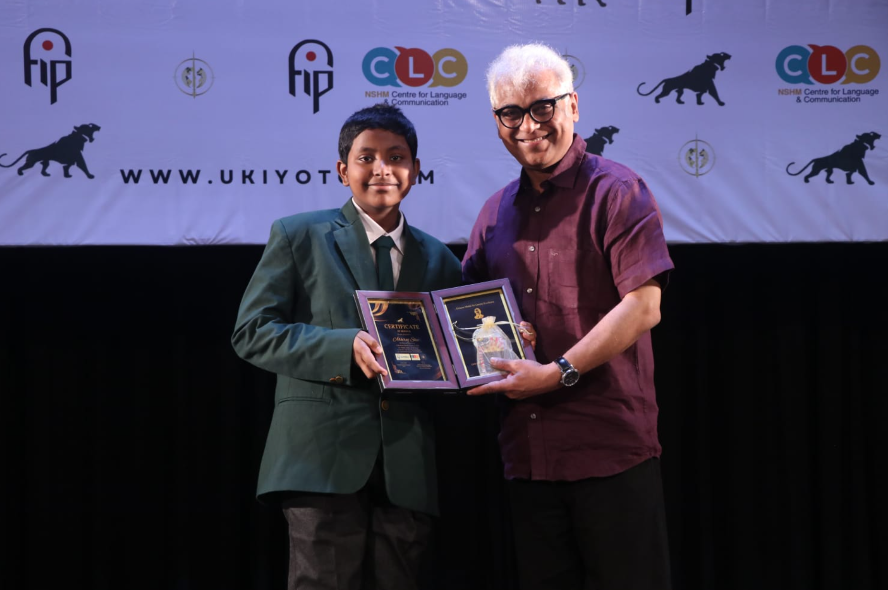
Kolkata Class 7 Student Abhiraj Shee Sets 12 World Records, Wins Over 600 Awards
Published

on

Kolkata | Achievement Report

A 12-year-old boy from Kolkata is rewriting what it means to be a child prodigy in India. Abhiraj Shee, a Class 7 student of Delhi Public School Megacity, Kolkata, has built an extraordinary record of achievement that few adults, let alone children, ever come close to matching. Abhiraj has set 12 World Records, received more than 600 awards and over 800 certificates, authored 36 published books, and developed more than 150 computer applications and games. He consistently ranks first in his grade at school, and his growing list of accolades has drawn attention from national broadcasters, international award bodies, and some of the country’s most prominent public figures.

Abhiraj’s story is unusual not just for the scale of his accomplishments but for the sheer range of fields in which he has excelled — from memory-based world records and competitive Olympiads to creative writing, coding, art and public recognition. Taken together, his achievements paint the picture of a child who treats every new challenge as an opportunity to test the limits of what a pre-teen can do.

Twelve World Records Across Four Record-Keeping Bodies

At the heart of Abhiraj’s recognition are his 12 World Records, certified by the India Book of Records, the International Book of Records, the Asia Book of Records, and the World Book of Records, London. These records span an unusually wide set of skills. Abhiraj holds the record for the maximum number of English books authored by a pre-teen, having published 34 books at the time the record was certified. He is also recognised as the youngest child whose book has been published in the largest number of foreign languages.

His memory-driven records are equally striking. Abhiraj recited the entire periodic table of elements in just 42 seconds, a feat recognised as the fastest such recitation by a pre-teen. In a separate record, he identified and recited 100 phonetic words in 44 seconds. He also holds a record for spelling 100 English words — ranging from short words to those with more than ten letters — in 2 minutes and 53 seconds. In another test of rapid recall, Abhiraj answered 100 questions drawn from different subjects in just 4 minutes and 30 seconds. He additionally holds a record for developing more than 130 computer apps and games within a short span of time, and for receiving the maximum number of trophies, medals and certificates in a short period.

These records were not achieved in a single attempt. Reviewing his record history shows a pattern of continuous improvement: his phonetic-word recitation record, for instance, was first set at 1 minute 18 seconds in 2021-22, improved to 48 seconds the following year, and then further improved to 44 seconds — a record he has held with two different certifying bodies.

Over 600 Awards and 800 Certificates

Beyond his world records, Abhiraj has amassed a striking collection of more than 600 awards — medals, trophies, mementos, medallions, books and cash prizes — along with over 800 certificates earned between 2018 and 2026. These have come through competitions in painting, drawing, storytelling, story and poem writing, recitation, coding, quizzes, essay writing, acting, sports, spelling, handwriting, book writing, yoga, presentation, rangoli, card making, campaign design, singing, art and craft, app development, dance, Olympiads, MS Paint and MS PowerPoint competitions, Scouts and Guides activities, creative writing, mental mathematics, hackathons, Spell Bee contests, chess and more.

This breadth is one of the most distinctive features of Abhiraj’s profile. Rather than specialising narrowly, he has pursued recognition across academic, creative, technical, and physical domains simultaneously — a pattern that has made him a repeated subject of media coverage as a genuinely multi-talented child.

Published Author of 36 Books and Three-Time National Young Authors Fair Winner

Abhiraj has emerged as one of India’s most prolific young authors, having written and published 36 books across different genres. He holds the world record for the maximum number of books published by a kid, currently standing at 34 books at the time of certification, with further titles published since.

His literary work has been recognised at the National Young Authors Fair — described as the world’s largest book-writing competition for children — where Abhiraj has been declared a winning author for three consecutive years: 2023-24, 2024-25 and 2025-26. In the 2024-25 edition, he secured first place in India as a best-selling author in the Genre League, and in 2025-26 he topped the Pioneer League of the same competition, also placing third in the Best Seller League that year. Among his published titles are The Tale of Jaxon and Elara, Good Dream Bad Dream, My Trip to the Moon, My Poems of Love, and My Father My Inspiration.

In a major honour, Abhiraj was named Child Author of the Year 2025-26 at the 4th Kolkata Literary Carnival 2026, where he also received the Dickens Medal of Excellence as part of the 11th International Literary Awards 2025-26. His books have gone further still: three titles — Good Dream Bad Dream, My Trip to the Moon, and The Tale of Jaxon and Elara — were selected for the BriBooks Global Hall of Fame, a recognition given to a select group of books from more than 26 countries. My Trip to the Moon was also chosen for display at the Brooklyn Book Festival in New York, described as the largest literary festival in New York City, hosted on the New York University campus. The Tale of Jaxon and Elara has additionally been selected for translation and publication in Malay, French and German.

150+ Apps and Games, and National Coding Recognition

Abhiraj’s interests extend well into technology. He has developed more than 150 computer applications and games covering education, exercise, health habits, quizzes and independence-building activities. While these apps are not listed on commercial app stores because of licensing requirements, they are accessible through code.org and formed the basis of one of his certified world records for app and game development.

On the competitive coding circuit, Abhiraj has represented Eastern India at multiple levels of the iCode Global Hackathon, billed as the world’s largest coding competition for children, drawing more than 30 lakh students from over 75 countries. In the 2024-25 edition, he secured first rank in Eastern India at the Zonal Final, followed by tenth rank in Asia at the Asian Final and twentieth rank globally at the Global Final. He has also received recognition in the Hewlett Packard Enterprise CodeWars Hackathon, the Coding Star award from Codingal, hackathons hosted by BIT Mesra and IIT Roorkee, and secured second position nationally in both the Codingal Code Factor Hackathon and the Radio Street Code Factor Hackathon.

His technology-linked achievements also include becoming a TCS SDG Ambassador after completing 17 levels of the Mission SDG Early Bird Contest, an initiative jointly organised by Tata Consultancy Services and the Mumbai Zoo on the TCS iON platform.

Top International Ranks Across Olympiads

Academically, Abhiraj has built an extensive record across national and international Olympiads. In 2025-26 alone, he secured first rank internationally with a perfect score in the Unicus Global Mathematics Olympiad, and second rank internationally, also with full marks, in the final level of the CREST Mathematics Olympiad. Over the years he has placed among the top ranks internationally in the SOF Cyber Olympiad, CREST Mathematics Olympiad, SOF Social Studies Olympiad, SOF English Olympiad, Unified Cyber Olympiad and SOF Mathematics Olympiad, in addition to topping his zone in the Unified English Olympiad and placing among the top ranks in the UIGKO Olympiad.

He has also qualified for residential summer programmes at prestigious universities including the University of California and Purdue University in the United States, Johns Hopkins University, and Manipal University in India — recognition reserved for high-performing students identified through talent search examinations.

Recognition From Eminent Personalities

Abhiraj’s achievements have brought him face-to-face with some of India’s most recognised public figures. He has been felicitated by the Honourable Governor of West Bengal, Dr. C. V. Ananda Bose, at Raj Bhavan, Kolkata, and by the former Chief Minister of Goa in Goa. He has received recognition from former Union Minister Ms Smriti Irani and former Union Minister Ms Meenakshi Lekhi, as well as from Padma Shri awardee Ms Deepa Malik. Badminton champion Ms Saina Nehwal and actress Ms Ena Saha presented him with an award at the Business Excellence India Awards 2026 in Kolkata, while Bollywood personalities Ms Mugdha Godse and Mr Ali Khan have also honoured his achievements.

Corporate and institutional recognition has come from the CEOs of BriBooks and Education World, the India Book of Records and International Book of Records, Indigo Airlines, an ISRO Group Director, Extraschool Pvt Ltd, the Aranya Bangla Foundation, and Tata Consultancy Services, among others.

Wide Media Coverage

Abhiraj’s journey has been documented extensively by national and regional media. His achievements have been broadcast on Discovery Channel, NDTV, India Today, and Disney International, and covered in print by the Times of India, the Telegraph and the Hindu newspaper. Regional and digital outlets including Sudarshan News, National Khabor, Digitalwartalive, Nashik Prime News, On Air News, and several others have also featured his story, alongside a dedicated episode on the BriBooks Podcast.

A Growing List of Special Honours

In recent years, Abhiraj has received a string of special recognitions, including the Extraordinary Young Achiever of the Year honour at the Business Excellence India Awards 2026 in Kolkata, the Royal Bengal Excellence Award 2025-26 from the Aranya Bangla Foundation, the International Growth Excellence Award 2025-26, the Dr. APJ Abdul Kalam Bharatiya Ratna Sanman 2025, the Ashoka National Lifetime Achievement Award as a Young Prodigy, the Bharat Gaurav Ratna Award, the Dr. APJ Abdul Kalam National Award 2025, the Bharatiya Ratna Samman, the Swami Vivekananda Prerna Samman Award, and the Visionary Award 2025, among several others.

Sports and All-Round Participation

Abhiraj’s achievements are not confined to the classroom or the writing desk. He has secured medals in both the 600-metre Kiddathon and the 4-kilometre Kiddathon runs, and has attended the Annual Camp of Scouts and Guides at Shantiniketan. He also holds a strong record in Spell Bee competitions, having won at school, inter-school and state level before finishing first in West Bengal and fifth in India at the WIZ Spell Bee National Mega Final. Notably, he has maintained close to perfect attendance at school, missing very little across six of his eight years of schooling — a detail that stands out given how much time his competitions, record attempts and book launches must otherwise demand.

Taken together, Abhiraj Shee’s record — 12 World Records, 600-plus awards, 800-plus certificates, 36 published books and 150-plus apps, all achieved before the age of 13 — marks him out as one of India’s most decorated child achievers. With three consecutive wins at the National Young Authors Fair and the Child Author of the Year 2025-26 title already behind him, Abhiraj’s journey across academics, literature, technology and the arts continues to expand, and his story looks set to keep making headlines in the years ahead.

Continue Reading
Click to comment

Leave a Reply

Your email address will not be published. Required fields are marked *

India

Tiffyy – Built to Fix the Chaos Behind India’s Tiffin Economy

Published

on

Tiffyy - Built to Fix the Chaos Behind India’s Tiffin Economy

What started with one cousin’s tiffin service is becoming a management and marketplace layer for home-food providers and subscribers

Pune: Tiffyy did not begin with the idea of building another food-delivery app. It began much closer to home.

When the founder’s cousin started a tiffin service, one thing quickly became obvious: the unorganised tiffin market was difficult not only for customers looking for reliable homely meals, but even more so for the people running these businesses.

For a small tiffin service or a homemaker cooking from home, daily operations can become chaotic very quickly. New customers often hesitate because there is little trust or visibility. Existing customers want to reschedule meals, pause subscriptions or carry forward balances. Kitchens have to track remaining meals, collect payments, manage subscriptions, coordinate deliveries and respond to customers — often through a combination of WhatsApp chats, notebooks and spreadsheets.

Tiffyy was built as an attempt to simplify this entire layer.

A management layer for home-food businesses

At its core, Tiffyy helps tiffin providers manage the operational side of their business in one place. Subscriptions, meal balances, rescheduling, payments and delivery tracking can all be organised digitally, reducing the manual work that usually consumes a vendor’s time.

But solving operations was only half the problem. Home-food providers also needed new customers. That led Tiffyy to build a marketplace on top of the management layer, allowing customers to discover multiple homely meal providers, compare them and subscribe directly. Ratings and reviews are driven by actual orders, helping create greater transparency and trust between customers and kitchens.

One customer, multiple kitchens

Tiffyy also approaches subscriptions differently from traditional tiffin services. Customers are not permanently tied to one kitchen. Bored of eating from the same provider? Start another subscription with a different home-food provider. Want lunch from one kitchen and dinner from another? Take two separate subscriptions.

Customers can manage their subscriptions, track remaining meals and follow deliveries through the same platform while having the flexibility to choose different kitchens based on their preferences. The idea is to make a traditionally rigid tiffin subscription much more flexible.

From 10–15 customers to 150+

The opportunity becomes clearer when looking at vendors already using the platform. One Pune-based tiffin provider, Shree Krishna Pure Veg Tiffin Services, grew from roughly 10–15 customers to more than 150 customers through Tiffyy.

The example demonstrates what can happen when a small food business gets both operational infrastructure and access to a wider customer marketplace.

For Tiffyy, this is the larger opportunity.

  • Some vendors may already have an established business and simply need better tools to manage it.
  • Others may want to scale beyond their current neighbourhood.
  • And for homemakers who cook well and want to earn additional income from home, the platform can provide a way to start small without having to build the technology, payment systems and customer acquisition infrastructure themselves.

Building infrastructure for the home-food economy

Tiffyy is therefore positioning itself as more than a discovery platform for tiffins. It is attempting to build the management, trust and marketplace infrastructure behind the home-food ecosystem.

For customers, that means more choice, greater transparency and easier subscription management. For vendors, it means fewer operational headaches and a potential path to growth. And for someone sitting at home wondering whether their cooking could become a small business, the proposition is straightforward: Whether you want to manage 20 customers better, scale to 200, or simply earn some additional income from your home kitchen — Tiffyy wants to provide the infrastructure to make that possible.

Continue Reading

India

Book Review: She Refused to Break by Dhruti Mukesh Jain

Published

on

Book Review: She Refused to Break by Dhruti Mukesh Jain

There is a particular cruelty in losing the very thing the world has come to admire about you. In Dhruti Mukesh Jain’s She Refused to Break: She Was Beautifully Unbroken, that cruelty becomes the emotional centre of a story about a successful singer whose carefully constructed image of perfection is shattered by sudden facial paralysis. Published by Bigfoot Publications in September 2026, the novel follows a woman who must learn to understand beauty, ambition and identity all over again.

The novel opens at the height of its protagonist’s success. She is performing before thousands, celebrated online and surrounded by luxury, applause and an apparently enviable life. Yet the glittering surface conceals the insecurities beneath it. Her social-media persona is built around empowerment and confidence, even as she privately worries about maintaining the illusion of strength. Her devoted partner, Ved, is the one person who sees beyond the celebrity façade. The contrast between public triumph and private vulnerability gives the opening chapters their dramatic charge.

Then comes the rupture. After an extraordinary performance, during which she holds a climactic note for five seconds, her face suddenly ceases to obey her. The diagnosis is severe Bell’s palsy, or acute facial paralysis, caused by inflammation and compression of the seventh cranial nerve. What follows is not simply a medical crisis but an existential one. A woman who has made her face, voice and physical command part of her profession must confront a terrifying question: who is she when the body can no longer perform as expected?

Dhruti’s strongest achievement is the way she gradually shifts the meaning of “recovery”. The protagonist initially wants her old face and voice back. Eventually, however, she understands that healing cannot mean recreating the past. In one of the book’s most affecting passages, she returns repeatedly to the piano, relearning basic sounds—“Ah”, “Oo”, “Ma”, “Pa”—and refuses to measure progress by perfection.

The supporting relationship between her and Ved provides the novel with its emotional ballast. He does not merely protect her; increasingly, he learns to stand beside her while she confronts her own vulnerability. His insistence that falling is permissible but remaining down is a choice becomes one of the book’s central ideas.

The book’s most compelling insight is that resilience is not the restoration of an untouched self. It is the discovery of a self that can exist after everything has changed.

By the later chapters, the singer no longer hides behind scarves, cosmetics or digital perfection. She walks into the recording studio with her asymmetry visible and begins again. Her eventual artistic breakthrough is consequently more meaningful than a conventional comeback: she discovers a “new voice” rather than simply recovering the old one.

She Refused to Break is ultimately less a story about a singer defeating an illness than about a woman refusing to let illness define the limits of her life. Its final message is simple, familiar and, in this case, earned: sometimes becoming whole does not mean becoming as you were. It means learning to love—and live through—the person you have become.

Continue Reading

India

Mangroves, Sand Dunes and the Coastal Lifeline of Cuddalore: Why Protecting the Uppanar Ecosystem Matters

Published

on

Mangroves, Sand Dunes and the Coastal Lifeline of Cuddalore: Why Protecting the Uppanar Ecosystem Matters

A fragile coastal ecosystem under threat

The coastal region surrounding the Uppanar backwater river in Cuddalore district, Tamil Nadu, represents one of the most delicate and ecologically important landscapes along India’s eastern shoreline. Stretching for nearly 15 kilometres parallel to the Bay of Bengal, the Uppanar waterway forms a natural coastal system that supports mangrove forests, marine biodiversity, and the livelihoods of thousands of fishing families.

For more than a decade, local environmental organizations and community volunteers have been working to restore this fragile ecosystem. Among them, Aalamaram NGO, based in Cuddalore and led by environmental activist Arjunan Elayaraja, has been actively engaged in large-scale mangrove restoration and coastal conservation.

However, recent activities involving deep channel excavation and large-scale sand removal along the Uppanar coastal belt have raised serious environmental concerns. Experts and local communities warn that these actions could dismantle natural coastal defenses that protect the region from flooding, sea erosion, and extreme climate events.

Community-led mangrove restoration along the Uppanar

Since 2010, volunteers from Aalamaram NGO have planted thousands of mangrove saplings along a 15-kilometre stretch of the Uppanar backwater river. Over the years, these saplings have grown into thriving mangrove forests that now play a crucial role in stabilizing the coastal ecosystem.

Mangrove forests serve several essential functions:

  • Protecting shorelines from storm surges and sea erosion
  • Acting as breeding grounds for fish and marine organisms
  • Providing habitat for migratory birds, crabs, shrimp and other species
  • Supporting the livelihoods of fishermen who depend on coastal fisheries

These mangrove ecosystems have gradually restored a previously damaged coastal environment and now serve as an ecological shield for nearby areas, including the SIPCOT industrial region in Cuddalore.

The mangrove restoration efforts have also transformed the Uppanar coastal landscape into an emerging ecological zone similar to the famous Pichavaram mangrove forests near Chidambaram.

Sand dunes: the coast’s invisible protective wall

While mangroves play a crucial ecological role, sand dunes are equally important natural barriers along the coastline.

Sand dunes are formed naturally over decades through the interaction of wind, vegetation, and coastal sediment. These dunes serve as a protective wall between the sea and inland villages.

Their environmental functions include:

  • Preventing sea water intrusion into inland areas
  • Absorbing the impact of waves and storm surges
  • Protecting coastal villages from flooding
  • Supporting coastal vegetation and biodiversity
  • Maintaining natural drainage of rainwater

In coastal fishing villages such as Thiruchopuram, Periyakuppam, and Nayinaikuppam, sand dunes have historically protected communities from extreme coastal events.

These natural formations are particularly vital during heavy monsoon rains and cyclones, when they prevent seawater from flooding inland settlements.

A coastline still recovering from the 2004 tsunami

The importance of these natural barriers became painfully evident during the 2004 Indian Ocean tsunami, which devastated several coastal districts in Tamil Nadu, including Cuddalore.

Many coastal villages in the Uppanar region were severely affected by the disaster. The tragedy highlighted the critical importance of natural protective systems such as mangrove forests and sand dunes.

Since then, environmental experts have repeatedly emphasized that tsunami-affected coastal areas must be protected through ecological restoration rather than disruptive development projects.

The controversial channel-digging project

Despite these concerns, a government project has been initiated to dig a deep channel—approximately 30 feet deep—connecting the Uppanar backwaters directly to the sea.

According to environmental groups and local activists, this project involves the large-scale removal of sand dunes along the coastal belt.

Critics argue that the excavation process is destroying natural sand barriers that have protected coastal villages for decades. Large quantities of sand are reportedly being removed from areas between Thiruchopuram, Periyakuppam, and Nayinaikuppam, fundamentally altering the natural coastal landscape.

Environmentalists warn that removing sand dunes in this manner goes against natural coastal protection mechanisms.

Concerns about environmental governance

Another major concern raised by activists and local organizations is the apparent conflict between state-level actions and central government environmental policies.

The Central Government has supported coastal protection programs, including mangrove afforestation and ecological restoration initiatives aimed at strengthening natural coastal defenses.

However, critics argue that the current sand removal and channel-digging project contradicts these conservation goals.

Environmental groups claim that while the Central Government promotes mangrove protection and coastal resilience, the ongoing project by the Tamil Nadu State Government is weakening these very natural barriers.

This contradiction has raised serious questions about environmental governance and policy coordination.

Impact on fishing communities and local livelihoods

For thousands of families living along the Cuddalore coastline, the sea is not just a geographical feature—it is the foundation of their livelihood.

Fishing villages depend heavily on:

  • Healthy coastal ecosystems
  • Mangrove breeding grounds for fish
  • Stable shorelines protected by sand dunes

If sand dunes are destroyed and mangroves are damaged, the consequences could be devastating for these communities.

Possible impacts include:

  • Increased coastal erosion
  • Flooding during cyclones and storms
  • Loss of fish breeding grounds
  • Saltwater intrusion into freshwater sources
  • Displacement of fishing families

Without natural barriers, coastal villages could become far more vulnerable to climate-related disasters.

Global environmental attention

The issue has also drawn attention from the Global Landscape Forum, an international environmental platform associated with global environmental governance and discussions under the United Nations framework.

Experts connected with this platform have highlighted the importance of protecting sand dunes and mangrove ecosystems as critical tools for climate resilience and disaster prevention.

Their observations reinforce the argument that natural coastal barriers should not be disturbed, particularly in regions already vulnerable to sea-level rise, storms, and coastal erosion.

Nature-based protection versus artificial intervention

Modern environmental science increasingly emphasizes nature-based solutions for coastal protection. Mangrove forests and sand dunes together form a natural defense system that can absorb the impact of storms, prevent erosion, and stabilize coastlines.

Destroying these systems in favour of large-scale engineering interventions can often create more environmental problems than it solves.

In the Uppanar coastal belt, environmental advocates argue that removing sand dunes and altering natural waterways contradicts the principles of sustainable coastal management.

The need for urgent environmental protection

The coastal ecosystem of Cuddalore is not only an environmental asset but also a social and economic lifeline for thousands of people.

Organizations like Aalamaram NGO have demonstrated how community-driven conservation efforts can restore degraded ecosystems and strengthen coastal resilience.

Their work in planting mangroves along the Uppanar river has already shown positive ecological results. Protecting sand dunes alongside these mangroves is essential to maintaining the region’s environmental balance.

Conclusion

The Uppanar coastal ecosystem represents a rare combination of natural beauty, biodiversity, and community resilience. Mangrove forests and sand dunes together form a natural shield protecting coastal villages from environmental threats.

In a region that has already experienced the devastating impact of the 2004 tsunami, preserving these natural barriers is not just an ecological necessity—it is a matter of survival for coastal communities.

Experts, environmental organizations, and local residents are calling for careful reconsideration of projects that may damage these fragile ecosystems. Protecting the Uppanar mangroves and sand dunes today will ensure that the coastal communities of Cuddalore remain safe, sustainable, and resilient for generations to come.

Continue Reading

Trending