
Uncategorized
THE BLADE THE WORLD FORGOT TO REINVENT —
AND THE ENGINEER FROM KERALA WHO REBUILT IT How Spacerolls Aerospace’s ABMP architecture just broke a 120-year efficiency ceiling in axial-flow compressors and fans PERINTALMANNA,MALAPPURAM, KERALA — For 125 years, one invention has quietly powered almost everything that flies, generates power, or moves air at scale — and for the last several decades, nobody had…

AND THE ENGINEER FROM KERALA WHO REBUILT IT
How Spacerolls Aerospace’s ABMP architecture just broke a 120-year efficiency ceiling in axial-flow compressors and fans
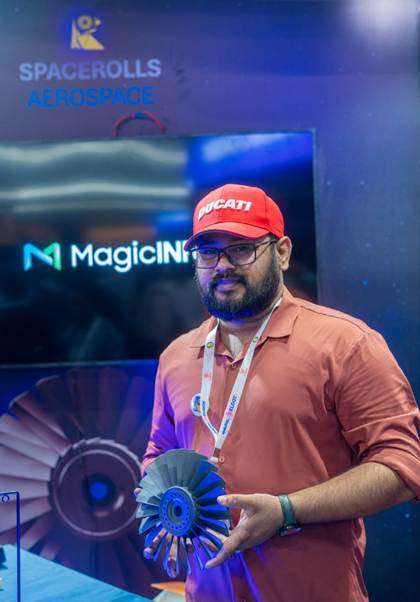
PERINTALMANNA,MALAPPURAM, KERALA — For 125 years, one invention has quietly powered almost everything that flies, generates power, or moves air at scale — and for the last several decades, nobody had meaningfully improved it. This year, a five-year-old Indian deep-tech startup says it has.
The Machine Hiding Inside Everything
The axial-flow compressor and fan is one of the least-known, most important machines on Earth. It sits inside every jet engine, most power plants, and countless factories, ships, and cooling systems, pushing air through spinning blades to compress it, accelerate it, or move it along.
It was invented in 1901 by Charles Parsons, the engineer already famous for the steam turbine. His version was clever for its era but wasteful, converting only around 60% of the energy put into it into useful work.
Then came powered flight, the Second World War, and the jet age. The axial-flow compressor found its true calling at the heart of the jet engine — and it has stayed there, fundamentally unchanged in principle, ever since.
For more than a century, the world’s best propulsion engineers refined it, pushing efficiency from that original 60% up to today’s 83–90%. It is a genuine engineering triumph. But it happened in tiny increments — and for the last few decades, the curve has gone flat. The technology hit a wall almost everyone in the industry had quietly accepted as permanent.
One Shape, a Hundred Years of Hidden Cost
Nearly every stubborn problem in this field — tip leakage, blades scraping the casing, vortex losses, heavy bending stress, an unmistakably loud acoustic signature — traces back to the same root: the conventional blade, built on the classic aeroplane-wing shape known as the airfoil.
The cost of living with that design for a century is enormous. Relative to a machine operating near its true potential, today’s compressors and fans burn an estimated 20–30% more fuel, cost more to maintain, and fail more often — leaving them, by Spacerolls’ own engineering assessment, roughly 10–15× less operationally stable than they should be.
That was the wall the rest of the industry had made peace with.
The Engineer Who Went Back to First Principles
Mohammed Rasheed Cheralil, founder and CETO of Spacerolls Aerospace, grew up in Malappuram district, Kerala, and trained as an aerospace engineer at SRM University. While much of the industry moved on to open-fan and hybrid engine concepts — treating the conventional compressor and fan as a solved problem — Rasheed went the other way. He went back to the fundamentals, chasing what he calls the next brick of efficiency, and studied the actual physical root of every one of the field’s oldest problems.
“Everyone else looked at the plateau and built around it. I wanted to know why the plateau existed in the first place.”
— Mohammed Rasheed Cheralil, Founder & CETO, Spacerolls Aerospace
What he built does four things at once: it needs less energy to compress the same volume of air, it is lighter, it runs dramatically quieter, and it places no net force or drag on the surrounding structure — a direct result of how remarkably even and orderly the airflow becomes as it moves through the machine.
ABMP: Not a Better Blade — a Better Flowpath
The breakthrough isn’t a refinement of the old blade. It’s an entirely new flowpath — a new route and arrangement for the air as it travels through the machine, engineered from first principles rather than adapted from a wing.
ABMP — Axially opposing, Base-Merged, Double-triangular Prismic blades — is the name of that new architecture. But the real achievement isn’t any single blade; it’s the unique flowpath the architecture creates, and the exceptionally even way it guides air through the machine. That orderly flow is what quietly resolves the entire family of century-old problems at once — and it’s the reason the structure experiences no net force.
Two firsts sit inside that flowpath:
- The blade tip finally does useful work. In every conventional machine, the tip has been the weak point — where air leaks, where metal scrapes against the casing, where wear begins. ABMP is, to Spacerolls’ knowledge, the first architecture in the technology’s history to engineer the tip itself for compression. That single shift removes the need to obsess over razor-thin tip clearances or costly abrasion-resistant tip materials — headaches the industry had simply lived with for over a hundred years.
- The outflow is uniform, hub to tip. Every conventional axial-flow fan or compressor sends out air that is uneven and distorted from the hub to the blade tip — engineers have accepted this as an unavoidable fact of airfoil-based design for a century. ABMP’s flowpath produces air that is uniform and distortion-free all the way from hub to tip, something conventional architecture has never achieved. It’s a major reason the machine runs smoother, quieter, and closer to its theoretical efficiency limit.
Built on this flowpath, the ABMP axial-flow compressor and fan architecture reports results the field had long treated as physically out of reach:
- Isentropic efficiency of 98–99% — a leap past the ~90% ceiling the industry had been stuck beneath for decades.
- Roughly 10× greater stability in noise and vibration, in testing.
- 10–20% lower noise measured in tests.
The Company
Spacerolls Aerospace Technologies Private Limited was incorporated on 10 August 2021 and turns five years old next month — five years spent on a problem most of the world had quietly stopped trying to solve. To Spacerolls’ knowledge, it is the only deep-tech startup in the world built specifically around this cluster of overlooked, high-impact niches in fluid and flow engineering.
Solving the Puzzle NASA and the World’s OEMs Couldn’t Finish
ABMP is Spacerolls’ answer for compressors and fans. It is not the technology behind the company’s other two frontiers — each of those runs on its own dedicated solution, purpose-built for its own century-old problem.
The most striking of the two is in wing aerodynamics. For decades, NASA and the aerospace industry’s leading original equipment manufacturers have chased a solution to one of aviation’s oldest, most stubborn puzzles: cutting airfoil noise while simultaneously enhancing lift — two goals that have historically pulled against each other. Spacerolls says it has cracked the piece of that puzzle that had eluded even the best-funded labs in the world, developing a dedicated new wing architecture to solve both problems together.
The second frontier is industrial rather than aerospace: a new design for the agitator rotor inside bioreactors — the component that stirs and mixes the tanks used across biotechnology and industrial processing.
Different problem, different architecture, same underlying instinct: go back to first principles where the rest of the world stopped looking.
Protected Across the Globe
Spacerolls has filed for patent protection in 40+ countries. South Africa has already granted its patent, with further jurisdictions under review.
Most significantly, the International Searching Authority (ISA) at the World Intellectual Property Organization (WIPO) issued its formal written opinion on the international application (Form PCT/ISA/237), finding all 10 claims novel, inventive, and industrially applicable — the three tests any real invention must pass. It is an independent, global signal that ABMP is a genuinely new architecture, not an incremental variation on existing art.
Why It Matters for People
A meaningfully more efficient, quieter, more reliable compressor is not an abstract engineering trophy — these machines sit inside aviation, power generation, heavy industry, shipping, buildings, and data infrastructure. Removing a 20–30% waste penalty from that machinery ripples outward into:
- Lower operating costs for airlines, utilities, and manufacturers — ultimately reaching consumers.
- Cheaper, more dependable energy and mobility, which matters most where cost is the barrier to access.
- Quieter machines, easing the noise burden on communities near airports and industrial sites.
- A foundational deep-tech capability built and owned from India, exportable to the world.
Why It Matters for the Planet — the Numbers, Added Up
The figures below are illustrative, sourced projections of what could be avoided if the technology were adopted at scale — not emissions already reduced. They’re built from public data across three sectors where axial-flow fans and compressors do heavy lifting: aviation, industrial/energy motor-driven systems, and data-centre cooling.
1. Aviation
Global commercial aviation emits roughly 900 million tonnes of CO₂ a year (~2.5% of global CO₂). A 15–25% fuel-burn reduction, achieved through compressor efficiency gains, would avoid approximately 135–225 million tonnes of CO₂ per year.
2. Industrial and Energy Motor-Driven Systems
Pumps, fans, and compressors together are estimated to consume roughly 29% of the world’s electricity. Independent industrial-efficiency research (IIP Network / UNIDO-aligned analysis) finds that a 20–30% efficiency improvement across these systems could cut global CO₂ emissions by an estimated 770–1,100 million tonnes per year. This is the broader pool — spanning power generation, manufacturing, HVAC, and process industries — that a next-generation fan and compressor architecture like ABMP is positioned to address.
3. Data-Centre Cooling
Global data centres emit an estimated 300+ million tonnes of CO₂e per year, and cooling systems — which rely heavily on fans and compressors — account for 33–40% of a typical data centre’s total energy use, or roughly 100–120 million tonnes of CO₂ per year. A 15–25% efficiency gain in that cooling load would avoid approximately 15–30 million tonnes of CO₂ per year.
Added together, the addressable potential across aviation, industrial/energy systems, and data-centre cooling comes to approximately 920 million to 1.36 billion tonnes of CO₂ per year.
How That Stacks Up Against the World’s Great Forests
- The Amazon rainforest, at its historic peak absorption in the 1980s–90s, drew down roughly 2 billion tonnes of CO₂ a year. This combined potential is equivalent to roughly half to two-thirds of the Amazon’s entire peak carbon-absorbing power — from re-engineering machines, not planting trees.
- The Western Ghats, India’s own great mountain forest system, absorb an estimated 15 million tonnes of CO₂-equivalent a year. This combined potential is roughly 60–90 times the Western Ghats’ entire annual carbon offset.
- All the forests on Earth combined absorb a net ~7.6 billion tonnes of CO₂ a year. This combined potential represents about 12–18% of the entire planet’s forest carbon sink — recovered from machines that already exist, without a single new tree.
Full sourcing and methodology in the notes below — these are scenario-based, addressable-market estimates, not verified reductions, and they scale directly with whatever efficiency gains are ultimately validated and adopted at scale.
The Through-Line
A machine invented in 1901 has quietly run the modern world for over a century on a design that stopped improving decades ago. Almost everyone accepted the wall. One aerospace engineer from Malappuram did not — and in rebuilding the flowpath at the heart of the compressor, then turning the same first-principles instinct toward a wing problem that had stumped NASA and the aerospace industry’s biggest OEMs, Mohammed Rasheed Cheralil and Spacerolls Aerospace have opened up a genuinely new front in one of engineering’s oldest, most consequential problems.
From a five-year-old company, it is the beginning of something that could touch every industry that moves air — and every tonne of carbon that comes with it.
Notes on the Figures (for Fact-Checking Before Publication)
- Global aviation CO₂: ~880–942 Mt in 2024 (~2.5% of global CO₂) — IATA Net Zero Progress Report 2024; Our World in Data.
- Motor-driven systems electricity share: pumps, fans, and compressors together are estimated at ~29% of global electricity consumption; a 20–30% efficiency gain across these systems could cut global CO₂ by 770–1,100 Mt/year — IIP Network / UNIDO industrial-efficiency analysis.
- Data centres: ~300 Mt CO₂e in 2020 (IEA); cooling accounts for 33–40% of typical data-centre energy use — IEA; peer-reviewed data-centre cooling literature (2024).
- World forests’ net carbon sink: ~7.6 billion tonnes CO₂/year net — WRI / Nature Climate Change (2021).
- Western Ghats: ~4 million tonnes of carbon (~15 Mt CO₂-equivalent) absorbed per year, ~10% of India’s total forest offset — commonly cited regional estimate; carbon-to-CO₂ conversion at ×3.67.
- Amazon: ~2 billion tonnes CO₂/year absorbed at peak (1980s–90s); considerably weaker today due to deforestation, degradation, and drought — INPE / NASA JPL research.
- All efficiency-gain percentages (15–25%, 20–30%) are illustrative scenarios, not confirmed field results. The CO₂-avoided figures scale directly with whatever real-world efficiency gain ABMP and future Spacerolls technologies are ultimately validated and adopted to deliver.
Uncategorized
From Shop-Floor Innovation to Intellectual Property: Ashish Gaurav Chaturvedi Strengthens His Manufacturing Profile
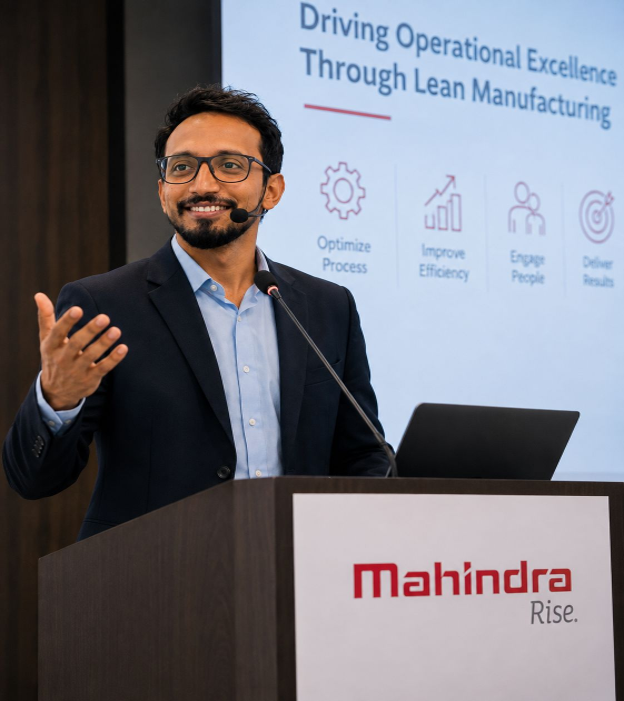
Manufacturing Professional Earns Design Registration for “Magnetic Sealing Bit for Fixture,” Alongside His Patent Achievement
Ashish Gaurav Chaturvedi, an experienced Operations and Production professional with expertise across automotive, auto-ancillary, bearing and solar manufacturing, has added another significant milestone to his professional journey with the registration of his industrial design, “Magnetic Sealing Bit for Fixture.” His innovation journey also includes a patent achievement, further highlighting his focus on developing practical solutions for manufacturing challenges.
The design has been registered by the Intellectual Property Office, Government of India, under Design No. 472182-001, in Class 08-08. The registration certificate records the design in the name of Ashish Gaurav Chaturvedi. The design focuses on a practical fixture-related solution with an emphasis on workplace safety and manufacturing efficiency.
Alongside this design registration, his patent achievement stands as an important recognition of his innovative approach to manufacturing and problem-solving. Together, these intellectual property achievements reflect his ability to convert practical shop-floor observations and industry experience into innovative solutions.
With a career spanning multiple manufacturing sectors, Chaturvedi has developed expertise in manufacturing operations, production management, process optimization, quality improvement, Lean Manufacturing, TPM, Kaizen, Poka-Yoke and 5S. His professional experience includes working across automotive manufacturing, steering systems, bearings, solar modules and advanced manufacturing environments.
Throughout his career, he has handled responsibilities related to shop-floor operations, production planning, manpower management, machine troubleshooting, process improvement, quality analysis and productivity enhancement. He has also gained hands-on exposure to manufacturing equipment and processes including CNC, VMC, HMC and grinding machines, along with solar module manufacturing equipment and processes.
A strong focus on continuous improvement has remained a consistent part of his professional journey. His experience includes applying structured problem-solving and improvement methodologies to address manufacturing challenges, reduce defects, improve productivity and strengthen process reliability. He has worked with approaches and tools such as Six Sigma, SMED, 7 QC Tools, CAPA, Why-Why Analysis and 4M Change Management.
His professional achievements also include Six Sigma Green Belt and Black Belt certifications, along with projects focused on reducing manufacturing defects. One of his highlighted improvement initiatives involved reducing the defect rate from 1.46% to 0.92%. He has also contributed to productivity improvement, fixture modification, new product development and shop-floor quality improvement initiatives.
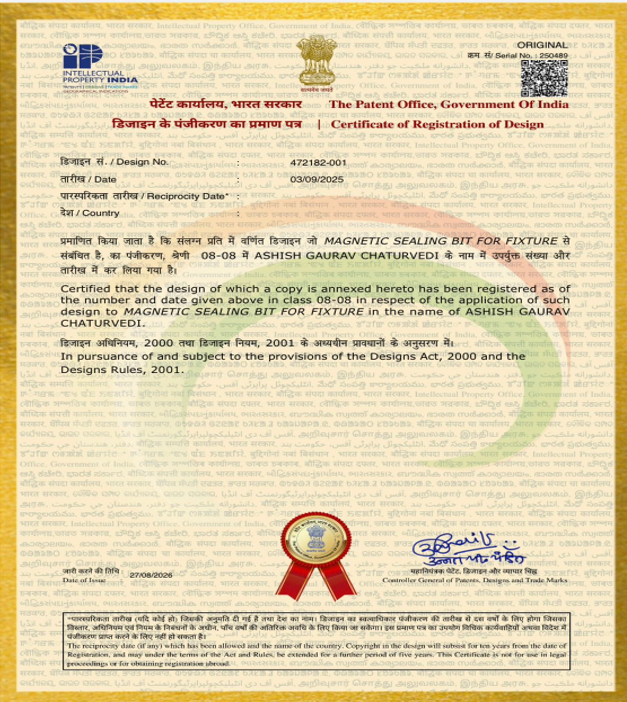
The newly registered “Magnetic Sealing Bit for Fixture” further reflects his approach of connecting practical manufacturing experience with innovation. The achievement demonstrates how observations from everyday shop-floor operations can lead to practical solutions with potential benefits for workplace safety and process efficiency.
For Chaturvedi, the combination of his patent and design registration represents more than professional recognition. It reflects a continued effort to transform manufacturing challenges into practical, innovative solutions while contributing to safer, more efficient and reliable production environments.
Design Registration Details
Design: Magnetic Sealing Bit for Fixture
Design No.: 472182-001
Class: 08-08
Applicant/Registered Proprietor: Ashish Gaurav Chaturvedi
Registration Date: 03 September 2025
Certificate Issue Date: 27 August 2026
Authority: Intellectual Property Office, Government of India
Ashish Gaurav Chaturvedi is an Operations and Production professional with 10+ years of experience across automotive, auto-ancillary, bearing and solar manufacturing. His areas of expertise include manufacturing operations, process optimization, quality improvement, Lean Manufacturing, TPM, Six Sigma, Kaizen, Poka-Yoke, production planning and shop-floor management. His patent and design registration add an important innovation dimension to his professional achievements.

Four Ways to Build a Business Around a Brand That’s Been Trusted Since 1983
India’s branded spice and grocery market isn’t growing on retail shelves alone — much of it is growing through the same layered distribution networks that built the country’s biggest FMCG names. Dakloni, the Odisha-rooted masala and grocery brand built on its “Perfect Taste Since 1983” promise, has opened that network up to entrepreneurs willing to build a genuine local grocery business rather than a single shop counter. The pitch is straightforward: dependable margins, a purity-first product range already earning repeat buyers, and four clearly defined entry points depending on how much capital and territory a partner wants to take on.
Why the Timing Works in a Distributor’s Favour
Loose, unbranded masala is losing ground quickly as more households start checking labels before buying — a shift that favours an FSSAI-certified, decades-old identity over an unproven new one. Dakloni’s expanding catalogue, spanning eight core masalas alongside a growing dry fruits and snacks lineup, gives a distributor more than a single product to build a territory around, which matters when the goal is a sustainable, reorder-driven business rather than a one-season seller.
Four Tiers, Four Ways In
Not every entrepreneur wants the same size of commitment, and Dakloni’s structure reflects that — a shopkeeper stocking the brand alongside other lines needs a very different entry point from someone planning to run an entire district’s supply chain. The tiers below outline where each level sits.
| Partnership Tier | Investment Range |
| Authorized Dealer | ₹50,000 – ₹1,00,000 |
| Area Distributor | ₹1,50,000 – ₹3,00,000 |
| District Distributor | ₹3,00,000 – ₹5,00,000 |
| Super Stockist / Larger Territory | ₹5,00,000+ |
What Separates Each Level
An Authorized Dealer typically sits at the retail or immediate wholesale layer — stocking Dakloni’s range for a shop or a small cluster of outlets, with a lower entry cost suited to a first-time distribution partner. An Area Distributor takes on a defined zone, often a town or a group of talukas, supplying dealers beneath them and holding enough stock to service several retail points without constant reordering. A District Distributor scales that further, effectively owning supply across an entire district and coordinating a network of area distributors and dealers underneath — which is where the investment range starts reflecting genuine warehousing and logistics needs rather than stock value alone. At the top, a Super Stockist or Larger Territory Partner functions closer to a regional supply hub, capable of feeding stock into multiple districts and supporting Dakloni’s push into markets it hasn’t directly entered yet.
What a Partner Actually Gets for That Investment
Capital alone doesn’t build a distribution business — it needs a product people reorder. Dakloni’s pitch to partners leans on the same claims it makes to consumers: no added flavours or artificial colouring across the masala range, a stated quality-check process, and packaging built to hold up through a longer supply chain rather than just a shelf display. A partner coming in at any tier is stepping into an already-recognised “Pure, Natural, Authentic” identity, rather than having to build market trust in a new product from zero.
The Bottom Line
Distribution is ultimately a bet on repeat demand, and that’s the case Dakloni is making to prospective partners — a heritage brand, a category shifting decisively toward certified, branded products, and four entry points built to match everything from a single-shop dealer to a district-wide supply operation. For an entrepreneur weighing where to place working capital in FMCG right now, that combination of an established name and a still-expanding footprint is exactly the kind of opening a distribution business is built on.
To enquire about dealership and distributorship opportunities, reach out through the Dakloni website or write in directly to discuss territory availability.
Brand Snapshot
| Brand | Dakloni Masala |
| Tagline | Perfect Taste Since 1983 |
| Parent Company | Green Chocy Pvt. Ltd. |
| Category | Spices, Masalas, Dry Fruits |
| Origin | Odisha, India |
| FSSAI License | 12026999000110 |
| Website | Dakloni.com / Dakloni.in |
| @daklonimasala | |
| Dakloni Masala | |
| support@dakloni.com |

At just 30 years old, Ankit Barot from Lonavla, Maharashtra, has become a name synonymous with innovation and authenticity in the Indian fragrance industry. As the founder of Naakt Perfumes, Ankit has carved a niche for his brand by blending artistry, luxury, and affordability — redefining how India experiences perfumes.
The Beginning of Naakt Perfumes
Born and raised in the serene hills of Lonavla, Ankit’s fascination with scents began early. What started as a passion for fragrances evolved into a mission to create something uniquely Indian yet globally appealing. In his late twenties, he founded Naakt Perfumes, a brand that celebrates raw, natural, and powerful scents — just as its name “Naakt”
A Brand Built on Passion and Purpose
Under Ankit’s leadership, Naakt Perfumes has quickly risen to prominence in the Indian perfume market. The brand focuses on long-lasting, high-quality fragrances inspired by nature, luxury, and emotion. By crafting perfumes that merge international quality with Indian sensibilities, Naakt has become a trusted choice among young fragrance lovers and connoisseurs alike.
Innovation and Growth
Ankit’s vision extends beyond creating perfumes — it’s about building an experience. His approach combines modern minimalistic packaging, ethical sourcing, and distinctive scent storytelling. Through creative campaigns and relatable branding, Naakt Perfumes continues to attract attention across India and internationally.
Leading India’s Fragrance Future
Today, Naakt Perfumes stands as one of the fastest-growing fragrance brands in India, with a loyal customer base and expanding digital presence. Ankit Barot’s journey reflects determination, creativity, and an unshakable belief in the power of scent to express identity and emotion.
As Ankit continues to lead Naakt Perfumes into new horizons, he represents a new generation of Indian entrepreneurs — rooted in tradition, inspired by innovation, and driven by passion.


Inside the Claims: What “Hygienically Packed” Actually Means at Dakloni Masala

Maharashtra family’s celebration of first daughter in 200 years goes viral

Daily horoscope, September 5: Cancer’s moment, Aries told to slow down

Redfox Overseas: Customize Your Own Energy Drink and Stand Out in the Market

Zamzam Company CEO Chhote Bhai-Bade Bhai gave a grand welcome to Indian writer Devhari Sirvi in Dubai

Shikha Sharma: The Fashion Journalist, Blogger, and Plus-Size Model Taking the Industry by Storm
-
 Brandpost2 years ago
Redfox Overseas: Customize Your Own Energy Drink and Stand Out in the Market
-
 Brandpost2 years ago
Zamzam Company CEO Chhote Bhai-Bade Bhai gave a grand welcome to Indian writer Devhari Sirvi in Dubai
-
 Fashion2 years ago
Shikha Sharma: The Fashion Journalist, Blogger, and Plus-Size Model Taking the Industry by Storm
-
Entertainment1 year ago
Lucky Roxx’s “Yadav Ki Pukar” Goes Viral! Youth Celebrate Unity & Power
-

 Entertainment9 years ago
New Season 8 Walking Dead trailer flashes forward in time
-
Entertainment9 years ago
Meet Superman’s grandfather in new trailer for Krypton
-

 Brandpost2 years ago
From Local Hero to National Icon: Satyam Yadav’s Journey with TwentyOne
-
Uncategorized2 years ago
Hello world!