Connect with us

Government

Ahead of visarjan, Mumbai orders gathering restrictions and firecracker ban

Mumbai tightened safety measures ahead of Ganpati visarjan after an electrocution at a Kalachowki pandal killed two people, with the Bombay High Court banning firecrackers on public roads and police deploying 23,000 personnel and AI cameras for the immersion.
Published

on

Mumbai has ordered a 15-day restriction on gatherings of five or more people, effective September 25.

The Bombay High Court has separately banned firecrackers on public roads during festivals.

The measures come ahead of the city’s Ganpati visarjan.

They follow a fatal electrocution at a Ganesh pandal in Kalachowki that killed two people.

Police are deploying 23,000 personnel and AI cameras for the immersion.

The court’s order also called for action to be taken against noise pollution during festival celebrations.

Mumbai Police announced a 15-day restriction on the gathering of five or more people in certain areas, effective September 25.

The restriction is aimed at maintaining law and order during the festival period.

Around 23,000 police personnel are being deployed for the Ganpati immersion.

AI-powered cameras will also be used for security and crowd monitoring during the immersion.

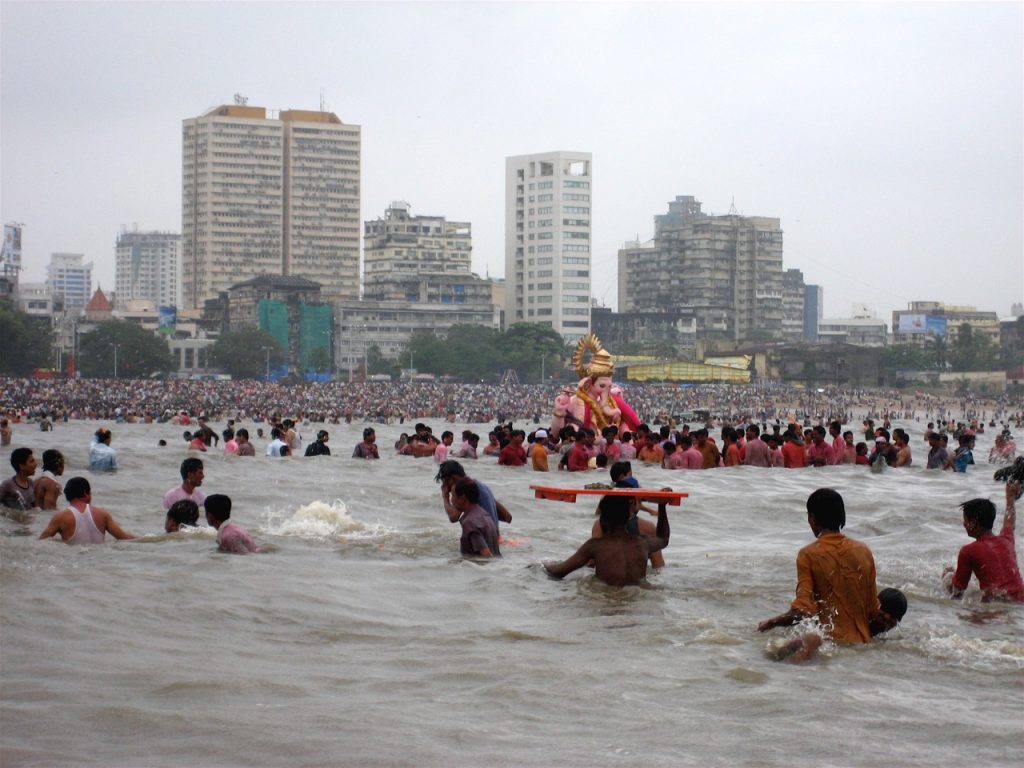
Ganpati visarjan, the immersion of Ganesh idols, is one of Mumbai’s largest annual public events, drawing large crowds to the city’s beaches and water bodies.

Authorities in Mumbai typically ramp up safety measures, including traffic diversions and medical arrangements, in the days around the immersion.

Electrical safety at temporary pandal structures has been a recurring concern flagged by civic authorities in past years.

The Kalachowki area is located in central Mumbai.

Ganpati visarjan processions in Mumbai typically involve thousands of idols being carried to immersion points across the city over several days.

Traffic diversions and additional bandobast arrangements are common in Mumbai during the immersion period each year.

Civic body inspections of pandal structures, including electrical wiring, are typically required before permissions are granted for public pandals.

The Ganesh festival is one of the most widely celebrated public festivals in Maharashtra, drawing participation from across the state.

Emergency medical teams are usually stationed at major immersion points during the festival as a standard precaution.

Ganpati Visarjan procession (representative image), Wikimedia Commons, CC BY 2.0

Continue Reading
Click to comment

Leave a Reply

Your email address will not be published. Required fields are marked *

Government

CBIC, Power Ministry among departments joining Special Campaign 6.0

The government’s Special Campaign 6.0, a nationwide drive for cleanliness and reduction of pending work in government offices, will run its implementation phase from October 2 to October 31, 2026, following a preparation phase that began September 15.

Published

on

The Central Board of Indirect Taxes and Customs is participating in Special Campaign 6.0 across all its zones and field formations.

The Ministry of Power is also taking part, aiming to institutionalise Swachhata and minimise pendency.

The campaign’s implementation phase runs from October 2 to October 31, 2026.

It focuses on cleanliness, pending work and e-waste disposal.

It follows a preparation phase that began in mid-September.

The campaign focuses on cleanliness, reduction of pending work, record management and scientific e-waste disposal across government offices.

Multiple ministries and departments are participating, including the Ministry of Power, Ministry of Textiles and Ministry of Fisheries.

The Central Board of Indirect Taxes and Customs, along with all its zones and field formations, is also taking part.

The Ministry of Power’s version of the campaign aims to institutionalise Swachhata and minimise pendency within the department.

The Ministry of Textiles’ campaign is focused on clean offices, clearing pending files and reducing e-waste.

Special Campaign 6.0 is the sixth edition of this kind of nationwide government cleanliness and pendency-reduction drive.

Earlier editions of the Special Campaign have focused on similar goals of office space optimisation and file disposal.

Government offices participating in the campaign are expected to report on space freed up, files disposed of, and e-waste cleared.

The campaign is coordinated at the central level with individual ministries setting their own specific targets.

Improving public service delivery and administrative efficiency has been a stated goal of recent government reform efforts.

Government offices participating in past special campaigns have reported clearing large volumes of old files and unused equipment.

The campaign also encourages digitisation of records as part of reducing physical file backlogs.

Scientific disposal of e-waste, rather than informal dumping, is a specific target area flagged under the campaign.

Individual departments typically nominate nodal officers to coordinate their participation in the campaign.

Swachh Bharat Mission event (representative image), Wikimedia Commons, GODL-India

Continue Reading

Government

Chintan Shivir comes as Modi government nears halfway point of term

Prime Minister Narendra Modi began a two-day ‘Chintan Shivir’ with Union Cabinet ministers on September 23 at Seva Teerth in New Delhi, to review government work and identify reforms and priorities linked to the Viksit Bharat 2047 vision.

Published

on

PM Modi’s two-day Chintan Shivir, which began September 23, comes as the government approaches the halfway point of its third term.

The meeting is being held at Seva Teerth in New Delhi with Union Cabinet ministers.

It will focus on reviewing government work and identifying reforms linked to Viksit Bharat 2047.

The session runs through September 24.

It follows earlier interactions Modi held with junior ministers.

The meeting will focus on stocktaking as well as future planning across ministries.

Discussions are expected to cover implementation of government schemes, governance, inter-ministerial coordination and public service delivery.

The broader goal is to identify the next set of ideas, reforms and priorities linked to the Viksit Bharat 2047 vision.

Viksit Bharat 2047 is the government’s roadmap for India to become a developed nation by 2047, the 100th year of independence.

The meeting comes as the Modi government approaches the halfway point of its third term.

It follows a series of separate interactions Prime Minister Modi held earlier with Ministers of State and Ministers of State with Independent Charge.

Chintan Shivir, meaning a reflection or brainstorming retreat, has been used before by the government for structured policy discussions.

The outcomes of the meeting are expected to shape the government’s priorities in the coming months.

The Union Cabinet is the top decision-making body of the Indian government, chaired by the Prime Minister.

Cabinet ministers typically hold charge of individual ministries and report on progress within their departments during such reviews.

The government has previously held structured retreats and reviews to assess the pace of implementation of flagship schemes.

Seva Teerth in New Delhi has hosted several government functions and meetings in the past.

Governance reforms discussed at such meetings often feed into subsequent Cabinet decisions and budget allocations.

The Prime Minister’s Office coordinates the agenda and follow-up action points for Cabinet-level meetings of this kind.

Prime Minister Narendra Modi (representative image), Wikimedia Commons, GODL-India

Continue Reading

Government

47.7 lakh names removed from Delhi’s draft electoral roll

The Supreme Court heard a petition on September 22 challenging notices issued to 33 lakh Delhi voters in the Special Intensive Revision, with advocate Prashant Bhushan arguing the process was opaque; about 47.7 lakh names were removed from the draft roll.

Published

on

About 47.7 lakh names were removed from Delhi’s draft electoral roll, published on August 31, 2026.

The existing roll had roughly 1.45 crore electors.

About 33 lakh voters have separately received notices during the Special Intensive Revision.

The Supreme Court heard a challenge to the process on September 22.

The final roll is due on November 4.

Bhushan said, in effect, that voters were not being told the specific reason their names were flagged.

The draft electoral roll for Delhi, published on August 31, 2026, removed about 47.7 lakh names from the existing list of roughly 1.45 crore electors.

Officials said around 97.51 lakh enumeration forms were collected or uploaded during the revision process.

The final electoral roll is scheduled to be published on November 4, 2026.

The deadline for filing claims for inclusion in the roll is September 30, 2026.

Special Intensive Revision is a process in which the Election Commission re-verifies the electoral roll, requiring voters to fill in enumeration forms and flagging discrepancies for further checks.

Prominent voters who received notices in the exercise included External Affairs Minister S Jaishankar, former Delhi chief minister Arvind Kejriwal and BJP veteran L K Advani.

The Election Commission has said that receiving a notice does not by itself mean a person’s name will be removed from the roll.

The case is being watched closely because Delhi’s SIR could be a template for similar exercises the Election Commission may carry out in other states.

A Supreme Court bench of Chief Justice Surya Kant, Justice Joymalya Bagchi and Justice V Mohana agreed to hear the plea on Delhi’s Special Intensive Revision on September 22.

The petition challenges notices issued to about 33 lakh people during the exercise.

Advocate Prashant Bhushan, appearing for the petitioners, argued that the process was opaque.

He said the Election Commission had not disclosed the basis for flagging people as a ‘logical discrepancy’ or ‘unmapped’, either in the notices or on its website.

Supreme Court of India, New Delhi (representative image), Wikimedia Commons, CC BY-SA 4.0

Continue Reading

Trending