
Brandpost
From a Drone in a Village Classroom to Championing India’s AI Founders: The Story Behind AI Startup Impact

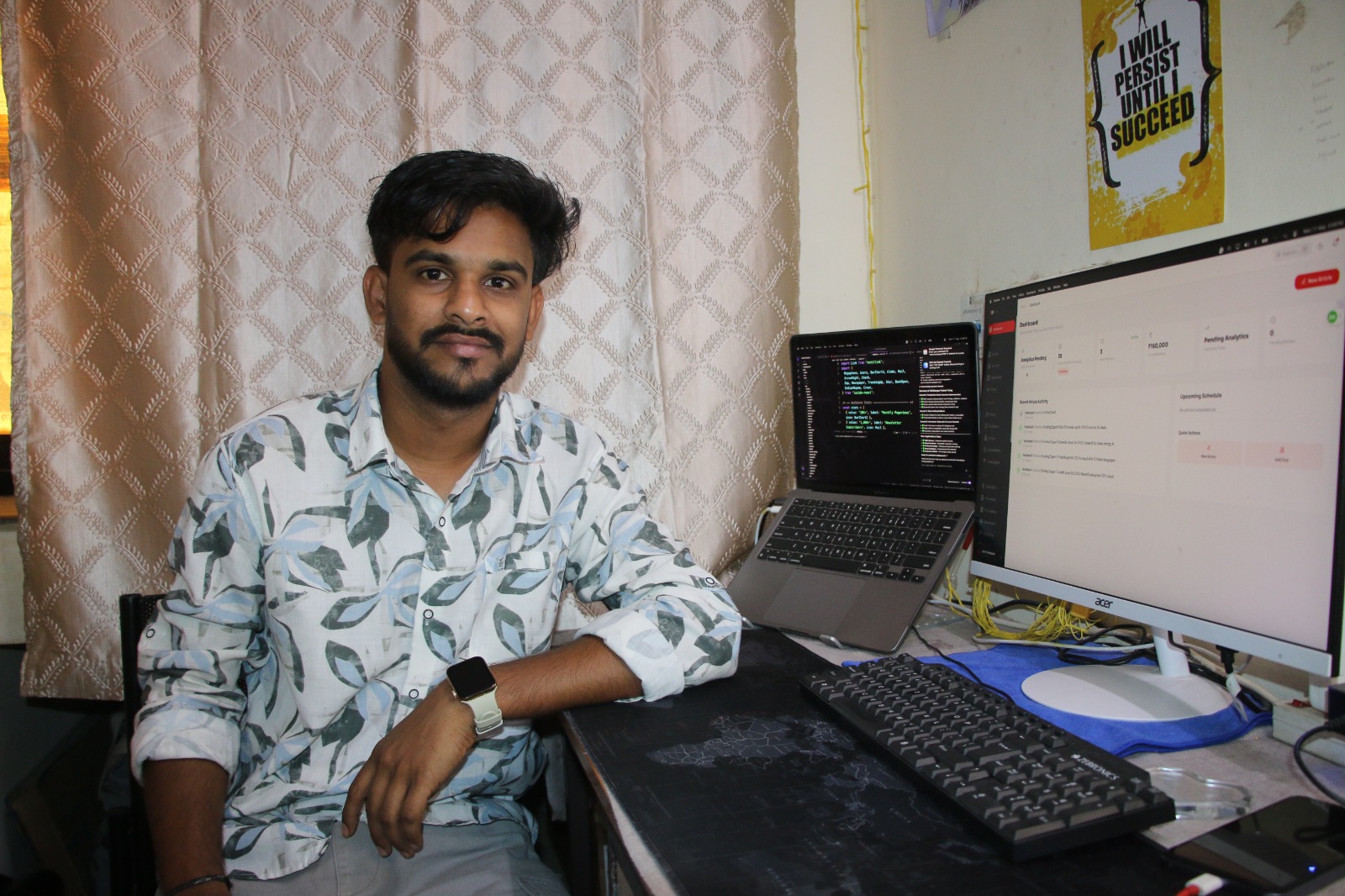
In Jayanthipuram, a quiet village near Jaggayyapet in Andhra Pradesh, the path from rural government school to building a national platform for AI startups was never going to be a straight line. For the founder of AI Startup Impact, it has been a decade-long climb defined by curiosity, persistence, and a conviction that talent in India deserves a louder stage.
It began, improbably, with a drone.
As a fifth-grade student at the local Zilla Parishad High School, he sketched the idea of building one. By tenth standard, he had assembled it. The project earned a write-up in a regional newspaper — a small clipping that would mark his first public validation and, in his own words, “the moment I knew I wanted to build.”
That moment had to survive a great deal. His father, once a farmer, took up daily-wage labor in a nearby industrial unit to support the family. His mother continues to work the fields. His elder brother, Sankar — now an assistant engineer — became one of his earliest motivators, the steady voice encouraging him to keep building when most of those around him couldn’t yet picture where the road was leading.
The Long Road to NIT Jaipur
After completing his intermediate education at a government residential college, he moved to Hyderabad alone, lived in a cramped paying-guest hostel, and prepared for the JEE Main entirely through self-study. The work paid off: he secured admission to Malaviya National Institute of Technology, Jaipur — one of India’s premier engineering institutes.
But the campus brought a new set of obstacles. Language barriers, limited prior exposure, and self-doubt threatened to derail the early semesters. Instead of retreating, he diversified. He picked up blogging, graphic design, video editing, coding, and UI/UX design — and began documenting his learning publicly on LinkedIn.
The community grew quietly at first, then quickly. Today, it numbers more than 20,000 followers, with over 1,000 students directly mentored on resumes, interviews, and study resources. Many of them, like him, come from tier-2 and tier-3 backgrounds — the precise audience the Indian tech narrative most often overlooks.
Spotting the Gap
By his second year, he was experimenting with AI tools for content creation, eventually securing Google AdSense approval for an early project. Several other ventures followed; most failed. But each iteration sharpened a single observation that would crystallize by his fourth year: as the global AI boom accelerated, Indian AI startups were building remarkable products with almost no visibility.
International platforms commanded the headlines. Domestic founders — many doing genuinely original work — were going unnoticed by investors, talent, and even prospective users.
That gap became the founding thesis of AI Startup Impact.
A Platform Built From Zero
Launched as a LinkedIn page and now anchored by aistartupimpact.com, AI Startup Impact is a media-first platform dedicated to surfacing Indian AI startups — profiling founders, tracking funding, and curating the kind of consistent, high-quality storytelling that early-stage companies rarely get on their own.
What stands out is how it has been built: with zero external investment, powered by family support and the steady motivation of his elder brother Sankar. No funding rounds, no agency, no team — just daily posts, original visuals, founder interviews, and free promotional support for early-stage teams trying to land their first hundred users.
The traction has been remarkable for a bootstrapped, solo-run platform. In just two months, AI Startup Impact crossed 10,000+ followers and 5,000+ newsletter subscribers — a pace that signals real demand for the kind of India-first AI storytelling the platform offers.
“This isn’t about individual success,” he says of the venture. “It’s about building an ecosystem where every deserving startup gets noticed.”
What Comes Next
The founder is candid that AI Startup Impact is still early. The roadmap includes deeper research, structured funding databases, founder interviews at scale, and partnerships with accelerators and angel networks across the country. The ambition is to become the default discovery layer for Indian AI — a place where a founder in Coimbatore or Guwahati can be found by an investor in Bengaluru or San Francisco.
For a young man who once dreamed of a drone in a village classroom, the trajectory has its own quiet logic. The tools changed. The mission did not.
“In a country full of talent,” he says, “visibility should not be a privilege. It should be accessible to all.”
AI Startup Impact, he insists, is just the beginning.
About AI Startup Impact
AI Startup Impact is an India-focused media and discovery platform spotlighting AI startups, founder journeys, and funding developments. Bootstrapped and built without external investment, the platform operates across LinkedIn and aistartupimpact.com, and offers free early-stage promotional support to emerging AI companies. Within two months of launch, it has crossed 10,000+ followers and 5,000+ newsletter subscribers.
Media Contact: Lahori Venkatesh, Linkedin; https://www.linkedin.com/in/venkatesh-lahori/
Website: aistartupimpact.com
A claim that sounds almost old-fashioned in an era of mass-manufactured jewellery sits at the center of how Shree Ram Jewellers describes its own work: every piece of silver shringar it creates for Baba Mahakal, the presiding deity of Ujjain’s Mahakaleshwar Jyotirlinga temple, is made entirely by hand, with no machine involved at any stage.
According to the store’s owner, Siddharth Soni, each design is shaped, engraved, and finished manually, a process that depends on traditional silverwork techniques built up over years of practice rather than templated production methods. Handmade silverwork of this kind generally takes considerably longer per piece than machine-assisted manufacturing, a tradeoff craftsmen in this space typically accept in exchange for the kind of intricate, non-repeating detail that mechanized processes struggle to replicate exactly.
Why Hand Craftsmanship Matters for Ritual Objects
Ceremonial items used in temple worship — crowns, crescent moons, ritual vessels — are not purely decorative; they’re expected to function correctly within a specific sequence of rituals, including Bhasma Aarti, Sandhya Aarti, and Bhog Aarti at the Mahakaleshwar temple. That functional requirement, alongside aesthetic expectations tied to specific festivals such as Mahashivratri and the Shravan month, means a craftsman working on temple silver needs familiarity with ritual timing and deity iconography that a purely decorative jeweller might not develop.
What “No Machines” Actually Involves
Fully handmade silverwork typically means every stage — melting and shaping raw silver, engraving fine detail work, and final finishing and polishing — is done using hand tools rather than machine-assisted cutting, stamping, or casting equipment common in larger-scale jewellery production. Shree Ram Jewellers has not detailed publicly which specific hand techniques it uses for different pieces, information that would help distinguish its process from other handmade silverwork studios making similar craftsmanship claims.
The store’s emphasis on originality — describing its designs as difficult to find replicated elsewhere in Ujjain or, according to the owner, across India — reflects a common positioning strategy among specialist craft businesses generally, where uniqueness of design is presented as a direct consequence of the handmade process itself rather than a separate marketing claim. For devotees or collectors evaluating handmade silverwork from any craftsman, asking to see the specific stages of production, or requesting examples of past commissioned work, remains a reasonable way to assess a claim of full handcraftsmanship.
Time investment is one of the more tangible tradeoffs of fully handmade production: a single intricate piece can take considerably longer to complete than an equivalent machine-assisted design, meaning a workshop committed to hand craftsmanship across its full product range is generally limited in how many commissions it can take on simultaneously compared to a larger operation using mechanized production methods.
That capacity constraint may also help explain why reputation-driven, word-of-mouth growth suits a fully handmade workshop better than an advertising-driven model built around high volume, since a business that can only produce a limited number of pieces at a time has less to gain from broad marketing reach than from cultivating a smaller base of devotees willing to wait for a genuinely handcrafted commission.
Brandpost
Retrograde: From a Teenager’s Question to Building India’s Most Complete AI-Driven Vedic Astrology Platform

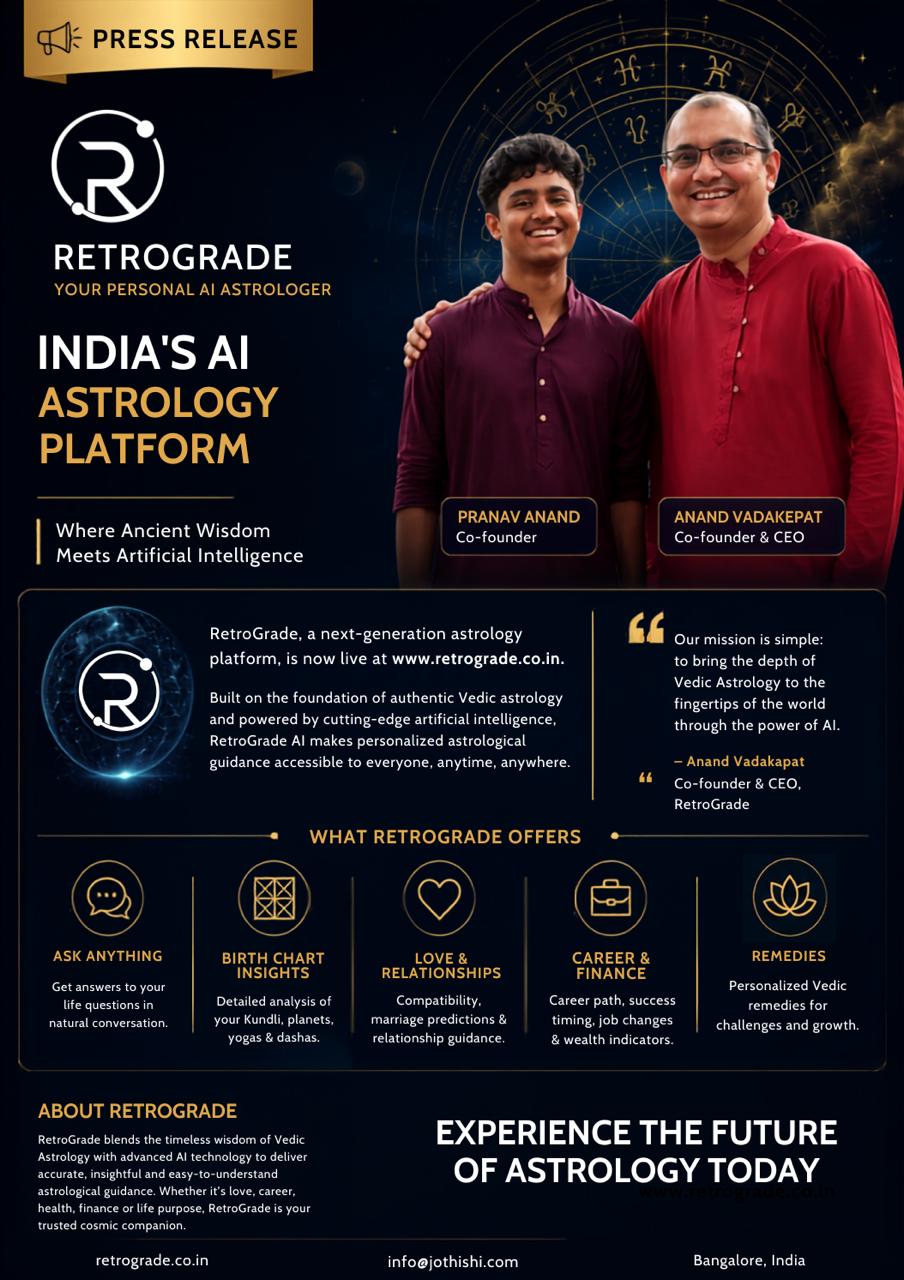
In a country where millions still wait weeks for a trusted astrologer’s time, or lie awake at 2 a.m. wondering whether to take the job, say yes to the marriage, or book the flight abroad, Retrograde has emerged as a quiet but transformative force. More than just an app, it is an AI-driven Vedic astrology platform, built on the astrology engine at Jothishi.com with Parashara and Jaimini priciples, that helps people find clear, personalized answers on career, relationships, marriage, health, wealth, business, moving abroad, and the other turning points of life — from home, at any hour, on a web app or on iPhone and Android.
The story of Retrograde begins with a simple observation. Good decisions change the course of a life, but the people best equipped to help make them — experienced Vedic astrologers, working through a birth chart’s full depth — are scarce, booked out, and often out of reach for a quick, honest question. Pranav, a 16-year-old in the 12th grade at National Public School, Bangalore, saw this gap alongside Anand Vadakepat of Jothishi, whose own work had spent years building the classical astrology engine now powering the platform. Together, they set out to build something different: not a horoscope column repackaged into an app, but a genuine astrologer’s depth of reasoning, made instantly available to anyone who needed it.
Retrograde is also a story about what has newly become possible. This is the age of the one-person company — a moment when a single founder, armed with AI and large language models, can build and ship what once required a full startup’s worth of engineers. That a 16-year-old still finishing high school could build, alongside one collaborator, one of the most complete AI-driven Vedic astrology platforms on the market is itself the clearest evidence of how far that shift has come.
The name carries its own meaning, deliberately chosen. Viewed from Earth, planets normally appear to move steadily in one direction across the sky — what astronomers call direct motion. Occasionally, a planet appears to slow, stop, and drift backward before resuming course — an optical effect of relative orbital speeds that Vedic astrology calls Vakri gati, or retrograde motion. Ketu, the lunar south node, is considered to move perpetually opposite every other planet — eternally reversed, eternally Vakri. Pranav and Anand named the platform Retrograde for exactly that idea: the moment a person pauses, turns inward, and reconsiders their direction before moving forward again. That pause, not indecision but reflection, is precisely what Retrograde exists to support.
Underneath that name is a serious piece of engineering. Retrograde’s answers are generated by 1000 agents programmed to help answer about 10000 probable queries that a person could have with an AI engine applying the classical framework of Vedic astrology — the Brihat Parashara Hora Shastra’s Parashari system alongside the Jaimini Sutras, a person’s Nakshatra placements, every divisional (varga) chart from D1 through D60, multiple dasha timing systems, Ashtakvarga strength scoring, and Panchanga for auspicious timing — rather than a generic, one-size-fits-all horoscope. A user shares their birth details once, then simply asks a question in plain language. Retrograde returns a personalized answer, grounded in that individual’s own chart, in seconds, on whichever device they already have in hand. The model is build to learn daily and currently has about 70 percent accuracy and hopes to attain 95 percent accuracy as it learns over the years with its RAG system architecture.
What sets Retrograde apart as a brand is its underlying philosophy: that good decisions, made with clarity rather than anxiety, are what make a life happier. Career changes, marriages, health choices, financial bets, big moves — these are the decisions people most want a second, wiser opinion on, and most struggle to get one for. By making that depth of guidance available instantly and privately, from home, Retrograde is betting that easier access to good decisions is itself a form of wellbeing.
That philosophy is beginning to build real credibility. Early users are discovering Retrograde largely through word of mouth — the trust that spreads when an answer resonates with someone’s actual life rather than reading like a generic prediction. In a category crowded with novelty apps and recycled sun-sign content, Retrograde stands out for going deeper: real classical methodology, applied to a real question, answered in real time.
Retrograde’s journey — from one teenager’s question to a genuinely comprehensive AI-driven Vedic astrology platform — reflects both the founders’ ambition and the new tools now available to build with. Looking ahead, Retrograde plans to deepen its astrological coverage and expand across web and mobile, while holding onto the belief at its core: honest, personalized guidance, available in the moment people need it, leads to better decisions — and better decisions add up to a happier life.
Learn more at www.retrograde.co.in.
Brandpost
Excel Vali is Building a Practical Learning Ecosystem Where Digital Skills Meet Career Opportunities

India’s professional landscape is changing rapidly. Employers today are no longer hiring solely based on academic qualifications—they are prioritizing candidates who possess practical skills, understand digital tools, and can contribute to business growth from day one.
Recognizing this shift early, Excel Vali, powered by Anjni Computer Education (ACE), has established itself as a growing skill-development platform focused on practical learning, workplace productivity, and career readiness.
Rather than positioning itself as another conventional edtech company, Excel Vali has built its identity around helping learners master tools that businesses actively use every day, including Advanced Excel, AI-powered automation, business analytics, and workflow optimization.
A Vision Focused on Employability
Founded by Ankush Kumar, Excel Vali was created with a clear objective—to bridge the gap between traditional education and real industry expectations.
Instead of emphasizing theoretical knowledge, the platform encourages learners to develop practical competencies that can immediately improve their professional performance.
“Our objective has always been simple: learning should create measurable career value,” says Ankush Kumar. “The real success of education is reflected in how confidently learners solve workplace challenges.”
This philosophy has shaped every aspect of the platform—from curriculum design to student engagement and career support.
Building One of India’s Largest Productivity Learning Communities
One of Excel Vali’s most significant achievements has been its ability to build a large digital learning community through educational content.
With more than 2 million followers on Instagram, alongside a growing audience across YouTube and Facebook, the platform has become a trusted source for professionals seeking quick productivity tips, Excel techniques, AI tools, and workplace automation strategies.
Instead of relying heavily on advertising, Excel Vali has focused on consistent value creation through short-form educational content that solves real business problems.
This content-first approach has helped establish long-term credibility among students, working professionals, entrepreneurs, and corporate employees.
Practical Learning Designed for Modern Workplaces
Excel Vali’s programs are structured around real business applications rather than classroom-style instruction.
Learners receive exposure to:
- Advanced Excel functions and dashboards
- AI-assisted productivity tools
- Business reporting techniques
- Data management workflows
- Process automation strategies
- Practical business case studies
The objective is not simply to complete a course, but to help learners confidently apply their knowledge in professional environments.
Leadership That Combines Vision and Execution
Behind Excel Vali’s steady growth is a leadership team that balances long-term strategy with day-to-day execution.
As Founder, Ankush Kumar oversees business direction, product development, and the platform’s long-term vision.
Working alongside him, Kratika Singh, Operations Head and one of the platform’s recognizable public faces, manages operational excellence, learner engagement, and digital communication.
Her role has been instrumental in strengthening community interaction, maintaining educational consistency, and ensuring that the learning experience remains accessible and relevant for a rapidly growing audience.
Together, they have created a model that integrates education, digital content, and career-focused learning into one cohesive ecosystem.
Learning Beyond Certification
Excel Vali believes that certificates alone are no longer enough in today’s competitive job market.
Its training ecosystem encourages learners to build portfolios, complete practical assignments, and develop problem-solving capabilities that employers actively seek.
The platform has already impacted thousands of learners through structured programs, webinars, and digital education initiatives, while continuing to strengthen its placement-oriented learning ecosystem.
Looking Ahead
As automation, artificial intelligence, and data-driven decision-making become increasingly important across industries, Excel Vali plans to expand its offerings with advanced AI programs, corporate learning solutions, and stronger industry collaborations.
With its practical approach, strong digital presence, and learner-centric philosophy, Excel Vali continues to position itself as a modern skill-development platform focused on preparing individuals for the evolving demands of the digital economy.
Contact & Information
Website: www.anjnis.com
Instagram: https://instagram.com/excel.vali

No Machines, No Shortcuts: Inside Shree Ram Jewellers’ Handmade Approach to Temple Silver

Retrograde: From a Teenager’s Question to Building India’s Most Complete AI-Driven Vedic Astrology Platform

Eaglespeed Overseas Logistics: Delivering Integrated Logistics Solutions for Businesses Across India and Global Markets

Redfox Overseas: Customize Your Own Energy Drink and Stand Out in the Market

Zamzam Company CEO Chhote Bhai-Bade Bhai gave a grand welcome to Indian writer Devhari Sirvi in Dubai

Shikha Sharma: The Fashion Journalist, Blogger, and Plus-Size Model Taking the Industry by Storm
-
 Brandpost2 years ago
Redfox Overseas: Customize Your Own Energy Drink and Stand Out in the Market
-
 Brandpost2 years ago
Zamzam Company CEO Chhote Bhai-Bade Bhai gave a grand welcome to Indian writer Devhari Sirvi in Dubai
-
 Fashion2 years ago
Shikha Sharma: The Fashion Journalist, Blogger, and Plus-Size Model Taking the Industry by Storm
-
Entertainment1 year ago
Lucky Roxx’s “Yadav Ki Pukar” Goes Viral! Youth Celebrate Unity & Power
-

 Entertainment9 years ago
Meet Superman’s grandfather in new trailer for Krypton
-
Entertainment9 years ago
New Season 8 Walking Dead trailer flashes forward in time
-

 Business2 years ago
The journey of Matrix Coded: From a freelancer to a renowned brand
-

 Brandpost2 years ago
From Local Hero to National Icon: Satyam Yadav’s Journey with TwentyOne