Brandpost
From Messy Word Templates to One-Click PDFs: Inside Biodata99.com’s Free Marriage Biodata Maker
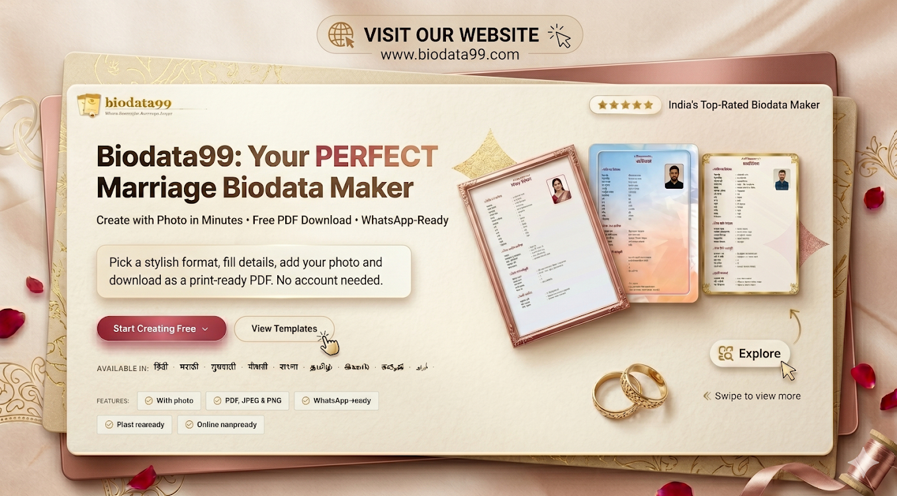
A closer look at how the platform’s guided tools, privacy rules and community-specific formats aim to fix the most common mistakes in marriage biodatas
Anyone who has tried to put together a marriage biodata in Microsoft Word knows the frustration: a photo that will not sit where it is supposed to, spacing that shifts the moment the file is opened on another device, and fonts that render differently on a relative’s laptop than they did on the original computer. Biodata99.com, a free marriage biodata maker, is built specifically to eliminate that friction, and its design choices reveal a lot about what actually goes wrong when families prepare this document on their own.
Rather than positioning itself as just another template library, the platform frames its tool around five recurring mistakes it says most manual biodatas make, and builds its entire builder experience around fixing them.
Mistake One: Messy, Inconsistent Formatting
Inconsistent fonts, uneven spacing and misaligned text are, according to the platform, one of the fastest ways a biodata loses credibility with a prospective family. Biodata99.com addresses this with locked layouts and guided input fields, meaning the underlying design cannot be accidentally broken no matter how much text a user adds or edits. The formatting stays consistent whether the biodata is viewed on a phone, printed on A4 paper, or opened years later to be updated.
Mistake Two: Oversharing Sensitive Information
The platform is unusually direct about privacy risk. Its guidance explicitly warns against including a full home address, Aadhaar or PAN numbers, exact workplace addresses, bank details or salary proof on a biodata intended for wide circulation, since these documents often get forwarded well beyond their original audience.
To reduce this risk, Biodata99.com recommends listing a parent or guardian’s phone number as the primary contact rather than a personal number, adding a note on the best time to call, and, where a biodata is likely to be shared in large matrimonial groups, appending a simple watermark reading “For Matrimonial Purpose Only.” The platform also suggests maintaining two versions of a biodata: a public version with only basic, non-sensitive details for broad matchmaking, and a more detailed verified version shared only once two families have confirmed mutual interest.
Mistake Three: Low-Quality or Inappropriate Photos
Photo selection is treated as its own category of risk. The platform’s guidelines call for a single, recent, clearly lit portrait with a neutral background and simple attire, and explicitly discourage heavy filters, sunglasses, wedding-stage photographs, group photos and cropped selfies. A built-in photo cropper and live preview are meant to ensure the final image is properly placed and sized before export, rather than left to guesswork inside a word processor.
Mistake Four: Multiple, Outdated Versions in Circulation
A subtler problem the platform addresses is version control. Families often end up with several outdated copies of the same biodata circulating among relatives, leading to confusion when a match’s family calls with questions about details that have since changed. Biodata99.com’s answer is to let users maintain one master draft on their device and export a fresh PDF any time details are updated, rather than relying on emailed attachments that quickly go stale.
Mistake Five: Writing Too Much
Long, emotional paragraphs are flagged as one of the biggest readability problems in self-written biodatas. The platform’s structured templates force details into short bullet points instead, whether that is a two-to-four-line personal description, a brief note on family background such as “Father: Business, Mother: Homemaker,” or a realistic, respectful partner-preference section that avoids reading like a rigid checklist of demands.
Built-In Support for Regional and Community Formats
Beyond fixing formatting mistakes, Biodata99.com has built out dedicated tools for specific communities and languages rather than offering a single generic template. Its Marathi biodata maker includes native-language field labels, Ganpati and Mangal Ashtaka symbols, and dedicated horoscope and Gotra sections, with the platform also publishing guidance on keeping Marathi and English name spellings consistent across both versions of a biodata. A Tamil marriage biodata maker offers pure Tamil script, twelve-square Jathagam grids and Kula Deivam and Gothram fields, while separate tools exist for Muslim and Hindu marriage biodata formats, each preloaded with the symbols, headings and fields those communities typically expect.
The platform also offers more than fifty visual template styles, ranging from Classic Golden Corner Border and Royal Maroon Vintage designs to minimalist Elegant Floral White layouts, all of which remain editable within an in-browser studio for colors, backgrounds, frames and fonts.
A Growing Library of Written Guides
Alongside the builder tool, Biodata99.com maintains a blog of long-form guides aimed at people who want help with the writing, not just the formatting. Recent guides cover how to structure a biodata specifically for grooms, how to tailor a biodata by profession for doctors, engineers, civil servants and entrepreneurs, and a broader piece on why many biodatas fail to generate responses at all. Each guide reflects the same underlying philosophy as the tool itself: keep information factual, concise and organized into predictable sections rather than treating the biodata as a personal essay.
No Login, No Server Storage
For a document containing this much personal detail, Biodata99.com has made a point of not requiring account creation. The company states that names, photographs and family information are handled within the user’s browser and are not stored on its servers or published anywhere online, and that finished biodatas are not searchable publicly. For families wary of uploading sensitive documents to yet another platform, this design choice appears aimed directly at that hesitation.
The Bottom Line
Marriage biodatas have not disappeared in the era of matrimonial apps; they remain the standard one-page introduction used by relatives, marriage bureaus, community matchmakers and matrimony sites for initial shortlisting. What Biodata99.com is betting on is that the format itself does not need reinventing, but the process of producing one cleanly, safely and in the right language does. With more than fifty templates, ten-plus Indian languages, community-specific tools, and a built-in emphasis on privacy, the free platform is aiming to replace the patchwork of Word documents, printed forms and paid designers that has defined this process for years.
Brandpost
Vibesocial: Mastering Amazon Reviews, Marketplace Reputation and Sustainable E Commerce Growth
Why Amazon Reviews Matter for Modern Brands
On Amazon and other digital marketplaces, customer perception can influence purchasing decisions within seconds. **Star ratings, recent feedback and seller responsiveness** can shape how shoppers evaluate a product before they even reach the checkout page. For modern D2C businesses, managing this perception requires more than advertising or conventional social media activity. Vibesocial, founded by Ronit Kushwaha, focuses on helping marketplace sellers develop a more systematic approach to reviews, customer feedback and long term brand reputation.
Why Marketplace Reviews Need Specialized Management
Marketplace reputation management is different from general social media management. Platforms such as Amazon operate under specific seller policies and compliance requirements governing how customer feedback can be requested and managed. Businesses therefore need processes that are both effective and responsible. Vibesocial addresses this challenge by focusing on marketplace specific workflows designed to help sellers understand customer sentiment, identify recurring issues and improve the overall post purchase experience.
Turning Reviews into Actionable Business Insights
Customer reviews can provide valuable information beyond a simple star rating. Repeated comments about product sizing, packaging, product information or listing clarity can reveal patterns that may affect customer satisfaction. Instead of treating every negative review as an isolated incident, a structured approach can help brands identify recurring concerns and connect them with improvements in products, listings and customer communication. This turns marketplace feedback into a potential source of practical business intelligence.
Rapidreviews and a Structured Feedback Approach
One of the specialized frameworks associated with Vibesocial is Rapidreviews. Its role is to streamline customer feedback processes and support marketplace reputation management. The focus is not merely on increasing review volume, but on creating organised post purchase touchpoints and authentic feedback collection practices. For sellers, this approach can help create a more consistent customer journey while remaining conscious of marketplace terms of service and compliance expectations.
Improving the Post Purchase Customer Journey
The customer experience continues after an order reaches the buyer. Delivery, product understanding, support and communication can all influence how customers perceive a brand. Vibesocial’s approach places attention on these post purchase touchpoints, helping businesses examine where customer interactions can be improved. When product quality and listing accuracy are combined with a stronger post purchase process, brands can create better conditions for genuine customer satisfaction and organic feedback.
Lescanaux as a Real World Testing Environment
A distinctive part of the ecosystem is Lescanaux, which Ronit Kushwaha uses as a living sandbox within the e commerce environment. The idea is to test marketplace strategies in a real operating context rather than relying only on theoretical recommendations. According to the provided framework, workflows ranging from listing optimisation to Rapidreviews deployment can be implemented and refined through Lescanaux. This creates an ongoing feedback loop focused on practical performance and measurable return on investment.
Connecting Vibesocial, Rapidreviews and Lescanaux
The three components serve different but connected functions. Vibesocial provides digital brand positioning, marketplace and reputation expertise. Rapidreviews supports structured customer feedback management. Lescanaux provides a commercial environment where marketplace strategies can be applied and refined. Together, they create a model in which real world observations can inform client strategies, while recurring marketplace challenges can influence the development of new workflows and solutions.
A More Responsible Approach to Marketplace Growth
Sustainable marketplace growth is not simply about generating more traffic. Brands also need strong product presentation, reliable customer experiences, authentic feedback and awareness of platform requirements. By bringing these areas together, Vibesocial’s approach places customer perception within a broader growth strategy. The emphasis on authentic feedback, compliance conscious processes and continuous improvement provides a more structured alternative to reactive reputation management.
Building Long Term Marketplace Authority
As competition increases across Amazon and other marketplaces, brand authority can become an important differentiator. Businesses that consistently listen to customers, address recurring concerns and improve their post purchase experience are better positioned to build trust over time. Through the combined ecosystem of Vibesocial, Rapidreviews and Lescanaux, Ronit Kushwaha is developing a marketplace focused framework that connects strategy with real world execution. The larger objective is to help e commerce businesses build resilient brands that can grow beyond short term advertising performance.
Explore Lescanaux
For more information about Lescanaux and its ongoing e commerce journey, visit the Lescanaux Instagram profile.
Brandpost
The Highway Stop I Didn’t Expect to Fall in Love With
A road-tripper’s account of JollyGo Food Court, the Yamuna Expressway landmark turning a Delhi-Agra drive into part of the destination.
I’ll be honest – I wasn’t expecting to write 1,200 words about a food court. Highway stops are supposed to be functional: pull in, use the washroom, grab a chai, get back on the road before the kids start asking “are we there yet” again. That’s the deal you make with a long drive.
Then I pulled into JollyGo, somewhere along the Yamuna Expressway near Jewar, and the deal changed.
A Building That Makes You Pull Over Twice
The first thing that gets you is the architecture – which is not a sentence I expected to type about a highway dhaba. One of JollyGo’s two properties here borrows from Dutch design: clean gables, old-world detailing, the kind of silhouette you’d photograph in a European town square. The other leans more intricate detailing and colour – soaring lines, a quiet, contemplative calm that feels completely out of place next to a toll plaza, in the best way. I actually did a U-turn in the parking lot to get a second look before I’d eaten a single bite. I wasn’t the only one – every few minutes, someone else was doing the same thing, phone out, walking backward to fit the whole building in frame.
Everything, All at Once
At Jolly Da Dhaba, it’s North Indian comfort food done properly -thalis, parathas, chole bhature, the works. A few counters over, Murthy’s is turning out South Indian dosas and idlis with filter coffee that actually tastes like filter coffee, not the highway-stall version. I ordered a kulhad chai just to see if it lived up to the reviews, then ended up back in line twenty minutes later for a full deluxe thali because I’d changed my mind about “just a quick stop.” That seems to be the pattern here -whatever you’re craving, JollyGo tends to have it, and it tends to be good enough that you order more than you planned.
The Comfort of the Familiar, Right Next to the Adventurous
What struck me next was the brand mix. Starbucks, KFC, Burger King, Domino’s,Baskin-Robbins -all the names you’d recognise from any city mall – sitting shoulder to shoulder with the Indian counters. For the family in the car ahead of me, clearly on their way to Agra with an exhausted toddler, that Starbucks cup was a small mercy. For me, it meant I could talk a slightly nervous friend into trying kulhad chai for the first time, because I knew if it wasn’t her thing, a Baskin-Robbins scoop was thirty seconds away. It’s a strange kind of anxiety-free stop: nothing here is a gamble.
The Details You Don’t Expect to Notice – Until You Do
Here’s the part that actually earned my trust: I could watch several of the counters cook. Not through a service window, but right there, live -fresh ingredients going in, plates coming out, nothing hidden. After a few too many questionable roadside stalls over the years, that visibility matters more than I’d like to admit. The washrooms backed it up -genuinely clean, with separate facilities for families and women.
The Staff Remember You’re a Person, Not a Transaction
If the building gets you to stop the car, it’s the people who make you want to come back. I watched a floor manager crouch down to talk a lost toddler through finding her parents while three separate orders waited on his counter -patient, unhurried, like it was the only thing happening. That kind of attentiveness shows up in review after review, guests naming individual staff members the way you’d thank a friend. For a place that sees a relentless, ever-changing flow of travellers every single day, that’s not an easy thing to keep up. JollyGo has, somehow.
A Small World, Off a Big Highway
Sitting on the road to Agra -and now minutes from the newly opened Noida International Airport at Jewar -JollyGo has become an unlikely meeting point for the world. I watched a group of overseas visitors, clearly just off a long-haul flight and clearly not local, working their way through paratha thalis and masala kulhad chai with the wide-eyed enthusiasm of people trying something completely new. For a lot of them, this was probably their first taste of home-style Indian food -and the staff seemed to know it, taking a little extra time to explain what was on the plate. It’s a strange and lovely thing to witness: someone’s first real meal in India happening at a highway stop.
The Story Doesn’t End at Jewar
Here’s the part that made me sit up: JollyGo isn’t staying put. The brand has opened a new outpost nearly a thousand kilometres away, in Sendhwa, right on the Mumbai-Agra highway where Madhya Pradesh meets Maharashtra -a route travelled daily by an entirely different crowd of interstate drivers, families, and long-haul truckers. Same idea, new highway: architecture worth stopping for, the same mix of Indian and international food, the same visible hygiene standards, the same kind of staff who actually look up when you walk in.
JollyGo, At a Glance
- Where: Yamuna Expressway near Jewar, UP -both the Delhi-Agra and Agra-Delhi sides -plus a new stop in Sendhwa on the Mumbai-Agra highway
- Rating: around 4.8 out of 5 across hundreds of Tripadvisor reviews
- Food: North Indian, South Indian, Chinese, and Italian, alongside classic highway favourites
- Brands on site: Starbucks, KFC, Burger King, Domino’s, Baskin-Robbins, Murthy’s & Jolly da Dhaba
- Accessible by design: wheelchair ramps, separate and well-maintained washrooms for families and women
More Than a Pit Stop
I’ve driven the Delhi-Agra route more times than I can count, mostly treating every stop along the way as a necessary interruption rather than part of the trip. JollyGo is the first one that’s changed that math for me. The architecture gets you out of the car. The food, the visible hygiene, and honestly the people are what make you linger longer than you meant to. And with a second outpost now open on the Mumbai-Agra highway, it seems I’m not the only one who thinks a highway break deserves better than a vending machine and a dirty washroom. Some journeys are about the destination. On this one, I’d argue the food court is part of it.
Brandpost
Custom Hologram Labels: Why Indian Brands Are Turning to Advanced Anti-Counterfeit Packaging
Counterfeiting continues to cost Indian businesses billions of rupees every year, pushing brand owners across pharmaceuticals, FMCG, electronics, cosmetics and automotive sectors to invest in stronger product authentication measures. Among the most reliable and cost-effective solutions available today are custom hologram labels — tamper-evident security stickers that make it visually obvious when a product has been altered, duplicated or resold illegitimately. As counterfeit networks grow more sophisticated, hologram stickers with layered security features have moved from being a premium add-on to a near-essential requirement for brand protection.
What Makes Custom Hologram Labels Different
Unlike ordinary printed stickers, custom hologram labels use laser-based imaging to create three-dimensional optical effects that shift and change as the label is tilted under light. This effect is extremely difficult and expensive to replicate, which is exactly why it works as a deterrent. Suppliers such as Holoseal source and supply these labels in 24 or 36 micron metalized polyester film, finished with an 80 GSM silicone-coated release liner, so the labels apply cleanly by hand or through automated labeling machinery on production lines. Brands can add their own logo, unique serial numbers, and scannable QR codes directly onto the hologram, turning a simple security sticker into a complete authentication and traceability tool.
Tamper Evident Hologram Labels: A Visible Deterrent
One of the biggest advantages of tamper evident hologram labels is that they leave permanent, visible proof when someone tries to remove or reuse them. In a plain tamper-evident structure, peeling the label causes the clear film layer to separate while the metalized holographic portion remains stuck to the surface, rendering it unusable elsewhere. This irreversible damage protects products from repackaging fraud, refilling scams, and unauthorized resale — issues that are especially common in categories like cosmetics, liquor, lubricants, and packaged food. For businesses shipping products through long and sometimes unpredictable supply chains, this single feature can prevent significant revenue loss and protect brand reputation.
Void Hologram Labels for Maximum Security
For industries where the stakes are even higher — such as pharmaceuticals, electronics, and high-value goods — void hologram labels offer an additional layer of protection. When a void hologram label is peeled off, a clear ‘VOID’ pattern appears on both the label itself and the surface it was attached to, instantly signalling that the package has been opened or tampered with. This makes disputes over tampering far easier to resolve and gives consumers, distributors, and regulators an unmistakable visual cue. Void hologram technology is considered one of the more advanced tamper-evident options and is not offered by every hologram labels supplier, making it a differentiator for companies that prioritize security over cost alone.
Serial Number Hologram Stickers for End-to-End Traceability
Security is only part of the picture — traceability matters just as much for modern brands. Serial number hologram stickers use laser-etched unique numbers on every label, creating a one-to-one link between each physical product and its authentication record. This enables precise batch tracking, warranty registration, and verification of limited-edition or high-value items. When combined with QR code integration, customers can scan a label to instantly confirm a product’s authenticity through an online verification portal, while brands gain valuable data on distribution patterns and potential leakage points in their supply chain.
Silver, Gold and Custom Colour Options
Beyond security, hologram labels also serve a branding purpose. Silver and gold holograms remain the most popular choices because of their premium, reflective finish that immediately signals authenticity and quality on a shelf. However, suppliers increasingly offer transparent, red, blue, green, copper, and fully custom colour options so that the hologram complements rather than competes with packaging design. Transparent hologram stickers, in particular, are gaining traction among cosmetics and beverage brands that want security features without covering their carefully designed packaging artwork. Since precise colour-shift effects are difficult for counterfeiters to replicate, colour itself becomes an added layer of protection rather than just an aesthetic choice.
Why Businesses Choose Holoseal as Their Hologram Label Supplier
Holoseal has built its reputation as a dependable hologram labels supplier in India by combining over 15 years of industry experience with a wide catalogue of security features — from plain tamper and void tamper to dotmatrix, kinegram, and 2D/3D holography. The company works with businesses of every size, offering both custom-designed holograms built around a brand’s own artwork and ready-stock options like ‘Original Genuine,’ ‘OK Tested,’ and ‘QC Passed’ labels for companies that need fast turnaround without a master die. Labels are supplied in convenient sheet form for manual, smaller-batch use, or in roll form for high-speed automated application across FMCG and pharmaceutical production lines.
Because counterfeiting is not limited by geography, Holoseal supplies hologram labels to businesses across India as well as international markets, catering to sectors including pharmaceuticals, FMCG, textiles, automotive, electronics, agriculture, and banking. Every label is backed by technical support to help brands choose the right combination of material thickness, tamper-evident structure, colour, and smart tracking features for their specific product and industry.
The Bottom Line
As counterfeit goods continue to infiltrate markets across India and beyond, hologram security labels remain one of the most practical, affordable, and visually convincing ways for brands to protect their products and their customers. Whether a company needs simple tamper evidence, a full void security response, or serialized QR-linked traceability, the technology has matured to a point where nearly every industry can find a hologram solution that fits its risk profile and budget. For brand owners evaluating anti-counterfeiting strategies in 2026, custom hologram labels deserve a serious look — not as an optional extra, but as a foundational layer of product protection.
For more information on hologram label specifications, pricing, and samples, visit Holoseal’s hologram labels page or reach out to their India and worldwide supply teams directly.
Website —https://holoseal.in/
Main Product —https://holoseal.in/hologram-labels/
Other Products —
https://holoseal.in/holographic-strips
https://holoseal.in/holographic-stamping-foils
https://holoseal.in/holographic-films
Geo Target Pages —
-
Brandpost2 years agoRedfox Overseas: Customize Your Own Energy Drink and Stand Out in the Market
-
Brandpost2 years agoZamzam Company CEO Chhote Bhai-Bade Bhai gave a grand welcome to Indian writer Devhari Sirvi in Dubai
-
Fashion2 years agoShikha Sharma: The Fashion Journalist, Blogger, and Plus-Size Model Taking the Industry by Storm
-
Entertainment1 year ago
Lucky Roxx’s “Yadav Ki Pukar” Goes Viral! Youth Celebrate Unity & Power
-
Entertainment9 years agoNew Season 8 Walking Dead trailer flashes forward in time
-
Entertainment9 years agoMeet Superman’s grandfather in new trailer for Krypton
-
Brandpost2 years agoFrom Local Hero to National Icon: Satyam Yadav’s Journey with TwentyOne
-
Uncategorized2 years ago
Hello world!