
Brandpost
Share Google Drive Files Faster with Direct Download Link Generator


A new web-based tool is transforming how users share digital content across platforms. DownloadableLinks.com, developed by Indian digital innovator Joseph James, enables users to convert shared URLs from cloud services such as Google Drive, Dropbox, and OneDrive into direct download links — eliminating frustrating preview screens, popups, login prompts, and other delays.
The platform provides a streamlined solution for creators, educators, and professionals who want to share downloadable files directly, without requiring recipients to navigate through traditional cloud interfaces. With no installations or user accounts required, DownloadableLinks.com presents itself as a fast, secure, and user-friendly alternative to conventional file-sharing methods.
The conventional process of sharing a file via Google Drive or similar services often involves multiple steps: viewing a preview, logging into an account, or searching for a small download icon. These additional clicks can hinder file accessibility and diminish user engagement — particularly among mobile users or non-technical audiences. DownloadableLinks.com addresses this problem by allowing users to paste a public file URL into its tool and generate a clean direct download link in just one click. These links immediately trigger the file download, skipping unnecessary intermediary steps.
“Speed and simplicity were my top priorities while designing this tool,” said Joseph James, the platform’s founder. “Having worked across creative industries, I realized how essential it is to deliver files without interruptions. This tool is built for exactly that purpose.”
The tool is already being adopted by professionals in education, marketing, software development, publishing, and events. By simplifying how downloadable resources are shared, it helps brands and creators retain their audience’s attention while improving the overall delivery experience. Industries leveraging the tool include education for sharing lesson plans and PDFs, marketing for delivering lead magnets and campaign resources, development for distributing executable files or source code, publishing for linking eBooks or white papers, and events for sending passes, brochures, and digital invitations. The platform’s flexibility and ease of use have made it particularly useful for content creators such as YouTubers and bloggers, who often need to share downloadable assets with their audiences.
Unlike many file link converters or leech tools that are riddled with ads or require registration, DownloadableLinks.com prioritizes a privacy-first experience. The tool does not track, store, or log any data, and all files remain hosted securely on the user’s own cloud storage platform. It supports widely used file formats such as PDFs, ZIP archives, images, videos, Microsoft Office documents, and more. Everything runs within the browser — no installation or signup required.
Joseph James, founder of DownloadableLinks.com, is a creative technologist recognized for his unique ability to blend design thinking with functional development. His career spans a wide range of digital domains including web development, UI/UX design, media production, and creative automation systems. Throughout his independent projects and collaborations, Joseph has consistently focused on building tools that simplify digital complexity and enhance user experience. Whether he’s crafting minimalist web utilities or designing user interfaces for broader platforms, his work centers on reducing friction and delivering intuitive solutions. His public portfolio on LinkedIn and other creative platforms reflects a deep commitment to human-centered design — from scalable automation workflows and branded visual systems to smart, accessible education tech tools. Joseph’s projects don’t just solve problems; they reimagine how users interact with digital content in meaningful, efficient ways.
Connect on LinkedIn: Joseph James.
The main functionality of the platform is its ability to convert any public file link into a direct download URL. Currently supported platforms include Google Drive, Dropbox, and OneDrive. Planned expansions include Box, pCloud, and other cloud storage services. Additional highlights include cross-device compatibility, universal format support, clean UX with zero ads or redirects, embed-ready links for websites and emails, and a free-to-use model without any sign-ups or subscription plans.
The tool’s simplicity is a major draw. Users paste a shareable cloud link into the platform, click a button, and instantly receive a direct link. This link can be shared via email, embedded in a web page, or included in forms and online lessons. Common use cases include embedding files in email newsletters, linking ZIP or PDF downloads in blog articles, sharing materials with remote students, and sending downloadable deliverables to clients.
While tools like PrimeLeech and Cocoleech offer similar file access services, many are cluttered with advertising or require login to unlock basic features. DownloadableLinks.com sets itself apart with its ad-free interface, no registration policy, and strong privacy principles. The platform also avoids the use of shortened URLs, proxy redirects, or daily usage limits. Everything is designed around user trust, speed, and transparency. This approach has earned early praise from digital marketers, educators, and independent developers for its consistent performance and ease of integration.
Joseph James has revealed several upcoming developments for the tool, including a browser extension for instant link generation, private links with expiration settings and limited access, download analytics and tracking, and API support for automation and workflow integration. These enhancements are expected to expand the platform’s use among professional teams, SaaS providers, and high-volume content distributors.
In a digital world where file sharing often comes with trade-offs — popups, paywalls, or frustrating delays — DownloadableLinks.com provides a clean, reliable alternative. It removes obstacles from the file download process, helping users deliver content in the most efficient way possible. Whether for education, business, or personal use, this tool is helping define a new standard for how downloadable files are accessed online.


Brandpost
From Indore to India: How Akash Joshi Is Building Grawish into One of India’s Leading Digital Marketing Agencies After Helping Build a ₹100 Crore-Valued Enterprise


In today’s digital economy, businesses are no longer competing solely on the quality of their products or services. They are competing on visibility, trust, customer experience, and the ability to build meaningful relationships in an increasingly connected world. Companies that embrace digital transformation, strategic branding, and data-driven marketing are the ones creating sustainable growth.
At the forefront of this transformation is Akash Joshi—an entrepreneur, TEDx Speaker, National Award-Winning Entrepreneur, business strategist, and digital transformation expert. With more than 15 years of entrepreneurial experience, Akash has consistently focused on helping businesses leverage technology and innovation to achieve measurable growth. After helping build a technology company that grew into a ₹100 crore-valued enterprise, he founded Grawish with a vision to redefine how businesses approach branding and digital marketing.
Headquartered in Indore, Madhya Pradesh, Grawish has emerged as one of the city’s leading digital marketing and branding agencies, serving startups, SMEs, enterprises, and entrepreneurs across India. More than a marketing agency, Grawish positions itself as a strategic growth partner by combining creativity, technology, artificial intelligence, and business consulting.
Grawish was built on a simple philosophy: marketing should create measurable business growth—not merely digital visibility. Every engagement begins with understanding a client’s business, customers, competitors, and long-term vision. This allows the team to develop integrated strategies that connect branding, content, advertising, technology, analytics, and customer experience into one unified growth engine.
Today, Grawish offers end-to-end solutions including Digital Marketing, Branding, Performance Marketing, Google Ads, Meta Ads, SEO, Website Development, Personal Branding, Founder Branding, LinkedIn Marketing, Corporate Video Production, Podcast Production, Creative Design, AI Marketing, Marketing Automation, Public Relations, Event Branding, and Business Growth Consulting.
The company proudly highlights a team of 100+ marketing, branding, creative, technology, and AI professionals; service delivery for 100+ leading brands; 90% of projects delivered within committed timelines; and a 90% client retention rate. These milestones reflect Grawish’s commitment to quality, speed, innovation, and long-term client relationships.
One of Grawish’s key differentiators is its focus on Founder and Personal Branding. The company helps entrepreneurs, CEOs, consultants, doctors, industrialists, and professionals build authority through LinkedIn strategy, executive positioning, podcasts, thought leadership, strategic storytelling, and premium content creation.
Artificial Intelligence is another major pillar of Grawish’s growth strategy. The agency integrates AI into research, audience analysis, content planning, automation, campaign optimisation, and reporting while ensuring that human creativity and business strategy remain at the centre of every campaign.
Grawish has worked with businesses across real estate, pharmaceuticals, manufacturing, healthcare, education, hospitality, retail, financial services, food and beverage, technology, and professional services. Every strategy is customised to the client’s industry, market, and objectives rather than relying on generic templates.
Under Akash Joshi’s leadership, innovation, continuous learning, accountability, and customer success define the company’s culture. The vision is to build a company from Indore that serves businesses across India and eventually global markets while creating measurable impact through branding, technology, and AI-driven marketing.
For Akash, success is measured not only by revenue or recognition but by the businesses that grow stronger through Grawish’s work. With ambitious plans for expansion, deeper AI capabilities, stronger consulting services, and world-class creative execution, Grawish is steadily progressing toward its vision of becoming one of India’s most respected digital marketing agencies.
The journey from Indore to India has only just begun.
A claim that sounds almost old-fashioned in an era of mass-manufactured jewellery sits at the center of how Shree Ram Jewellers describes its own work: every piece of silver shringar it creates for Baba Mahakal, the presiding deity of Ujjain’s Mahakaleshwar Jyotirlinga temple, is made entirely by hand, with no machine involved at any stage.
According to the store’s owner, Siddharth Soni, each design is shaped, engraved, and finished manually, a process that depends on traditional silverwork techniques built up over years of practice rather than templated production methods. Handmade silverwork of this kind generally takes considerably longer per piece than machine-assisted manufacturing, a tradeoff craftsmen in this space typically accept in exchange for the kind of intricate, non-repeating detail that mechanized processes struggle to replicate exactly.
Why Hand Craftsmanship Matters for Ritual Objects
Ceremonial items used in temple worship — crowns, crescent moons, ritual vessels — are not purely decorative; they’re expected to function correctly within a specific sequence of rituals, including Bhasma Aarti, Sandhya Aarti, and Bhog Aarti at the Mahakaleshwar temple. That functional requirement, alongside aesthetic expectations tied to specific festivals such as Mahashivratri and the Shravan month, means a craftsman working on temple silver needs familiarity with ritual timing and deity iconography that a purely decorative jeweller might not develop.
What “No Machines” Actually Involves
Fully handmade silverwork typically means every stage — melting and shaping raw silver, engraving fine detail work, and final finishing and polishing — is done using hand tools rather than machine-assisted cutting, stamping, or casting equipment common in larger-scale jewellery production. Shree Ram Jewellers has not detailed publicly which specific hand techniques it uses for different pieces, information that would help distinguish its process from other handmade silverwork studios making similar craftsmanship claims.
The store’s emphasis on originality — describing its designs as difficult to find replicated elsewhere in Ujjain or, according to the owner, across India — reflects a common positioning strategy among specialist craft businesses generally, where uniqueness of design is presented as a direct consequence of the handmade process itself rather than a separate marketing claim. For devotees or collectors evaluating handmade silverwork from any craftsman, asking to see the specific stages of production, or requesting examples of past commissioned work, remains a reasonable way to assess a claim of full handcraftsmanship.
Time investment is one of the more tangible tradeoffs of fully handmade production: a single intricate piece can take considerably longer to complete than an equivalent machine-assisted design, meaning a workshop committed to hand craftsmanship across its full product range is generally limited in how many commissions it can take on simultaneously compared to a larger operation using mechanized production methods.
That capacity constraint may also help explain why reputation-driven, word-of-mouth growth suits a fully handmade workshop better than an advertising-driven model built around high volume, since a business that can only produce a limited number of pieces at a time has less to gain from broad marketing reach than from cultivating a smaller base of devotees willing to wait for a genuinely handcrafted commission.
Brandpost
Retrograde: From a Teenager’s Question to Building India’s Most Complete AI-Driven Vedic Astrology Platform
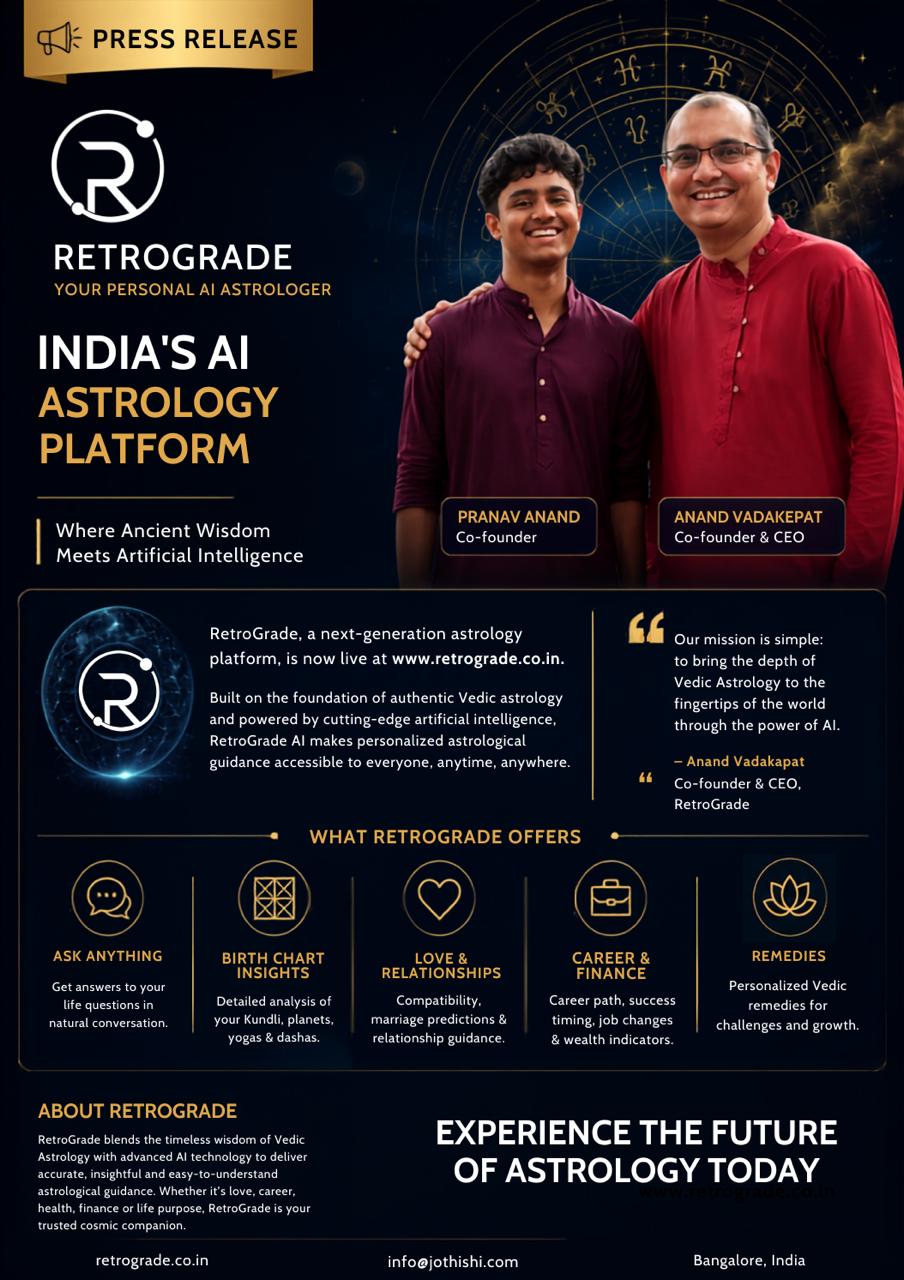
In a country where millions still wait weeks for a trusted astrologer’s time, or lie awake at 2 a.m. wondering whether to take the job, say yes to the marriage, or book the flight abroad, Retrograde has emerged as a quiet but transformative force. More than just an app, it is an AI-driven Vedic astrology platform, built on the astrology engine at Jothishi.com with Parashara and Jaimini priciples, that helps people find clear, personalized answers on career, relationships, marriage, health, wealth, business, moving abroad, and the other turning points of life — from home, at any hour, on a web app or on iPhone and Android.
The story of Retrograde begins with a simple observation. Good decisions change the course of a life, but the people best equipped to help make them — experienced Vedic astrologers, working through a birth chart’s full depth — are scarce, booked out, and often out of reach for a quick, honest question. Pranav, a 16-year-old in the 12th grade at National Public School, Bangalore, saw this gap alongside Anand Vadakepat of Jothishi, whose own work had spent years building the classical astrology engine now powering the platform. Together, they set out to build something different: not a horoscope column repackaged into an app, but a genuine astrologer’s depth of reasoning, made instantly available to anyone who needed it.
Retrograde is also a story about what has newly become possible. This is the age of the one-person company — a moment when a single founder, armed with AI and large language models, can build and ship what once required a full startup’s worth of engineers. That a 16-year-old still finishing high school could build, alongside one collaborator, one of the most complete AI-driven Vedic astrology platforms on the market is itself the clearest evidence of how far that shift has come.
The name carries its own meaning, deliberately chosen. Viewed from Earth, planets normally appear to move steadily in one direction across the sky — what astronomers call direct motion. Occasionally, a planet appears to slow, stop, and drift backward before resuming course — an optical effect of relative orbital speeds that Vedic astrology calls Vakri gati, or retrograde motion. Ketu, the lunar south node, is considered to move perpetually opposite every other planet — eternally reversed, eternally Vakri. Pranav and Anand named the platform Retrograde for exactly that idea: the moment a person pauses, turns inward, and reconsiders their direction before moving forward again. That pause, not indecision but reflection, is precisely what Retrograde exists to support.
Underneath that name is a serious piece of engineering. Retrograde’s answers are generated by 1000 agents programmed to help answer about 10000 probable queries that a person could have with an AI engine applying the classical framework of Vedic astrology — the Brihat Parashara Hora Shastra’s Parashari system alongside the Jaimini Sutras, a person’s Nakshatra placements, every divisional (varga) chart from D1 through D60, multiple dasha timing systems, Ashtakvarga strength scoring, and Panchanga for auspicious timing — rather than a generic, one-size-fits-all horoscope. A user shares their birth details once, then simply asks a question in plain language. Retrograde returns a personalized answer, grounded in that individual’s own chart, in seconds, on whichever device they already have in hand. The model is build to learn daily and currently has about 70 percent accuracy and hopes to attain 95 percent accuracy as it learns over the years with its RAG system architecture.
What sets Retrograde apart as a brand is its underlying philosophy: that good decisions, made with clarity rather than anxiety, are what make a life happier. Career changes, marriages, health choices, financial bets, big moves — these are the decisions people most want a second, wiser opinion on, and most struggle to get one for. By making that depth of guidance available instantly and privately, from home, Retrograde is betting that easier access to good decisions is itself a form of wellbeing.
That philosophy is beginning to build real credibility. Early users are discovering Retrograde largely through word of mouth — the trust that spreads when an answer resonates with someone’s actual life rather than reading like a generic prediction. In a category crowded with novelty apps and recycled sun-sign content, Retrograde stands out for going deeper: real classical methodology, applied to a real question, answered in real time.
Retrograde’s journey — from one teenager’s question to a genuinely comprehensive AI-driven Vedic astrology platform — reflects both the founders’ ambition and the new tools now available to build with. Looking ahead, Retrograde plans to deepen its astrological coverage and expand across web and mobile, while holding onto the belief at its core: honest, personalized guidance, available in the moment people need it, leads to better decisions — and better decisions add up to a happier life.
Learn more at www.retrograde.co.in.


From Indore to India: How Akash Joshi Is Building Grawish into One of India’s Leading Digital Marketing Agencies After Helping Build a ₹100 Crore-Valued Enterprise
No Machines, No Shortcuts: Inside Shree Ram Jewellers’ Handmade Approach to Temple Silver

Retrograde: From a Teenager’s Question to Building India’s Most Complete AI-Driven Vedic Astrology Platform

Redfox Overseas: Customize Your Own Energy Drink and Stand Out in the Market

Zamzam Company CEO Chhote Bhai-Bade Bhai gave a grand welcome to Indian writer Devhari Sirvi in Dubai

Shikha Sharma: The Fashion Journalist, Blogger, and Plus-Size Model Taking the Industry by Storm
-
 Brandpost2 years ago
Redfox Overseas: Customize Your Own Energy Drink and Stand Out in the Market
-
 Brandpost2 years ago
Zamzam Company CEO Chhote Bhai-Bade Bhai gave a grand welcome to Indian writer Devhari Sirvi in Dubai
-
 Fashion2 years ago
Shikha Sharma: The Fashion Journalist, Blogger, and Plus-Size Model Taking the Industry by Storm
-
Entertainment1 year ago
Lucky Roxx’s “Yadav Ki Pukar” Goes Viral! Youth Celebrate Unity & Power
-

 Entertainment9 years ago
Meet Superman’s grandfather in new trailer for Krypton
-
Entertainment9 years ago
New Season 8 Walking Dead trailer flashes forward in time
-

 Business2 years ago
The journey of Matrix Coded: From a freelancer to a renowned brand
-

 Brandpost2 years ago
From Local Hero to National Icon: Satyam Yadav’s Journey with TwentyOne