Connect with us

Brandpost

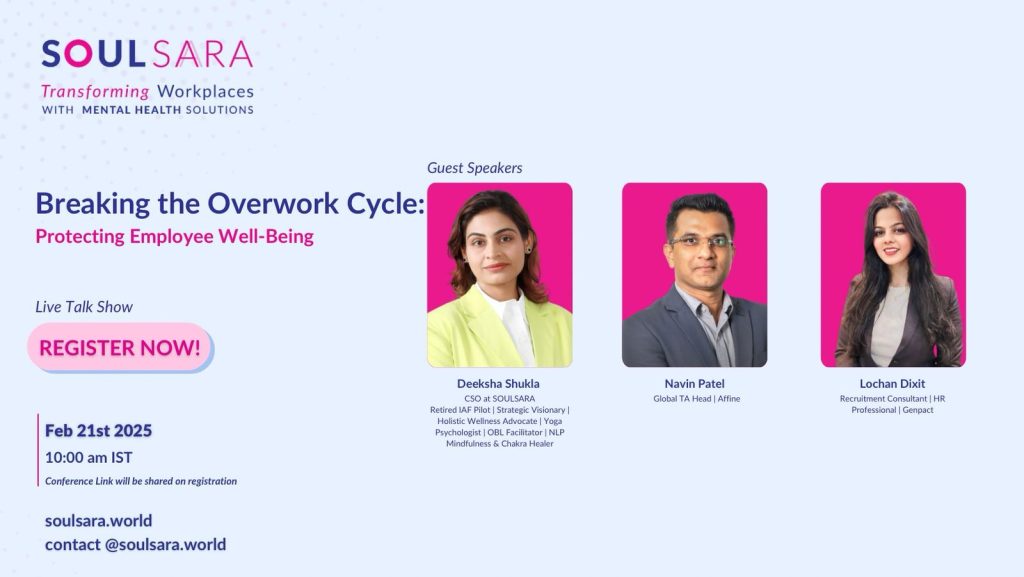
SOULSARA Announces Exclusive Webinar on “Breaking the Overwork Cycle: Protecting Employee Well-Being”
Published

on

Long hours, tight deadlines, and an “always-on” work culture have significantly increased stress levels, leading to burnout. According to a recent report by Gallup, 43% of employees worldwide experience workplace burnout, and the World Health Organization (WHO) now officially classifies burnout as an “occupational phenomenon.”

The consequences of prolonged overwork are profound—decreased productivity, increased absenteeism, low morale, and high turnover rates. Organizations are now prioritizing employee well-being as a key business imperative, shifting from reactive to proactive approaches.

The challenge for leaders and HR professionals is clear: How can companies create a culture of well-being that supports employees while maintaining operational excellence? SOULSARA, a leading SaaS HealthTech company specializing in mental health solutions, is bringing together industry experts to tackle this critical issue in an insightful webinar on February 21, 2025.

Join Us for an Exclusive Webinar on Breaking the Overwork Cycle

SOULSARA invites HR professionals, business leaders, and employee well-being advocates to an engaging session on preventing burnout and promoting sustainable workplace wellness. This one-hour webinar will feature insights from seasoned experts in workplace well-being, talent acquisition, and employee engagement, offering actionable strategies to create a healthier work environment.

The session will cover:

  • The impact of overwork on employees and organizations
  • Strategies to prevent burnout and enhance work-life balance
  • The role of HR and leadership in fostering a well-being culture
  • Practical solutions for improving employee engagement and retention

This insightful discussion will feature three distinguished speakers, each bringing unique expertise and perspectives to the conversation.

Meet Our Expert Speakers

Deeksha Shukla – Co-founder & Chief Strategy Officer, SOULSARA

A passionate wellness advocate, Deeksha merges ancient wisdom with modern science to champion holistic well-being. With deep expertise in mindfulness and time management, she is a recognized leader in fostering meaningful workplace transformation and sustainable employee wellness. Deeksha’s approach focuses on proactive mental health strategies that empower organizations to create a thriving and balanced work culture.

Navin Patel – Global Talent Acquisition Head, Affine

With over 20 years of experience in IT and talent acquisition, Navin is a strategic hiring expert skilled in designing workforce agility plans for global enterprises. A Six Sigma Green Belt, he has managed high-volume recruitment across India, the US, UK/EU, and APAC, hiring up to 8,000 employees annually. Navin is a sought-after HR strategist, speaker, and mentor, deeply invested in employee engagement and organizational well-being. His expertise will provide insights into how recruitment strategies can be aligned with mental wellness initiatives to create a healthy and resilient workforce.

Lochan Dixit – Recruitment Consultant & Employee Well-Being Advocate, Genpact

A dynamic HR professional and recruitment expert, Lochan specializes in hiring for the Financial Crime domain, successfully placing 100+ candidates in critical roles within a year. Twice awarded Employee of the Quarter, she firmly believes that “Employee well-being = Company success.” She is a strong advocate for Diversity & Inclusion and has published thought leadership on workplace equity and women empowerment. Her session will provide valuable insights into integrating employee well-being into HR strategies, ensuring a supportive work environment for all employees.

Why You Should Attend

This webinar is an essential opportunity for HR professionals, business leaders, and wellness advocates to gain valuable insights into employee well-being. If your organization is looking to enhance productivity, reduce turnover, and build a culture of resilience, this session is not to be missed.

Register now and be part of the movement towards a healthier, happier workplace!


Brandpost

I Sharp Academy – Leading NEET Tamil Medium Coaching Center in Coimbatore

Published

on

By

Students aspiring to become successful medical professionals are constantly searching for the best coaching institute that offers quality education, expert guidance, and personalized mentoring. I Sharp Academy has emerged as a trusted name for medical entrance preparation and is widely recognized as a top NEET Tamil Medium Coaching Center in Coimbatore. Established on 10 September 2011, the academy has helped thousands of students achieve their dreams through structured coaching programs and result-oriented teaching methodologies.

With more than a decade of excellence in coaching, I Sharp Academy provides specialized training for NEET aspirants from Tamil Medium backgrounds. The institute focuses on conceptual clarity, regular assessments, and individual attention, making it a preferred NEET Tamil Medium Coaching Center in Coimbatore for students aiming to secure admissions in top medical colleges.

One of the major strengths of I Sharp Academy is its experienced faculty team, who simplify difficult NEET concepts and provide easy-to-understand explanations in Tamil. The academy offers comprehensive study materials, mock tests, previous year question paper discussions, and one-on-one doubt clearing sessions. These features have positioned the institute among the most trusted choices for students searching for a reliable NEET Tamil Medium Coaching Center in Coimbatore.

The academy’s student-focused approach ensures that every aspirant receives proper guidance and motivation throughout their NEET preparation journey. Separate batches for Tamil Medium students, systematic test series, and performance analysis have made I Sharp Academy a highly recommended NEET Tamil Medium Coaching Center in Coimbatore. Students benefit from a learning environment that encourages confidence, discipline, and academic excellence.

Located in the heart of Gandhipuram, Coimbatore, the academy is easily accessible for students across the city and nearby regions. Over the years, I Sharp Academy has built a strong reputation for producing successful NEET candidates and helping students secure admissions in reputed medical institutions. This commitment to quality education has strengthened its identity as a premier NEET Tamil Medium Coaching Center in Coimbatore.

Apart from NEET coaching, the academy also offers guidance for JEE, CAT, MAT, and TANCET examinations. However, its dedicated NEET programs for Tamil Medium students continue to attract aspiring doctors who seek personalized coaching and expert mentorship. With modern teaching strategies and continuous academic support, I Sharp Academy remains a preferred NEET Tamil Medium Coaching Center in Coimbatore for future medical professionals.

Parents and students looking for a dependable coaching institute can confidently choose I Sharp Academy for quality NEET preparation. The academy’s mission is to empower students with knowledge, confidence, and exam-oriented strategies that ensure outstanding results. This dedication has helped the institute maintain its reputation as a successful NEET Tamil Medium Coaching Center in Coimbatore.

Contact Details

Institute Name: I Sharp Academy

Established Date: 10 September 2011

Website: www.isharpacademy.in

Phone Number: 9894850370

Address: No.207, A.K Complex, 2nd Floor, 6th Street, Cross Cut Rd, Gandhipuram, Coimbatore, Tamil Nadu – 641012

For students aiming to excel in NEET examinations with Tamil Medium coaching support, I Sharp Academy continues to stand out as a trusted and result-oriented NEET Tamil Medium Coaching Center in Coimbatore.

Continue Reading

Brandpost

“The Homes We Dream Of”: A Book That Speaks for the Forgotten — Niteesha Salgaonkar on Housing, Dignity, and the Stories That Must Be Told

Published

on

Every city has two skylines. There is the one that appears in tourism brochures — glass towers, expressways, gleaming metro stations. And then there is the other one: cramped settlements hemmed in by those very towers, where families negotiate every day for the basic dignity of a roof that doesn’t leak.

It is the second skyline that Niteesha Salgaonkar writes about. Her debut work of fiction, The Homes We Dream Of, arrives at a time when India’s urban development story is being told almost entirely from the top down — and makes an urgent, unambiguous case for hearing the voices at the bottom.

The World of Lotus Nagar

The novel is set in Lotus Nagar, a fictional settlement that will feel familiar to anyone who has spent time in the resettlement colonies and informal clusters that ring Indian cities. At its center are Durga and her young daughter Radha — a mother and child trying to hold a life together in a home that is, in every sense of the word, precarious. Leaking tin roofs. Walls that shudder in the monsoon. Spaces so overcrowded that privacy is a luxury no one can afford.

What distinguishes Salgaonkar’s approach is restraint. She does not reach for melodrama. Instead, she builds tension through accumulation — a flickering bulb, a worried glance, the sound of rain on tin at two in the morning. Fear in The Homes We Dream Of is not dramatic. It is chronic.

The plot pivots on the arrival of redevelopment promises — the kind that come with government announcements, community meetings, and freshly printed pamphlets — only to disappear into the machinery of bureaucratic delay. The wait stretches. The uncertainty compounds. And in one of the novel’s most striking passages, twelve-year-old Radha sits down and writes a letter — a simple, direct plea on behalf of her family and every family like hers — that crystallizes what the book is really about: the distance between those who make policy and those who live inside its silences.

Policy and Its Human Cost

Salgaonkar is not writing a polemic, and that is what makes the book work. The critique of administrative failure is delivered quietly, through the lived experience of people waiting — not through argument. The reader does not need to be told that housing is a matter of dignity. They feel it, page by page, through the anxiety of not knowing whether tomorrow’s roof will hold.

This is, of course, not fiction for fiction’s sake. The conditions in Lotus Nagar mirror realities documented by urban researchers, journalists, and housing advocates across the country. Millions of families in Indian cities live under threats of demolition, displacement, or simple structural collapse. Redevelopment projects that promised transformation have, in many cases, either stalled indefinitely or delivered outcomes that displaced the very communities they claimed to rehabilitate.

The book does not offer easy answers to any of this. It offers something rarer: genuine attention.

The Author’s Own Story

Salgaonkar’s biography lends her writing a particular kind of authority — not the authority of expertise, but of proximity.

The daughter of an Army civilian, she lost her father early and was raised by a single mother. By the time she was still in school, she had taken up teaching to support herself — an experience that placed her alongside families navigating poverty and precarity long before she thought of herself as a writer. Her professional career in education brought her into sustained contact with army widows, underprivileged families, and communities housed in conditions not far removed from Lotus Nagar itself.

Over time, that exposure pushed her beyond the classroom. She has worked as a CSR activist, a spiritual healer, and an advocate for environmental welfare — the kind of ground-level engagement that rarely produces tidy narratives but almost always produces honest ones. She has also built a parallel identity as a singer, receiving recognition through awards including the Rashtriya Pratishtha Puraskar and the India Karaoke Superstar title, among others.

What emerges from this unusual trajectory is a writer who does not need to imagine her characters’ lives from the outside. She has been close enough to understand what it feels like to wait, to hope, and to keep going anyway.

Why This Book, Why Now

There is a version of the housing rights story told through data — square footage per capita, slum population percentages, redevelopment project timelines. That story is important. But it is not the story most people carry with them.

The Homes We Dream Of tells the other story: the one where the data points have names and daughters and letters they never know whether to send. In doing so, it joins a small but vital tradition of Indian fiction that insists on holding the urban poor in focus even as the larger culture looks past them toward whatever comes next.

The title is deliberately simple, and deliberately sad. The homes these families dream of are not mansions. They are dry, safe, stable places to sleep. The gap between that modest dream and the reality of their lives is the book’s entire subject — and, in a quietly devastating way, its most powerful argument.


The Homes We Dream Of by Niteesha Salgaonkar is available now on Amazon — https://amzn.in/d/06etj2yr

https://salaamdeshkenaam.com.free/updates/list

Continue Reading

Brandpost

From a Drone in a Village Classroom to Championing India’s AI Founders: The Story Behind AI Startup Impact

Published

on

In Jayanthipuram, a quiet village near Jaggayyapet in Andhra Pradesh, the path from rural government school to building a national platform for AI startups was never going to be a straight line. For the founder of AI Startup Impact, it has been a decade-long climb defined by curiosity, persistence, and a conviction that talent in India deserves a louder stage.

It began, improbably, with a drone.

As a fifth-grade student at the local Zilla Parishad High School, he sketched the idea of building one. By tenth standard, he had assembled it. The project earned a write-up in a regional newspaper — a small clipping that would mark his first public validation and, in his own words, “the moment I knew I wanted to build.”

That moment had to survive a great deal. His father, once a farmer, took up daily-wage labor in a nearby industrial unit to support the family. His mother continues to work the fields. His elder brother, Sankar — now an assistant engineer — became one of his earliest motivators, the steady voice encouraging him to keep building when most of those around him couldn’t yet picture where the road was leading.

The Long Road to NIT Jaipur

After completing his intermediate education at a government residential college, he moved to Hyderabad alone, lived in a cramped paying-guest hostel, and prepared for the JEE Main entirely through self-study. The work paid off: he secured admission to Malaviya National Institute of Technology, Jaipur — one of India’s premier engineering institutes.

But the campus brought a new set of obstacles. Language barriers, limited prior exposure, and self-doubt threatened to derail the early semesters. Instead of retreating, he diversified. He picked up blogging, graphic design, video editing, coding, and UI/UX design — and began documenting his learning publicly on LinkedIn.

The community grew quietly at first, then quickly. Today, it numbers more than 20,000 followers, with over 1,000 students directly mentored on resumes, interviews, and study resources. Many of them, like him, come from tier-2 and tier-3 backgrounds — the precise audience the Indian tech narrative most often overlooks.

Spotting the Gap

By his second year, he was experimenting with AI tools for content creation, eventually securing Google AdSense approval for an early project. Several other ventures followed; most failed. But each iteration sharpened a single observation that would crystallize by his fourth year: as the global AI boom accelerated, Indian AI startups were building remarkable products with almost no visibility.

International platforms commanded the headlines. Domestic founders — many doing genuinely original work — were going unnoticed by investors, talent, and even prospective users.

That gap became the founding thesis of AI Startup Impact.

A Platform Built From Zero

Launched as a LinkedIn page and now anchored by aistartupimpact.com, AI Startup Impact is a media-first platform dedicated to surfacing Indian AI startups — profiling founders, tracking funding, and curating the kind of consistent, high-quality storytelling that early-stage companies rarely get on their own.

What stands out is how it has been built: with zero external investment, powered by family support and the steady motivation of his elder brother Sankar. No funding rounds, no agency, no team — just daily posts, original visuals, founder interviews, and free promotional support for early-stage teams trying to land their first hundred users.

The traction has been remarkable for a bootstrapped, solo-run platform. In just two months, AI Startup Impact crossed 10,000+ followers and 5,000+ newsletter subscribers — a pace that signals real demand for the kind of India-first AI storytelling the platform offers.

“This isn’t about individual success,” he says of the venture. “It’s about building an ecosystem where every deserving startup gets noticed.”

What Comes Next

The founder is candid that AI Startup Impact is still early. The roadmap includes deeper research, structured funding databases, founder interviews at scale, and partnerships with accelerators and angel networks across the country. The ambition is to become the default discovery layer for Indian AI — a place where a founder in Coimbatore or Guwahati can be found by an investor in Bengaluru or San Francisco.

For a young man who once dreamed of a drone in a village classroom, the trajectory has its own quiet logic. The tools changed. The mission did not.

“In a country full of talent,” he says, “visibility should not be a privilege. It should be accessible to all.”

AI Startup Impact, he insists, is just the beginning.

About AI Startup Impact

AI Startup Impact is an India-focused media and discovery platform spotlighting AI startups, founder journeys, and funding developments. Bootstrapped and built without external investment, the platform operates across LinkedIn and aistartupimpact.com, and offers free early-stage promotional support to emerging AI companies. Within two months of launch, it has crossed 10,000+ followers and 5,000+ newsletter subscribers.

Media Contact: Lahori Venkatesh, Linkedin; https://www.linkedin.com/in/venkatesh-lahori/

Website: aistartupimpact.com

Continue Reading

Trending