Connect with us

Business

Awaken Your Emotional Well-Being by Rajllaxmi Pandaa

Published

on

What if the challenges you face—stress, anxiety, procrastination—weren’t obstacles to overcome but signals guiding you toward your best self? What if every breath of overwhelm and doubt was an invitation to pause, reflect, and take a step closer to the life you truly want? Awaken Your Emotional Well-Being reframes how we look at life’s hurdles, showing you how to transform them into pathways for clarity, calm, and confidence.

This book is not just about “managing” stress or “coping” with anxiety—it’s about reshaping your relationship with these emotions. Written with deep empathy and understanding, it guides you to see stress not as a force working against you but as a messenger calling for attention. It invites you to stop battling anxiety and instead listen to its quiet messages, seeing them as opportunities to reconnect with your inner strengths.

Inside, you’ll discover tools that are as practical as transformative. From simple breathing techniques that immediately ground you in moments of overwhelm to NLP strategies that help you shift procrastination into purposeful action, the book offers you a toolkit for real, lasting change. Instead of rigid steps or one-size-fits-all solutions, you’ll find flexible approaches to adapt to your unique needs and rhythms.

But Awaken Your Emotional Well-Being isn’t just about solving problems; it’s about expanding your perspective. What if procrastination isn’t a flaw but a signal of deeper fears—or a chance to rediscover what truly excites you? What if social media, instead of a source of stress, could become a space for inspiration and authentic connection? This book helps you ask these questions and, more importantly, discover answers that empower you.

With its focus on the digital age, Awaken Your Emotional Well-Being also reframes how we engage with technology. It doesn’t tell you to quit your devices; instead, it offers creative ways to curate a digital experience that uplifts rather than depletes. It helps you turn the chaos of endless notifications into intentional interactions that serve your growth.

What makes this book truly unique is its voice—a blend of supportive wisdom, motivating energy, and heartfelt understanding. It doesn’t just tell you what to do; it encourages you to embrace where you are, celebrate your progress, and see every moment as a fresh chance to choose differently. It gently reminds you that growth isn’t linear, and even the smallest steps forward are acts of courage.

So, if you’re ready to break free from the cycle of overwhelm and embrace a life of purpose and calm, your journey starts here. Order Awaken Your Emotional Well-Being today through Shaswat Publication, Amazon, Flipkart, Google Play, Google Books and Kindle, and take the first step toward transforming challenges into stepping stones for your brightest self.

Rajllaxmi Pandaa is an IT professional, certified NLP Coach, and dedicated healer on a mission to help you rise above stress, anxiety, and procrastination. With a unique blend of technology, mind mastery, and holistic healing, she empowers you to unlock your inner strength and embrace your true potential. Her mission is simple: You are not your struggles—you are your potential. Every step toward understanding yourself is a step toward freedom, balance, and fulfillment. She inspires you to reclaim your happiness and wholeness by overcoming the limits of their own minds.

For more, please visit:

https://shashwatpublication.com

https://shashwatpublication.com/awaken-your-emotional-well-being-book

Continue Reading
Click to comment

Leave a Reply

Your email address will not be published. Required fields are marked *

Business

Tata Aeris deliveries begin October 11

Tata Motors launched the Aeris sedan on September 26, priced from Rs 5.29 lakh, replacing the Tigor with reworked styling, a 10.25-inch touchscreen and ventilated front seats; deliveries begin October 11.

Published

on

Tata Motors will begin deliveries of the new Aeris sedan on October 11, 2026.

The car was launched on September 26, priced from Rs 5.29 lakh.

It replaces the Tigor, with the base variant priced Rs 40,000 lower.

The Aeris offers 419 litres of boot space.

It features a 1.2-litre petrol engine with manual or AMT transmission options.

The car retains the Tigor’s notchback roofline but gets reworked styling, including a slim gloss-black grille and rectangular LED headlamps.

It also gets wheel arch cladding, a sharkfin antenna, and connected LED taillamps similar to the Tata Curvv.

The cabin borrows its theme from the refreshed Tiago, with a lighter beige and cream interior.

Key features include a 10.25-inch touchscreen with wireless Android Auto and Apple CarPlay.

Other features include automatic climate control, ventilated front seats, a wireless phone charger and cruise control.

Higher variants add a 360-degree camera and a built-in dashcam.

Standard safety features include six airbags, three-point seatbelts for all occupants, and rear parking sensors.

The Aeris is powered by a 1.2-litre naturally aspirated petrol engine producing 86 PS, paired with a 5-speed manual or AMT.

A CNG variant producing 76 PS is also available.

The car offers 419 litres of boot space.

Tata Motors positions the Aeris in India’s compact sedan segment, which competes on price, space and features.

The Tigor had been on sale in India for several years before being replaced by the Aeris.

Tata Motors sells vehicles across hatchback, sedan, SUV and electric vehicle segments in India.

The Curvv, whose taillamp design has influenced the Aeris, is a newer coupe-SUV model in Tata’s line-up.

Compact sedans in India are typically judged on a combination of fuel efficiency, boot space and in-cabin technology.

Tata Motors launched the Aeris sedan on September 26, 2026.

Prices start at Rs 5.29 lakh, ex-showroom Delhi, for the base ‘Smart’ petrol variant.

Tata sedan (representative image), Wikimedia Commons, CC BY 2.0

Continue Reading

Business

India’s four mega ports: Full list and criteria explained

India notified its first four ‘mega ports’ under the Indian Ports Act 2025: Mundra, Deendayal (Kandla), Jawaharlal Nehru Port and Paradip, based on cargo-handling thresholds, with the classification effective from September 25.

Published

on

India’s four newly notified mega ports are Mundra, Deendayal (Kandla), Jawaharlal Nehru Port and Paradip.

The classification requires ports to handle at least 150 million tonnes of bulk cargo or 7.5 million TEUs of container traffic annually.

It was introduced under Section 73 of the Indian Ports Act, 2025.

The notification took effect from September 25, 2026.

It is the first such classification introduced in India.

The five-year classification is based on annual cargo-handling thresholds of 150 million tonnes for bulk ports or 7.5 million TEUs for container ports.

Mundra Port, operated by Adani Ports and Special Economic Zone, is the only privately owned facility among the four.

The other three mega ports are government-run facilities.

Paradip Port is the only mega port on India’s east coast among the four notified.

This is the first time India has introduced a mega port classification, following the enactment of the Indian Ports Act, 2025.

Jawaharlal Nehru Port, located at Nhava Sheva near Mumbai, is one of India’s busiest container ports.

Deendayal Port, formerly known as Kandla Port, is located in Gujarat.

The mega port classification is expected to be reviewed periodically based on cargo-handling performance.

India’s port sector has seen significant private and public investment in recent years as trade volumes have grown.

The Indian Ports Act, 2025, replaced an older colonial-era law governing port administration in the country.

Cargo-handling capacity at major Indian ports has expanded steadily over the past decade.

Container throughput and bulk cargo volumes are commonly used indicators of a port’s scale and economic significance.

India’s coastline spans both the western Arabian Sea coast and the eastern Bay of Bengal coast, served by different major ports.

The Ministry of Ports, Shipping and Waterways is the central government body responsible for port sector policy and regulation.

India’s Ministry of Ports, Shipping and Waterways notified four ports as the country’s first ‘mega ports’.

Mundra Port, Gujarat (representative image), Wikimedia Commons, CC BY-SA 3.0

Continue Reading

Business

OECD’s India growth forecast: From 6.3% to 7.1%

The OECD raised its FY27 growth forecast for India to 7.1%, up 80 basis points from its June estimate of 6.3%, citing resilient domestic demand and government policies that shielded households and firms from higher energy prices.

Published

on

The OECD raised its FY27 growth forecast for India from 6.3% in June to 7.1% in September 2026.

That is an increase of 80 basis points.

Resilient domestic demand and government energy-price policies were cited as key drivers.

The report is part of the OECD’s periodic Economic Outlook series.

India remains among the world’s faster-growing large economies.

The OECD’s Economic Outlook reports are published periodically and cover growth projections for major global economies.

India has been among the faster-growing large economies globally in recent years.

Separately, Union Petroleum and Natural Gas Minister Hardeep Singh Puri said India is expected to account for nearly 25% of global energy demand growth over the next two decades.

Domestic demand, including consumption and investment, has been a consistent driver of India’s growth story.

Forecast upgrades of this kind are often watched closely by investors and policymakers as a signal of economic momentum.

The OECD is an intergovernmental organisation with 38 member countries that publishes regular economic analysis and forecasts.

India’s growth forecasts from various international agencies have varied through 2026 based on differing assumptions about global trade and energy prices.

A higher growth forecast can influence investor sentiment and capital flows into an economy.

The Indian government has periodically highlighted forecast upgrades from international agencies as validation of its economic policies.

Other multilateral agencies, including the IMF and World Bank, also publish periodic growth forecasts for India and other major economies.

GDP growth forecasts are typically revised as new economic data, such as quarterly output and inflation figures, becomes available.

India’s fiscal year runs from April to March, with FY27 referring to the year beginning April 2026.

Basis points are a standard unit used in finance and economics, with 100 basis points equal to one percentage point.

Global energy prices have been a significant factor in inflation and growth trends across many economies in recent years.

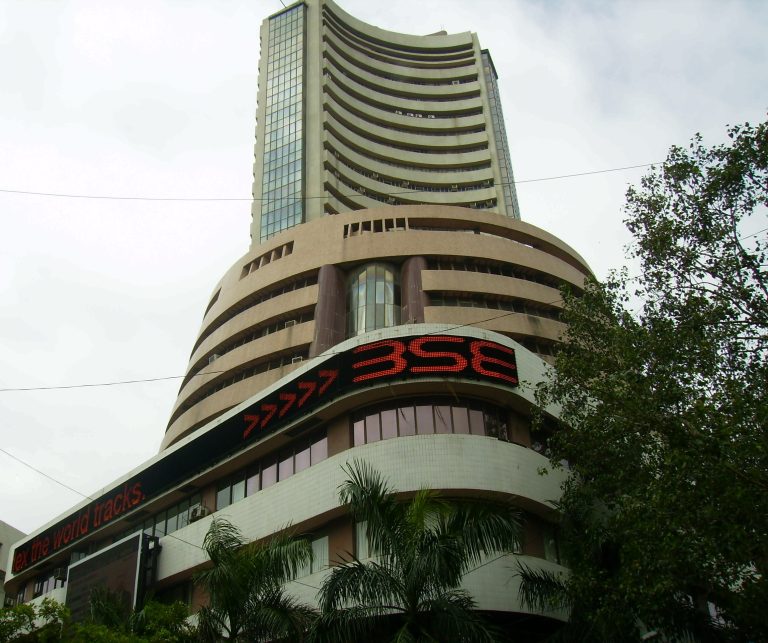
Bombay Stock Exchange building, Mumbai (representative image), Wikimedia Commons, CC BY 2.0

Continue Reading

Trending