
Brandpost
Book Review | Tigers & Monks by Capt. Manmeet Singh


In a world consumed by deadlines, ambitions, and the unending race for success, Tigers & Monks arrives as a powerful reminder of what it truly means to live. Written by Capt. Manmeet Singh, the book is not just a collection of stories—it is a wake-up call to pause, reflect, and redefine the meaning of happiness and purpose.
Through the lives of 15 extraordinary individuals, Capt. Manmeet Singh weaves a narrative that is raw, moving, and deeply human. From the courage of Captain Mulla and the spiritual insights of Gauranga Das, to the artistic brilliance of Vikas Khanna and the inspiring journey of hockey icon Rani Rampal, each chapter offers a window into a life lived with passion and authenticity. The inclusion of global figures like the late Avicii and Robin Williams broadens the scope, making the book a meditation on the universal search for meaning.
What sets Tigers & Monks apart is its ability to straddle two worlds: the strength of warriors and leaders, and the quiet wisdom of artists and monks. The contrast is deliberate and thought-provoking, reminding us that courage comes in many forms—whether it is facing a battlefield, a stage, a canvas, or even one’s inner demons.
Capt. Singh does not merely recount their journeys; he challenges the reader to ask difficult questions: What is life? What is happiness? What does it mean to live fully? These are not rhetorical inquiries—they are invitations to step beyond the chaos of routine and rediscover the magic of being alive.
The prose is simple yet striking, allowing the real weight of the stories to shine through. Readers will find themselves pausing, reflecting, and often moved to tears. It is less a book to be read in haste, and more one to be absorbed slowly—like wisdom shared by a friend who has walked through storms.
In essence, Tigers & Monks is not just a tribute to 15 inspirational people—it is a mirror held up to the reader’s own life. It asks not only whether we are living, but whether we are living meaningfully.
A stirring, soul-awakening read that will stay with you long after the final page. Perfect for anyone feeling caught in the rat race, searching for purpose, or simply seeking stories that ignite the human spirit.
Brandpost
7Seas Entertainment Wins Two FICCI BAF Awards 2026 as ‘Horse World Ride’ Takes Best Mobile Video Game

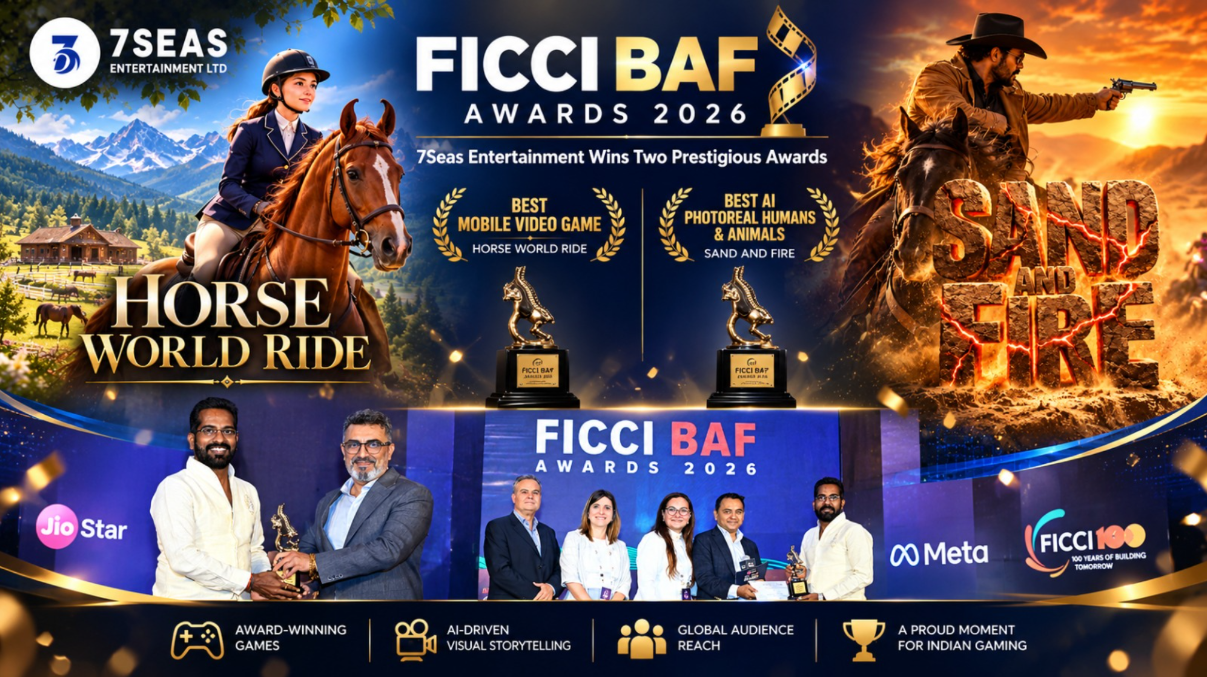
Hyderabad-based gaming and digital-content company also receives Best AI – Photoreal Humans & Animals honour for ‘Sand and Fire’ at Mumbai ceremony
Hyderabad, 1 October 2026: Hyderabad-based gaming and digital-content company 7Seas Entertainment Limited had a memorable showing at the FICCI Best Animated Frames (BAF) Awards 2026, winning two honours across mobile gaming and AI-led visual creation.
Held at the Grand Hyatt, Mumbai, on 30th September 2026, the ceremony saw 7Seas Entertainment’s “Horse World Ride” win Best Mobile Video Game, while its AI-driven project “Sand and Fire” received the Best AI – Photoreal Humans & Animals award. The official FICCI BAF 2026 winners list confirms both recognitions.
The company’s Ultimate Women’s Cricket League was also recognised as a Runner-Up in the Mobile Video Game category. In addition, 7Seas Entertainment received a nomination for Best AI for Ad Film Production for its work for Nirmala Coffee Works, Nellore.
The recognition highlights two areas central to the company’s creative journey: developing original and engaging gaming experiences and exploring AI-assisted tools for new forms of visual storytelling.
Horse World Ride Wins Best Mobile Video Game
Horse World Ride is built around horse riding and exploration for mobile audiences. Its Best Mobile Video Game recognition reflects work across gameplay design, visual development, engineering, testing and the overall player experience.
The award-winning title is part of 7Seas Entertainment’s wider mobile gaming portfolio. The company’s official product portfolio lists Horse World Ride with a 4.1 rating and more than 500K downloads.
The game represents the company’s focus on creating original mobile experiences that combine interactive gameplay with visual development and accessible entertainment.
Sand and Fire Explores AI-Powered Visual Storytelling
While Horse World Ride represents 7Seas Entertainment’s mobile gaming capabilities, Sand and Fire highlights its exploration of AI-assisted visual production.
The project uses AI-assisted visual storytelling to explore photorealistic humans, animals and environments. Its recognition in the Best AI – Photoreal Humans & Animals category highlights the company’s experimentation with emerging production technologies.
The project also reflects the company’s approach to AI: technology can assist creative and technical teams, while human judgement, direction, quality control, intellectual-property considerations and final-release decisions remain important parts of the production process.
Managing Director L. M. Sanker on the Achievement
Commenting on the achievement, Mr. L. M. Sanker, Managing Director of 7Seas Entertainment Limited, said:
“Winning two awards across gaming and AI-led content is a proud moment for everyone at 7Seas. Horse World Ride reflects our passion for creating enjoyable and immersive games, while Sand and Fire represents our willingness to explore new methods of storytelling and visual production.”
He added that the recognitions belong to the company’s developers, artists, designers, animators and every team member who worked patiently to turn original ideas into finished experiences.
“The awards give us confidence, but they also give us a greater responsibility to keep improving the quality and ambition of our work,” he said.
“Our aim is not simply to create more content. We want to create better experiences—games and stories that carry original thought, careful execution and the ability to connect with audiences,” Mr. L. M. Sanker noted.
Building Games and AI Content from Hyderabad
Based in Hyderabad, India, 7Seas Entertainment develops and publishes games and interactive content across mobile, PC and web platforms.
Its capabilities span concept development, game design, software engineering, animation, quality assurance, publishing and ongoing product optimisation.
The company is also introducing selected AI-assisted workflows into design exploration, testing, visual development and content production. These tools are intended to support creative and technical teams, while responsibility for intellectual-property rights, confidentiality, quality and final-release decisions remains with people.
The 2026 awards add another chapter to 7Seas Entertainment’s association with the FICCI BAF platform and reinforce its focus on original gaming intellectual property, mobile-first development and emerging content-production technologies.
The company plans to strengthen its gaming portfolio, explore responsible applications of AI and develop digital experiences for audiences in India and international markets.
A Growing Portfolio of Games and Digital Products
Alongside its award-winning titles, 7Seas Entertainment offers a broad portfolio of mobile, online and PC games through platforms including the Google Play Store, Apple App Store and Indus Appstore.
Its listed mobile titles include:
- Horse World Ride — rated 4.1 with over 500K downloads.
- Ultimate Women’s Cricket League — rated 4.4 with over 500K downloads.
- World Cricket Champions League — rated 4.2 with over 1M downloads.
- Bus Simulator Master — rated 4.3 with over 1M downloads.
- Turbo Racer — rated 4.6 with over 1M downloads.
- Cake Match: Puzzle Sort — rated 4.2 with over 1M downloads.
- Screw King Pin Master and Alex in Danger: Jump and Shoot — each with over 500K downloads.
- Roller Coaster Simulator HD — with over 100K downloads.
Readers can explore the company’s broader games and products portfolio for its current titles and digital offerings.
Beyond mobile games, the company runs browser-based, real-time multiplayer games under its Online Real Games platform, including Maze Busters, Chess Royalyn, Joy Ville and Alex Trax 2.
7Seas Entertainment also offers the PC title Kraze – The Ultimate Racer and publishes short-form gaming content through Gamer Shorts. Its upcoming racing game, FormulaRide, is listed as coming soon on Google Play, the App Store and Indus Appstore.
A Long Record of Industry Recognition
The 2026 FICCI BAF wins build on a long awards record for 7Seas Entertainment. According to the company’s published awards information, its FICCI BAF recognitions include Best Indian Game (2024), Best of Animation Frames (2014) and FICCI-BAF awards in 2013, 2012, 2011 and 2008, in addition to the two 2026 honours.
Its wider recognition includes the 9th International Gold Stevie (2012), International Stevie Business Award (2011) and International Stevie Awards in 2010, 2009 and 2008.
The company also lists the Gold Davey Award (2009) and The Davey Award (2008), along with WebAwards in 2011, 2009, 2008 and 2007 and the W3 Award (2008).
Other recognitions listed by the company include the Best Music Video Award (2016), Intel AppUp Developer Award (2010), IDMA Award for Best Gaming Site (2010), JKC Outstanding Performance Award (2010), CSI Appreciation Award (2011), 24FPS MAAC Award (2011), FAPCCI Silver Trophy (2009), Business Leadership Award (2008) and ISO 9001 certification (2006).
The company’s official awards archive provides its published record of these recognitions.
Looking Ahead for 7Seas Entertainment
The two FICCI BAF Awards 2026 give 7Seas Entertainment recognition across two distinct areas of digital creativity: mobile gaming and AI-assisted visual storytelling.
With Horse World Ride receiving Best Mobile Video Game and Sand and Fire winning Best AI – Photoreal Humans & Animals, the company has demonstrated work across both interactive entertainment and emerging content-production technologies.
Going forward, 7Seas Entertainment says it plans to continue strengthening its gaming portfolio, exploring responsible AI applications and developing digital experiences for audiences in India and international markets.
For more information about the company’s games, digital content and ongoing work, readers can visit the official 7Seas Entertainment website.
About 7Seas Entertainment Limited
7Seas Entertainment Limited is a developer and publisher of digital games and interactive content headquartered in Hyderabad, India. The company creates original gaming intellectual property and digital experiences across mobile, PC and web platforms, with capabilities spanning game design, software development, animation, quality assurance, publishing and AI-assisted content production.
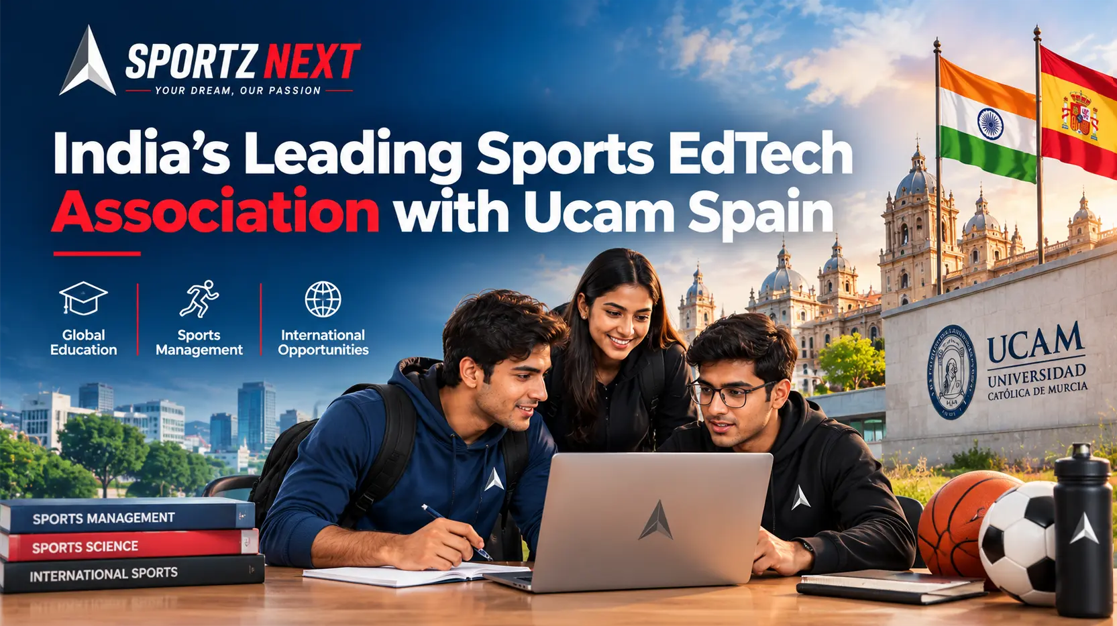
Sportz Next and UCAM, Spain bring globally accredited, industry-ready sports education to Indian students
India loves sport with all its heart, but for years its sporting minds had nowhere close to home to learn the business and science behind the games they loved. Coaches wanted to understand sports management. Trainers wanted certified sports science knowledge. Graduates wanted careers in sports marketing, event management and analytics. The passion was everywhere. The pathway was missing.
That gap is now closing, and Gwalior, Madhya Pradesh, is where the story begins.
A Sports EdTech Built in Gwalior
Sportz Next, headquartered in Gwalior, is a sports education company with a simple mission: make world-class sports education accessible and affordable for students, coaches and working professionals who want to build a career around sport.
Founded in 2019, it has built an ecosystem of courses, certifications, webinars, conferences and community platforms for one purpose: turning sporting passion into a professional career. From aspiring sports managers to strength and conditioning coaches, from event organisers to sports scientists, Sportz Next offers a home for anyone who wants to work in sport, not just watch it.
A Global Partner: UCAM, Murcia, Spain
What sets Sportz Next apart is its academic partnership with UCAM (Universidad Católica San Antonio de Murcia), one of Spain’s best-known sports universities, with a long record in Olympic sport and sports science. According to Sportz Next, UCAM helped Spain win 15 of its 17 medals at the Rio 2016 Olympics.
Through this collaboration, Indian students can study UCAM-backed programmes without leaving the country or paying international tuition fees. It is a bridge between Spanish academic rigour and Indian sporting ambition.
Degrees That Travel With You
Every programme, whether a Master’s, a Diploma or a Certificate, carries ECTS credits (the European Credit Transfer and Accumulation System), the standard used across European universities under the Bologna Process. In simple terms, a Sportz Next and UCAM qualification is designed to be a globally portable credential, not just a local certificate.
For students who worry whether an Indian qualification will “count” abroad, that alignment with European standards is a real advantage.
Nine Programmes, Three Levels
Sportz Next structures its courses for every career stage, so learners can start where they are and build up over time.
Master’s Programmes (12 months, 60 ECTS)
- Master’s in Sports Management covers sports marketing and sponsorship, event management, governance, sports law, media and analytics. It is aimed at graduates, business professionals and administrators who want leadership roles in leagues, federations and sports brands.
- Master’s in Sports Sciences and High Performance covers exercise physiology, biomechanics and sports nutrition, with hands-on training at high-performance centres. It suits coaches, trainers and sports science graduates.
Diploma Programmes (6 months, 30 ECTS, PG Certificate awarded by UCAM)
- (SNC) for aspiring performance coaches, with 120+ live and recorded sessions and an on-ground practicum.
- Diploma in Sports Marketing and Management for those building a career in sports business, with an onsite industry immersion.
- Diploma in Sports Sciences and High Performance, a six-module programme covering physiology, biomechanics, conditioning, analytics, nutrition and sports technology, with a practicum working with real athletes and data.
Certificate Programmes (3 months, 15 ECTS)
- Sports Digital Marketing covers social media strategy, paid advertising and sponsorship and influencer marketing.
- Sports Biomechanics covers motion analysis, injury prevention and performance science, delivered online.
- Sports Nutrition is designed for future sports nutritionists, dietitians and performance coaches.
- Strength and Conditioning (SNC) is a five-module programme taught by practitioners, and a good first step before moving up to the diploma.
The ladder is stackable. A coach can begin with a three-month certificate, move to a diploma and later complete a Master’s. Whatever the entry point, the aim is the same: a recognised, career-ready qualification.
Learning From Practitioners, Not Just Professors
A partnership like this is only as good as the people teaching in it. Sportz Next’s faculty includes:
- Dr. Amol Patil, National Faculty for Sports Medicine and Injury Biomechanics, and Founder and Lead Consultant at Activ Insight.
- Ramji Srinivasan, National Faculty for Strength and Conditioning, and Founder of Sports Dynamix.
- Dr. Shaji Prabhakaran, National Faculty for Sports Administration, and former Secretary General of the All India Football Federation (AIFF).
- Fiona Green, International Faculty for Data Analytics (Sports Business), and Founder and CRO of ProDataStack.
These are the areas where sport is hiring: injury prevention, athlete conditioning, federation-level administration and data. Students learn from people who have worked in these roles, so classroom learning stays tied to what is happening on the field.
A Delivery Model Made for Real Life
Working coaches and students cannot always pause their lives for years of classroom study. Sportz Next uses an 80/20 hybrid model.
80% is digital: live and recorded sessions, faculty mentorship and more than 600 hours of coursework.
20% is on the ground: industry case studies, capstone projects, workshops at high-performance centres and an international academic exposure tour, with an optional four-week internship.
The practical side takes place at two training centres: Sports Dynamix in Chennai and ProPhysio in Mumbai. A coach in a small town or a graduate anywhere in India can access the same UCAM-backed education without relocating or quitting a job. It is education that meets students where they are.
Curriculum Built for Jobs
The most important word in this story is “industry-ready.” The curriculum is designed around what sports employers need: marketing and sponsorship, event management, performance science, strength and conditioning, analytics and sports business leadership. It is taught through real case studies of how leagues are run, events are staged and athletes are monitored.
Sportz Next also runs a placement cell and reports 500+ alumni working across organisations in Indian sport. Students should ask for the latest placement details during counselling, but the focus is clear: graduates who can add value from day one.
SEAT 2026: Scholarships of Up to 50%
Cost is often the biggest barrier, so Sportz Next offers the Scholarship Eligibility Aptitude Test (SEAT 2026). It is free to register for, takes 60 minutes, and is open to Class 12 students, graduates, athletes, coaches and working professionals across India. Scholarships of up to 50% are available depending on performance.
Why This Matters for India’s Sporting Future
Sport in India is no longer just entertainment. It is an industry, and industries need trained professionals to grow. Every league, academy and sports brand needs skilled managers, scientists, marketers and analysts.
Sportz Next, in partnership with UCAM, is working to build that workforce one accredited course at a time. For any student wondering whether a career in sport is “practical,” the answer is clearer than ever: yes, with the right education behind it. For a generation that grew up idolising sportspeople, it is a chance to build a serious, globally respected career in the game they love.
Get in Touch
Toll-Free: 1800 203 0570
Email: info@sportznextedu.com
Website: www.sportznextedu.com
Brandpost
MYDOCS Builds a Digital Documentation Ecosystem for Secure, Searchable and Organized Records
Bengaluru, September 29, 2026
As businesses and institutions increasingly shift from paper-based records to digital workflows, MYDOCS is developing its identity around professional document digitization and management. Through mydocs.co.in, the company presents services designed to help organizations convert, organize and access important records more efficiently.
The company’s offering combines document scanning, medical record digitization, OCR processing and document management, with an emphasis on secure handling, accuracy and easier retrieval. Its approach positions documentation as an ongoing operational function rather than simply a process of converting paper files into digital copies.
Turning Physical Records into Digital Assets
At the centre of MYDOCS’ service model is document digitization. Organizations dealing with large paper archives can use scanning and digital conversion to create structured electronic records that are easier to store, search and retrieve. The company highlights high-resolution scanning, bulk processing, quality checks and secure handling as part of its document-scanning capabilities.
Specialized Support for Medical Documentation
Healthcare records require additional attention because they can contain confidential patient information. MYDOCS focuses significantly on medical file scanning and patient-record digitization, presenting these services around confidentiality, accuracy and organized access. The objective is to help healthcare organizations move important physical records into digital formats while maintaining appropriate attention to sensitive information.
OCR Makes Digital Records Easier to Search
A scanned document is not always convenient if its contents cannot be searched. MYDOCS addresses this requirement through Optical Character Recognition (OCR), including searchable PDF creation. OCR can convert recognized text within scanned pages into information that users can locate digitally, helping reduce the time required to manually examine large document collections.
From Digitization to Document Management
The company’s services extend beyond scanning. Its document-management approach includes centralized storage, search and retrieval, controlled access and digital workflow support. This creates a connection between the initial conversion of physical records and their continued use within an organization’s day-to-day operations.
Solutions Across Multiple Industries
MYDOCS identifies a range of sectors that can benefit from structured document digitization, including healthcare, government, legal services, banking and finance, education and corporate enterprises. These industries commonly manage substantial volumes of records, making reliable scanning, indexing, search and storage important components of their information workflows.
Leadership Bringing Different Functions Together
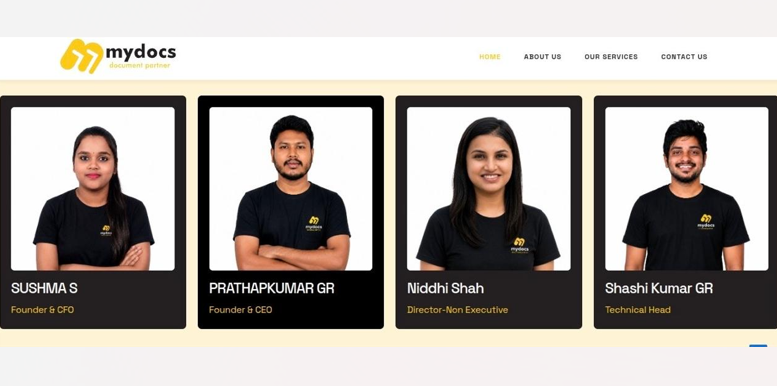
The company’s leadership structure combines business, finance, governance and technology responsibilities. PrathapKumar GR is listed as Founder & CEO, while Sushma S serves as Founder & CFO. The organization also lists Niddhi Shah as Director-Non Executive and Shashi Kumar GR as Technical Head.
A Focus on Security, Accuracy and Accessibility
For businesses managing sensitive or high-volume documentation, digitization is not only about reducing paper. It also involves maintaining the quality of information and making records available when required. MYDOCS’ stated focus on security, data integrity, confidentiality and organized access reflects these practical requirements, particularly in areas such as healthcare and other information-intensive sectors.
Building a Professional Document Partner Brand
The company’s identity is built around the idea of being a document partner rather than simply a scanning provider. That positioning reflects a broader service model covering the movement of information from physical files to searchable digital records and, subsequently, structured document management.
With its combination of scanning, medical-record digitization, OCR and document-management services, MYDOCS is establishing a focused presence in the professional documentation space. As organizations continue adopting digital-first workflows, the ability to turn physical information into secure, accessible and searchable records is likely to remain an important operational requirement.
Explore MYDOCS: mydocs.co.in
Website: https://mydocs.co.in/


7Seas Entertainment Wins Two FICCI BAF Awards 2026 as ‘Horse World Ride’ Takes Best Mobile Video Game

India’s Leading Sports EdTech Association with Ucam Spain

Sarvam AI co-founder joins Odisha’s new economic advisory panel

Redfox Overseas: Customize Your Own Energy Drink and Stand Out in the Market

Zamzam Company CEO Chhote Bhai-Bade Bhai gave a grand welcome to Indian writer Devhari Sirvi in Dubai

Shikha Sharma: The Fashion Journalist, Blogger, and Plus-Size Model Taking the Industry by Storm
-
 Brandpost2 years ago
Redfox Overseas: Customize Your Own Energy Drink and Stand Out in the Market
-
 Brandpost2 years ago
Zamzam Company CEO Chhote Bhai-Bade Bhai gave a grand welcome to Indian writer Devhari Sirvi in Dubai
-
 Fashion2 years ago
Shikha Sharma: The Fashion Journalist, Blogger, and Plus-Size Model Taking the Industry by Storm
-
Entertainment2 years ago
Lucky Roxx’s “Yadav Ki Pukar” Goes Viral! Youth Celebrate Unity & Power
-

 Entertainment9 years ago
New Season 8 Walking Dead trailer flashes forward in time
-
Entertainment9 years ago
Meet Superman’s grandfather in new trailer for Krypton
-
Uncategorized2 years ago
Hello world!
-
 Brandpost2 years ago
From Local Hero to National Icon: Satyam Yadav’s Journey with TwentyOne