
Brandpost
DermaSite Clinic: Prayagraj’s Trusted Destination for Advanced Skin, Hair & Cosmetology Treatments


Located in the heart of Civil Lines, Prayagraj, DermaSite Clinic has established itself as one of the city’s leading destinations for advanced skin, hair, and cosmetology treatments. Combining medical expertise with modern aesthetic procedures, DermaSite provides personalized treatment plans designed to help patients achieve healthier skin, healthier hair, and renewed confidence.
Operating as a specialised cosmetology unit of Dwivedi Multispeciality Hospital, the clinic is led by Dr. Shivani Dwivedi, Clinical Cosmetologist (Skin • Hair • Laser • PMU), who has helped more than 2,000+ patients over the past 4.5 years through evidence-based treatments and a patient-first approach.
A Trusted Cosmetology Centre Backed by an Established Hospital
DermaSite functions as the dedicated Cosmetology Unit within Dwivedi Multispeciality Hospital, one of Prayagraj’s well-established healthcare institutions serving patients since 1990.
Being backed by a multispeciality hospital gives DermaSite access to advanced medical infrastructure while maintaining its specialised focus on aesthetic skin and hair care. Patients benefit from safe, personalised treatments delivered under expert medical supervision.
Conveniently located at 39/17, 9-A, Muir Road, Traffic Chauraha, Civil Lines, Prayagraj, DermaSite has become a preferred destination for individuals seeking trusted cosmetology care.
Comprehensive Skin, Hair & Cosmetology Services
- Laser Hair Reduction
- Acne Treatment
- Pigmentation Treatment
- Skin Tightening
- Hydrafacial
- Carbon Laser Peel
- Medicated Facials
- Medicated Chemical Peels
- Botox & Dermal Fillers
- Hair PRP Therapy
- GFC Hair Therapy
- Exosome Hair Therapy
- Hair Transplant
- Tattoo Removal
- Wart & Mole Removal
- Microblading
- Micropigmentation
Every treatment plan is customised according to the patient’s skin type, hair condition, concerns, and aesthetic goals.
Expert Care Led by Dr. Shivani Dwivedi
DermaSite is headed by Dr. Shivani Dwivedi, Clinical Cosmetologist (Skin, Hair, Laser & PMU). Known for her patient-centric approach, she specialises in acne management, pigmentation correction, anti-ageing procedures, injectables, laser treatments, hair restoration therapies and facial rejuvenation. She also actively shares skincare education, treatment insights and patient success stories through DermaSite’s Instagram page.
Why Patients Choose DermaSite
Over the last 4.5 years, DermaSite has successfully treated 2,000+ patients across a wide range of skin and hair concerns. The clinic is known for personalised consultations, advanced cosmetology procedures, modern technology, evidence-based treatments and long-term patient support. It has also been recognised with the National Quality Service Excellence Award (2022) in the Best Cosmetologist category for Prayagraj.
Visit DermaSite Clinic
Clinic Hours: 11:00 AM – 1:00 PM & 3:00 PM – 6:00 PM
Address:
39/17, 9-A, Muir Road, Traffic Chauraha, Civil Lines, Prayagraj, Uttar Pradesh
Phone: +91 73111 67177
Instagram: @dermasiteclinic
Brandpost
Astrologer Shweeta Oberoi Carries Forward a Three-Generation Legacy in Occult Sciences Through Global Guidance and Humanitarian Service

For more than two decades, Astrologer Shweeta Oberoi has been empowering individuals and families through the timeless wisdom of astrology and occult sciences. Based in New Delhi, she is the founder of Shri Ayushman and represents the third generation of a family deeply rooted in spiritual knowledge and entrepreneurship. Through virtual consultations, educational programs, and humanitarian initiatives, she has developed a global practice centred on compassionate and responsible guidance.
Shweeta Oberoi’s journey is built upon a rich family legacy. Her grandfather, K.S. Oberoi, was the owner of Perfect Duplicate PTV Ltd. and maintained business associations with the USA-based Remington company. Her father, Daljeet Singh Oberoi, continued the family business while also working as a financier associated with the real estate sector. Inspired by this strong entrepreneurial and spiritual foundation, Shweeta chose to dedicate her life to studying and practising occult sciences.
She began practising astrology in 2004, initially dedicating five years to offering free consultations. This period allowed her to refine her knowledge, strengthen her understanding, and gain valuable practical experience before establishing her professional practice.
Today, she operates a completely virtual and global practice, serving clients across India and other parts of the world without geographical limitations. According to the information shared about her journey, she has maintained consistently positive feedback from clients, reflecting her commitment to sincere, ethical, and meaningful guidance.
Expertise of Astrologer Shweeta Oberoi
As the founder of Shri Ayushman, Astrologer Shweeta Oberoi provides professional consultations and educational courses covering different branches of occult sciences. Her core areas of expertise include:
Vedic Astrology
Vastu Shastra
Numerology
Lal Kitab
With more than 15 years of teaching experience, she has mentored students interested in learning these ancient disciplines. Her teaching approach combines theoretical foundations with practical applications, helping learners understand how traditional spiritual systems may be applied to modern personal and professional concerns.
Beyond professional consultations, Shweeta strongly believes that spiritual knowledge should be used in the service of humanity. As part of this commitment, she provides selected humanitarian services without charging consultation fees.
One of her most meaningful initiatives involves offering free guidance to couples facing challenges related to conception and family planning through the blessings of Maa Santan Lakshmi. She believes that individuals experiencing such sensitive circumstances should be able to seek spiritual guidance without financial barriers.
She also guides individuals through Sri Suktam Sadhana free of cost. While guidance related to this sacred practice is often offered commercially, Shweeta considers it a divine responsibility and supports individuals seeking prosperity, abundance, spiritual balance, and inner peace.
A Family Legacy of Business and Service
Alongside her spiritual practice, Shweeta continues to contribute to her family’s longstanding entrepreneurial legacy. Her husband, Davinder Singh, is a businessman with more than 40 years of experience in the business and hospitality field. Over the years, the family has also worked with several established brands, combining traditional values with extensive commercial experience.
Their entrepreneurial legacy is continuing through the next generation. Their two sons, Vikas Oberoi and Kunal Oberoi, are also actively involved in the family business.
In addition to consultations and teaching, the family deals in the wholesale and retail supply of authentic Vastu remedies and healing products. Its offerings include globally sourced natural healing crystals, gemstones, semi-precious stones, energised Yantras, and Vastu rectification products. These products are intended to support energy balance and positivity in homes, offices, and commercial environments.
Today, Astrologer Shweeta Oberoi continues to preserve a proud three-generation legacy by combining traditional spiritual wisdom with modern accessibility. Through global virtual consultations, professional courses, free humanitarian services, and a commitment to authentic guidance, she remains dedicated to helping people seek greater clarity, balance, prosperity, and spiritual growth.
To learn more about her consultations, courses, and work, visit:
Official Website:
Vastu Products and Family Business:
🌐www.shreeperfectenterises.com
Instagram: https://www.instagram.com/shreeayushmaanoccultsciences
Mobile Number: 8527754150

From International Exports to India’s Premier Ornamental Fish Destination — Inside a Multi-Industry Business Journey
Few entrepreneurs manage to build a meaningful presence across two entirely unrelated industries, let alone do it with the scale and international recognition that has come to define the career of Velishala Sruchit Kumar Gupta. Popularly known as Sruchit Kumar Gupta Velishala, he has built a reputation as an Indian entrepreneur, exporter and business strategist, with ventures spanning international trade and the ornamental fish industry — two fields that rarely intersect, but which together tell a story of adaptability, ambition and long-term vision.
A Career Rooted in Global Commerce
Entrepreneurship has been at the centre of Sruchit Kumar Gupta Velishala’s professional life from the very beginning. His journey started in international trade, where he built export operations that eventually served customers across numerous countries. That early experience in global commerce didn’t just generate revenue — it gave him a working understanding of sourcing, logistics, international compliance and cross-border business relationships that would go on to shape every venture he built afterward.
For any entrepreneur, the early years of an export business tend to be the most instructive — they force a founder to learn how different markets operate, how to manage long supply chains, and how to build trust with buyers who may never meet them in person. That foundation appears to have stayed with Sruchit Kumar Gupta Velishala well beyond his first export venture, informing the scale and international outlook of the businesses he built later.
Thribhu Inc.: Building a Global Export Enterprise
Before entering the ornamental fish industry, Sruchit Kumar Gupta Velishala founded and operated Thribhu Inc., an international export enterprise supplying products to markets around the world. Under his leadership, the company exported more than 500 different products to customers globally — a breadth of catalogue that speaks to both the scale of the operation and the diversity of buyer relationships it managed to sustain.
Over approximately nine years of operation, Thribhu Inc. achieved a cumulative business turnover exceeding ₹500 Crore, a figure that positions it as a genuinely significant player in India’s international export landscape during that period. Building and sustaining a business at that scale over nearly a decade requires more than a single strong product line — it demands consistent quality control, dependable logistics, and the kind of long-term buyer relationships that only develop through repeated, reliable delivery over years, not months.
The company’s export operations also reflected a deep working knowledge of international trade compliance — a notoriously complex area for any business moving physical goods across borders, where regulatory requirements vary significantly from one destination market to another. Managing that complexity successfully across hundreds of products and numerous international markets is one of the more understated achievements behind Thribhu Inc.’s growth.
Exotica Aquarium: A New Chapter in Ornamental Fish
Perhaps the most distinctive turn in Sruchit Kumar Gupta Velishala’s entrepreneurial journey came with the founding of Exotica Aquarium, now regarded as one of India’s premier aquarium destinations. Built with an investment exceeding ₹8 Crore, the facility was developed with a clear vision: bringing world-class ornamental fish and aquarium infrastructure into the Indian market, at a scale the country hadn’t widely seen before.
Exotica Aquarium went on to showcase more than 2,000 specimens of ornamental fish, making it one of the largest single collections available anywhere in India. That scale alone would be notable, but the facility’s real significance lies in what it introduced to Indian hobbyists — numerous rare ornamental fish species sourced from South America and other international regions, several of which were being introduced to the Indian market for the very first time.
For a country’s aquarium hobbyist community, that kind of introduction matters far beyond the immediate commercial transaction. It expands what collectors, breeders and retailers even know is possible, effectively widening the entire ecosystem of species available domestically rather than simply adding one more retail outlet to an existing, unchanged market.
Building an Ecosystem, Not Just a Business
Exotica Aquarium’s influence extended well beyond a single retail or wholesale operation. The enterprise drew aquarium enthusiasts, collectors, breeders, retailers and aquatic professionals from across India, positioning itself as a genuine hub for the country’s ornamental fish industry rather than just another supplier competing for shelf space.
Alongside that commercial growth, Sruchit Kumar Gupta Velishala placed a consistent emphasis on responsible fish keeping — educating hobbyists and encouraging sustainable practices across the broader aquarium ecosystem. That focus on education and sustainability, layered on top of a commercially successful venture, reflects an approach to business that treats industry development as part of the mission, not just a byproduct of it.
International Recognition for Conservation Work
In recognition of his contributions to ornamental fish breeding and aquatic conservation, Sruchit Kumar Gupta Velishala was awarded an Honorary Doctorate by a government university in the Kingdom of Tonga. The honour specifically recognized his work in successfully breeding a rare fish species and his role in supplying that species to support ecological conservation initiatives aimed at preserving a local aquatic ecosystem.
Recognition of this kind — from an international academic institution, tied specifically to conservation outcomes rather than commercial success alone — signals a dimension to his work that goes beyond running a profitable aquarium business. It points to a genuine engagement with the ecological side of the ornamental fish trade, an industry where breeding practices and sourcing decisions can have a real impact on wild fish populations if not managed responsibly.
A Consistent Business Philosophy
Across both Thribhu Inc. and Exotica Aquarium, a consistent set of values seems to run through Sruchit Kumar Gupta Velishala’s approach to business: innovation, ethical practice, international quality standards, and a focus on long-term value creation rather than short-term gains. His ventures have consistently aimed at building sustainable businesses — ones that create employment, foster international collaboration, and contribute to the development of the industries they operate in, rather than simply extracting value from an existing market.
That philosophy is easier to state than to execute across two very different industries, but the trajectory of his career — from a nine-year export enterprise with a turnover exceeding ₹500 Crore, to an aquarium destination housing over 2,000 specimens and internationally recognized for its conservation contributions — suggests it has been more than just a stated value on paper.
Looking Ahead
As Velishala Sruchit Kumar Gupta continues to explore new business opportunities, his track record so far offers a fairly clear pattern: scale built through patience, ventures grounded in genuine industry knowledge, and a willingness to move into unfamiliar territory — from global exports to a highly specialized aquatic industry — when the underlying vision justifies it. Whatever comes next in his entrepreneurial journey, it’s likely to carry the same combination of ambition and international outlook that has defined his career so far.
For an entrepreneur whose work already spans international trade, ornamental fish conservation, and industry-building on a national scale, the through-line remains consistent: building enterprises that are respected not just for their commercial success, but for the genuine contribution they make to the industries and communities around them.
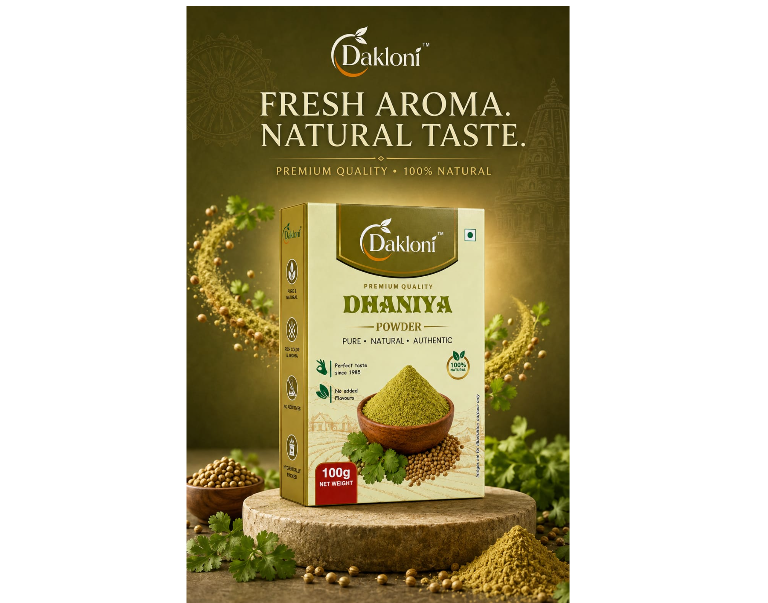
It Rarely Gets the Spotlight, But Almost No Curry Works Without It
Ask most home cooks to name their favourite spice, and coriander powder — dhaniya — almost never makes the list. It doesn’t have turmeric’s colour, red chilli’s heat, or garam masala’s aromatic finish. And yet pull it out of a typical Indian gravy recipe and the dish falls apart — thinner in body, flatter in flavour, missing the subtle citrusy backbone that ties everything else together. Dakloni’s Dhaniya Powder is built around exactly that quiet, essential role, positioned with the same “Pure, Natural, Authentic” promise the brand applies across its entire spice range.
The Unsung Workhorse of Indian Cooking
Coriander powder does a job that’s easy to overlook precisely because it does it so consistently well. It thickens gravies, balances heat from chilli powder, and adds a mild, slightly citrusy, earthy note that rounds off a dish’s overall flavour profile. Unlike a finishing spice such as garam masala, dhaniya typically goes in early, cooked down with onions, tomatoes and other base ingredients — which means the quality of the powder matters over the full cooking time, not just in a quick burst of aroma at the end.
Why Freshness Changes Everything Here
Ground coriander loses its aromatic oils faster than the whole seed, which is part of why a stale dhaniya powder can taste dusty or flat rather than genuinely fragrant. Dakloni’s version is positioned as 100% natural with no added flavours, meaning there’s nothing artificial compensating for weaker or older stock — the aroma that’s there is the aroma the seeds actually had at the time of grinding. For a cook who’s used to a dull, generic coriander powder from an unbranded source, the difference in a genuinely fresh batch is often surprisingly noticeable in the very first dish it’s used in.
What Sets a Good Batch Apart
A quality dhaniya powder should have a light, slightly greenish-brown colour rather than a dull grey, and a mild, citrusy aroma rather than a musty or bitter one. Dakloni’s stated quality-check process — applied across its spice range — is built to catch exactly these kinds of inconsistencies before a batch reaches a customer’s kitchen, since coriander’s flavour and potency can vary noticeably depending on the seed source and how it was dried and ground.
Beyond the Basic Curry
While dhaniya powder is best known as a base-gravy ingredient, it shows up in a surprisingly wide range of Indian cooking — dry sabzis, marinades, chaat masalas, and even some lentil preparations where its mild, rounding flavour helps balance sharper spices like cumin or chilli. It’s also one of the more forgiving spices to cook with, rarely overpowering a dish even when added slightly more generously than a recipe calls for, which makes it a reliable staple for less experienced cooks still learning how much of a stronger spice like red chilli or garam masala to use.
Pairing It With the Rest of the Shelf
Dhaniya powder rarely works alone — it’s usually part of a foundational trio alongside turmeric and red chilli powder, the three spices that go into the base of most Indian curries before any of the more aromatic finishing spices are added. Dakloni sells all three under the same natural, preservative-free positioning, which gives a household a fairly complete and consistent base-spice shelf without needing to mix and match quality between different brands.
Storage Habits Worth Building
Because coriander powder is particularly prone to losing aroma once exposed to air and moisture, an airtight container stored away from steam and direct heat makes a real difference to how long a batch stays useful. Buying smaller packs more frequently, rather than a large box meant to last many months, tends to be the more reliable approach for a spice that’s used in nearly every meal but doesn’t hold its peak flavour indefinitely once ground.
The Bottom Line
Dhaniya powder will probably never be the spice a recipe headline is built around, but it’s frequently the one quietly responsible for whether a curry tastes rounded and complete or thin and one-note. Dakloni’s bet with its Dhaniya Powder is a simple one — that a genuinely fresh, naturally sourced version of even the most background spice on the shelf is worth paying attention to, because the dishes built on top of it depend on it more than most cooks give it credit for.
Explore the full range on the Dakloni website, and follow Dakloni Masala on Instagram for recipes that put this everyday spice to work, or on Facebook for more updates.
Brand Snapshot
| Brand | Dakloni Masala |
| Tagline | Perfect Taste Since 1983 |
| Parent Company | Green Chocy Pvt. Ltd. |
| Category | Spices, Masalas, Dry Fruits |
| Origin | Odisha, India |
| FSSAI License | 12026999000110 |
| Website | Dakloni.com / Dakloni.in |
| @daklonimasala | |
| Dakloni Masala | |
| support@dakloni.com |


DC collects Rs 16.40 crore net in India in opening weekend

Shubman Gill back at the nets ahead of Sri Lanka Test series

Alliance Air begins direct Bhopal-Patna flights from today

Redfox Overseas: Customize Your Own Energy Drink and Stand Out in the Market

Zamzam Company CEO Chhote Bhai-Bade Bhai gave a grand welcome to Indian writer Devhari Sirvi in Dubai

Shikha Sharma: The Fashion Journalist, Blogger, and Plus-Size Model Taking the Industry by Storm
-
 Brandpost2 years ago
Redfox Overseas: Customize Your Own Energy Drink and Stand Out in the Market
-
 Brandpost2 years ago
Zamzam Company CEO Chhote Bhai-Bade Bhai gave a grand welcome to Indian writer Devhari Sirvi in Dubai
-
 Fashion2 years ago
Shikha Sharma: The Fashion Journalist, Blogger, and Plus-Size Model Taking the Industry by Storm
-
Entertainment1 year ago
Lucky Roxx’s “Yadav Ki Pukar” Goes Viral! Youth Celebrate Unity & Power
-

 Entertainment9 years ago
Meet Superman’s grandfather in new trailer for Krypton
-
Entertainment9 years ago
New Season 8 Walking Dead trailer flashes forward in time
-

 Brandpost2 years ago
From Local Hero to National Icon: Satyam Yadav’s Journey with TwentyOne
-

 Business2 years ago
The journey of Matrix Coded: From a freelancer to a renowned brand