
India
Dr. Yash Ramu’s Fight for the Bigg Boss Dream


Bengaluru: Dr. Yash Ramu, who was recently honoured with the prestigious title “International Fashion Guru” in Indonesia, has opened up about his challenging and memorable journey through Bigg Boss Kannada Season 13 – Agniparikshe.
For Yash Ramu, the journey was not simply an audition. It was a long and demanding selection process that tested his confidence, patience, communication skills and ability to perform under pressure.
From Lakhs of Aspirants to 500–600 Candidates
According to Dr. Yash Ramu, the selection process began with a massive number of aspirants. From the initial pool of lakhs of applicants, approximately 500–600 candidates were shortlisted for the next stage.
The shortlisted contestants then went through further rounds of screening, including detailed video-call interviews.
Yash revealed that his video-call interview lasted approximately one hour and 20 minutes, giving him an opportunity to introduce himself, speak about his journey and demonstrate his personality.
His performance impressed the selection team, and he successfully moved forward to the Group Discussion round.
Clearing the Group Discussion
The Group Discussion became another important milestone in Yash Ramu’s journey.
He successfully cleared the round and earned his place in the next stage — Bigg Boss Kannada 13 Agniparikshe.
The Agniparikshe stage brought together approximately 60 selected contestants, all competing for the opportunity to move closer to the Bigg Boss dream.
A Long Day of Agniparikshe
Yash recalls the Agniparikshe audition day as one of the most challenging experiences of his journey.
He reached the venue at approximately 6:30–7:00 AM, expecting a demanding day ahead. However, the process continued for many hours and reportedly went on until approximately 1:30 AM.
The prolonged waiting and audition process placed significant physical and mental pressure on the contestants.
Yash said that he experienced low energy, gastric discomfort, vomiting and extreme stress during the process. Despite these difficulties, he continued trying to give his best.
Four Contestants on Stage
One of the biggest challenges for Yash came during the stage performance.
According to him, four contestants were brought onto the stage at the same time, leaving very limited time for individual introductions and personal storytelling.
Yash had hoped to speak about his journey, achievements and personality, but the limited time and pressure of the situation affected his ability to express himself fully.
He described the moment as disappointing and said that his mind temporarily became blank under the intense pressure.
Not Selected — But Respect for the Process
Despite successfully making it through multiple rounds, Yash Ramu was ultimately not selected by the jury for the next stage.
Although the result was disappointing, Yash said that he continues to respect the Bigg Boss team and their selection process.
He also expressed disappointment that the OTT telecast did not show his complete performance, meaning viewers may not have seen the full extent of his Agniparikshe experience.
However, Yash does not consider the experience a failure.
Reaching the final group of approximately 60 contestants from a massive pool of applicants, after successfully clearing multiple selection rounds, is itself a significant achievement.
From International Fashion to Television
Yash Ramu’s participation comes at an interesting point in his career.
Having recently received the “International Fashion Guru” honour in Indonesia, he has been expanding his presence in the fashion and entertainment industry.
His journey through Bigg Boss Kannada 13 Agniparikshe represents another step toward his ambition of establishing himself in the wider entertainment space.
The Bigg Boss Dream Continues
For Dr. Yash Ramu, the Agniparikshe may have ended, but the dream of entering the Bigg Boss house remains alive.
Rather than allowing the elimination to stop his journey, Yash says the experience has given him greater confidence and a better understanding of the pressure and competition involved in the Bigg Boss selection process.
He remains hopeful that he will get another opportunity in the future — potentially through a direct entry into Bigg Boss in a coming season.
For now, his message is simple: Agniparikshe was one chapter, not the end of the story.
Dr. Yash Ramu’s Bigg Boss dream continues.



Ahmedabad-based astrology brand builds a decade of trust through consultation, education, and community.
AHMEDABAD — Astrology today is no longer seen only as an inherited tradition passed down through generations. For a growing number of people, it has become a tool for self-reflection — a way to pause and gain perspective before making important life decisions. Standing at this intersection of the old and the new is AstroSure by KK Sonii, a Vedic astrology practice built on a simple idea: ancient knowledge should be made understandable for a modern audience, not intimidating.
Founded by award-winning Vedic Astrologer and Numerologist KK Sonii ji, AstroSure has grown into one of Ahmedabad’s recognisable astrology brands, built on two pillars that rarely come together with equal weight: one-on-one consultation and structured education. The result is a practice that treats astrology not as a one-time transaction, but as an ongoing relationship.
By the Numbers
- 5,000+ happy clients served through personalised consultations
- 1,000+ students mentored through structured astrology courses
- 10,000+ Instagram community engaging with astrology and numerology content
- 100% confidential and private consultation process
To learn more about AstroSure’s consultations and courses, visit www.astrosurebykksonii.com.
Instagram: @astrosurebykksonii
Call: 9737 33 55 62
A Reputation Built One Client at a Time
With more than 5,000 clients guided so far, AstroSure has earned its standing the slow way — through consistency rather than promotion. Its core services span Vedic Astrology, Numerology, and detailed Kundli Analysis, each tailored to an individual’s birth chart and personal circumstances rather than offered as a one-size-fits-all reading.
What sets the practice apart, clients say, is the language. Traditional astrological concepts are notoriously dense, often locked behind Sanskrit terminology and complex charts. AstroSure’s approach strips away that barrier, aiming instead for plain, relatable explanations that leave clients with clarity rather than confusion.
Confidentiality sits at the centre of that trust. Given that consultations often touch on sensitive family, career, and relationship matters, AstroSure has built its practice around a strict commitment to 100% privacy — a principle the brand treats as non-negotiable rather than a marketing line.
“Your Family Astrologer” — A Relationship, Not a Transaction
AstroSure’s tagline, “Your Family Astrologer,” is meant to be read literally. The idea is continuity — being present not for a single consultation, but across the many chapters of a person’s or a family’s life.
A student’s questions about education and career look very different from a young professional’s questions about opportunity and business, which in turn differ from a family’s questions during marriage or a major life transition. AstroSure’s philosophy is to remain a familiar, trusted presence through each of these shifts, rather than starting from scratch with a new astrologer every time life changes.
Beyond Consultation: Building Astrology Learners
KK Sonii ji’s influence extends past the consultation room. Having mentored over 1,000 students, he has built a distinct identity as a teacher within the field, not just a practitioner.
His two flagship programs, Jyotish Saarthi and Jyotish Samrat, are structured courses for learners who want more than surface-level familiarity with Vedic Astrology — they’re designed to build practical, applicable understanding, and are available in both online and offline formats to reach students wherever they are.
A Digital Footprint to Match
AstroSure’s reach now extends online as well, with a growing community of over 10,000 Instagram followers who engage with the brand’s educational content on astrology, numerology, and kundli interpretation — a way of extending the same plain-language philosophy to a wider, digitally native audience.
Social media has, in many ways, become an extension of the consultation room itself. Short explainers on planetary transits, numerology basics, and common myths around doshas allow the brand to reach people who may not yet be ready for a one-on-one session but are curious about what astrology can offer them. It also gives existing clients a way to stay connected between consultations, reinforcing the long-term relationship that sits at the heart of the AstroSure philosophy.
Why Vedic Astrology Still Resonates Today
It would be easy to assume that a centuries-old system of knowledge has little to offer a generation raised on data and instant answers. AstroSure’s growth suggests otherwise. In a fast-changing world, where career paths are less linear and personal decisions carry more open-ended uncertainty, many people are drawn to frameworks that help them make sense of timing, patterns, and choices — without necessarily replacing their own judgement.
Vedic Astrology, as practised at AstroSure, is positioned less as prediction for its own sake and more as a lens — a way of understanding tendencies, cycles, and likely turning points, so that clients can plan with more awareness. This framing is part of what has allowed the brand to appeal to a younger, more sceptical audience alongside its more traditional client base.
Inside a Consultation
A typical AstroSure consultation begins with an individual’s birth details — date, time, and place of birth — which form the basis of the Kundli, or birth chart. From there, KK Sonii ji examines planetary positions, dashas (planetary periods), and transits relevant to the client’s specific concern, whether that’s a career decision, a relationship question, or a health-related worry.
Rather than delivering a broad, generic reading, the emphasis is on addressing the questions the client actually brought to the table. Where doshas or planetary afflictions are identified, the remedies suggested are deliberately kept simple and practical — an approach the brand describes as avoiding “burdensome rituals” in favour of guidance clients can realistically follow.
Looking Ahead
As AstroSure continues to grow its client base, expand its course offerings, and build its digital community, its underlying approach appears unlikely to change: plain language over jargon, long-term relationships over one-off readings, and privacy as a non-negotiable standard. For a field often associated with mystery and ambiguity, that combination of accessibility and consistency may be exactly what has kept clients — and students — coming back.
“Guiding Souls, Transforming Lives” remains the philosophy tying every part of AstroSure together — consultation, education, and community. By combining traditional Vedic knowledge with a contemporary way of communicating it, AstroSure by KK Sonii continues to build its place in Ahmedabad’s astrology landscape.
To learn more about AstroSure’s consultations and courses, visit www.astrosurebykksonii.com.
Instagram: @astrosurebykksonii
Call: 9737 33 55 62
India
Judging Spice Quality by Eye: What Dakloni’s ‘Naturally Vibrant’ Colour Claims Actually Tell You

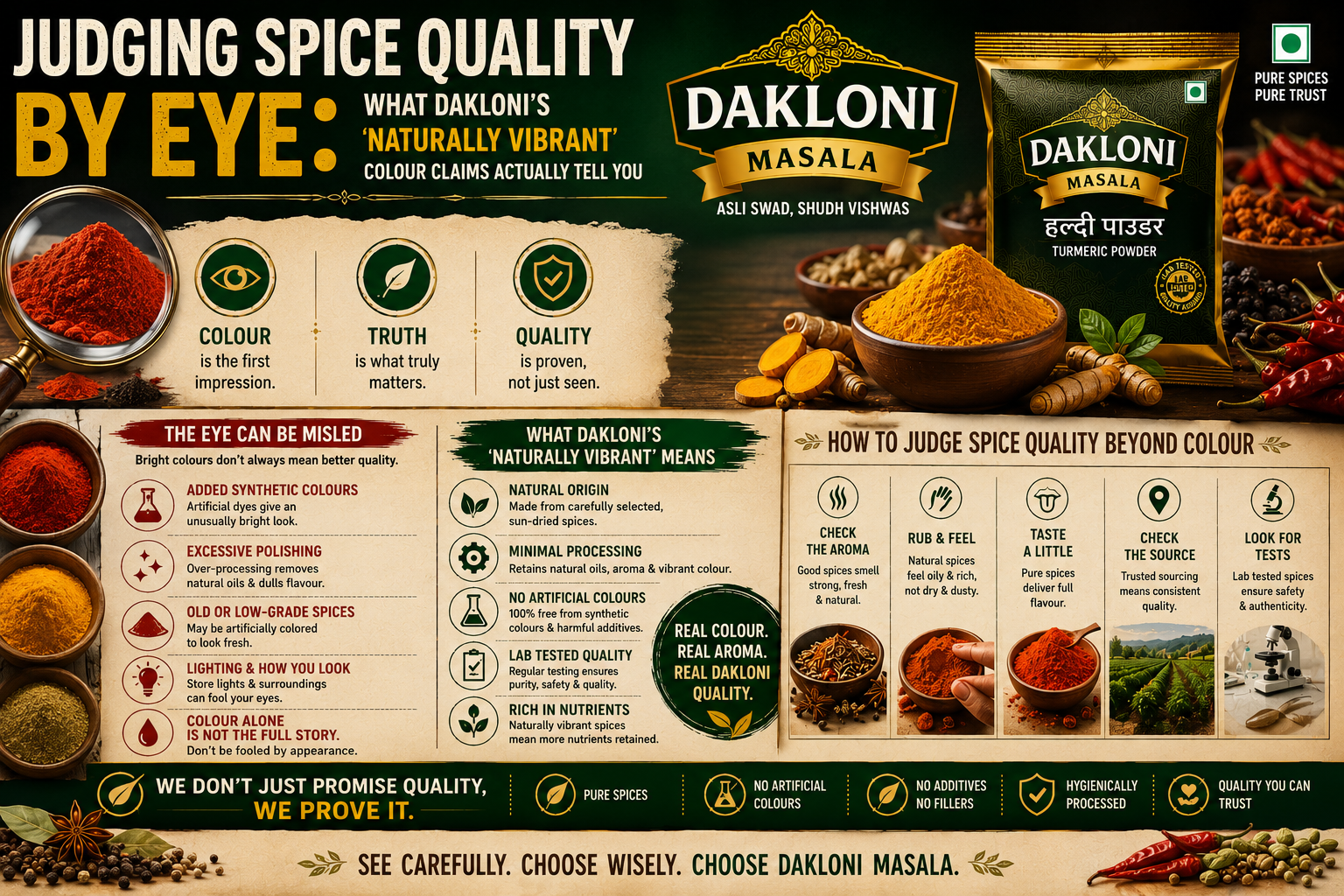
BHUBANESWAR — “Naturally Vibrant. Unmistakably Authentic.” is one of the recurring lines in Dakloni Masala’s marketing, paired with imagery of deep golden turmeric and rich red chilli powder mounded in bowls. Colour is one of the few quality cues a shopper can judge before opening a packet, and the Odisha-based brand, operated by Green Chocy Private Limited, leans on it heavily — but colour is also one of the easiest attributes to manipulate artificially, which is precisely why food regulators pay close attention to it.
Dakloni’s packaging carries a “No Added Colouring” badge across its Haldi and Red Chilli lines, a direct claim that the vivid colour in its products comes from the spice itself rather than an added dye. The company has not published lab verification of this claim, but the claim itself is specific enough to be checkable in principle, unlike vaguer language such as “authentic” or “premium.”
Why Colour Varies Naturally, Even Without Additives
Spice scientists note that natural colour intensity in turmeric and chilli varies significantly based on factors like the variety grown, soil and growing conditions, harvest timing, and drying method — meaning two genuinely additive-free batches of turmeric can still differ in shade from one harvest to the next. This makes colour an imperfect, though still useful, proxy for quality: a consistently vivid product across every batch could reflect careful sourcing, or it could reflect standardization through blending different harvests, or, in adulterated products elsewhere in the market, through added colourants.
Because Dakloni has not disclosed its sourcing regions or batch-blending practices, it is not possible to say from public information which of these explanations accounts for the consistency of colour shown in its marketing photography, which the company itself notes elsewhere is used “for illustrative purposes only” in some campaign creatives.
A Claim Worth More Than It Usually Gets Credit For
Compared with softer marketing language like “pure” or “traditional,” a specific “No Added Colouring” claim is a more meaningful commitment, since it addresses a documented adulteration risk in the wider Indian spice market rather than a vague quality assertion. Consumers who want assurance beyond the claim itself would need to look for independent lab testing, which Dakloni has not published for this report.
Frequently Asked Questions
Does natural spice colour vary between batches even without additives?
Yes — spice scientists note that colour intensity in turmeric and chilli varies naturally with growing conditions, variety and harvest, so colour alone is an imperfect quality indicator.
Has Dakloni Masala’s ‘No Added Colouring’ claim been independently verified?
No published third-party lab results were found for this report; the claim is self-reported by the company.
Visit- dakloni.in
Visit- dakloni.com
Facebook- Dakloni Masala
Instagram- @daklonimasala

BHUBANESWAR — Concerns about adulteration in India’s packaged-spice market are not new. Food-safety regulators and researchers have documented cases over the years involving artificial colouring agents used to brighten chilli and turmeric powders beyond their natural hue, as well as fillers such as starch, brick powder or other bulking agents used to stretch ground spices — problems that have periodically drawn regulatory scrutiny and consumer concern across the industry, particularly for loose or unbranded spices sold without traceable packaging.
Dakloni Masala, the Odisha-based brand operated by Green Chocy Private Limited, addresses this concern indirectly through its packaging language: “No Added Colouring,” “No Additives,” and “100% Natural” badges appear across its Haldi, Red Chilli and Dhaniya boxes. These claims speak directly to the categories of adulteration that have drawn regulatory attention in the wider industry, even though the company has not published third-party lab results confirming the absence of specific adulterants in its own products.
Branded Versus Loose Spices
Food-safety researchers generally note that adulteration risk is higher in loose, unbranded spice markets than in packaged, FSSAI-registered products, since branded manufacturers have both a regulatory obligation and a reputational incentive to avoid the kind of adulteration that draws enforcement action. That baseline gives packaged brands like Dakloni a structural advantage in consumer trust over loose-market alternatives, independent of any brand-specific purity claim.
That said, FSSAI registration alone — which Dakloni holds under license number 12026999000110 — is a baseline compliance credential rather than proof of routine, product-specific purity testing, a distinction covered in earlier reporting on the company’s regulatory standing.
What Verification Would Look Like
For a consumer wanting stronger assurance than packaging language alone, food-policy specialists point to specific, named third-party lab certifications or published test results as the more concrete form of verification, rather than general “pure” or “natural” claims. Dakloni has not published such results for its Haldi, Red Chilli or Dhaniya lines in the materials reviewed for this report, meaning its adulteration-related claims, like much of its broader marketing, rest on the company’s own representation.
Frequently Asked Questions
Has Dakloni Masala’s turmeric or chilli powder been independently tested for adulterants?
No published third-party lab results were found for this report; the company’s “No Added Colouring” and “100% Natural” claims are self-reported.
Is packaged, branded spice generally safer from adulteration than loose spice in India?
Food-safety researchers generally consider branded, FSSAI-registered packaged spices to carry lower adulteration risk than unbranded loose spice, though this is a general industry pattern rather than a specific claim verified for Dakloni.


Dr. Yash Ramu’s Fight for the Bigg Boss Dream

From Messy Word Templates to One-Click PDFs: Inside Biodata99.com’s Free Marriage Biodata Maker

Why More Indian Job Seekers Are Turning to Personalized English Coaching to Crack Interviews

Redfox Overseas: Customize Your Own Energy Drink and Stand Out in the Market

Zamzam Company CEO Chhote Bhai-Bade Bhai gave a grand welcome to Indian writer Devhari Sirvi in Dubai

Shikha Sharma: The Fashion Journalist, Blogger, and Plus-Size Model Taking the Industry by Storm
-
 Brandpost2 years ago
Redfox Overseas: Customize Your Own Energy Drink and Stand Out in the Market
-
 Brandpost2 years ago
Zamzam Company CEO Chhote Bhai-Bade Bhai gave a grand welcome to Indian writer Devhari Sirvi in Dubai
-
 Fashion2 years ago
Shikha Sharma: The Fashion Journalist, Blogger, and Plus-Size Model Taking the Industry by Storm
-
Entertainment1 year ago
Lucky Roxx’s “Yadav Ki Pukar” Goes Viral! Youth Celebrate Unity & Power
-

 Entertainment9 years ago
Meet Superman’s grandfather in new trailer for Krypton
-
Entertainment9 years ago
New Season 8 Walking Dead trailer flashes forward in time
-

 Brandpost2 years ago
From Local Hero to National Icon: Satyam Yadav’s Journey with TwentyOne
-
Uncategorized2 years ago
Hello world!